Monday, January 31, 2011

Translating the US State Dept.'s position on the Egyptian Uprising

See this quite penetrating 'translation' of the US State Department's position on the ongoing Egyptian uprising.


The political equations in the Middle East are changing. Power vs. powerlessness, dignity vs. humiliation, sovereignty vs. occupation are the logics that primarily define the politics of the masses against their dictatorial status-quo regimes and foreign encroachments. This is the appropriate analytical lens to understand the politics in most parts of of the Middle East and not 'sectarian-feuds' so much.


Above: Anti-government protesters carry posters in English reading “USA, why you support dictator”, center, referring to Egyptian President Hosni Mubarak and in Arabic reading “Down Omar Suleiman, Israel’s man”, referring to the recently-named Egyptian Vice-President, with links to CIA, left, at the demonstration in Tahrir square in downtown Cairo, Egypt, Sunday, Jan. 30, 2011. – AP Photo

Monday, January 17, 2011

Incompetence or Conspiracy in Iraq?

In deliberating on the outcomes of Washington's misadventures in Iraq and Afghanistan, a strategy of analysis that many Washington pundits use is to prefer 'incompetence' over 'conspiracy' ("They really wanted to spread democracy, but they messed up!"). But below I quote an interview clip of Dick Cheney from 1994 which shows that the Neocons clearly knew what would happen in Iraq. And, not just that, I believe they knew the fault lines (polarized and exacerbated by Saddam's neo-tribal and sectarian policies) and pro-actively exploited them to create instability in the country to justify their prolonged presence (A close scrutiny of Paul Bremer's policies immediately after the occupation and of the presence of John Negroponte and Blackwater would provide ample illuminations. Washington did at first flirt with the idea of installing the puppet Ahmed Chalabi, while utilizing the ongoing instability as the pretext for its longer stay, but the plan failed due to Iraq's Ayatollah Ali Sistani's timely intervention calling for open elections in 2005.)


A longer stay in Iraq not only had financial incentives for the military-industrial complex, but also was crucial for Washington's long-term hegemonic ambitions for the region. (It is for similar reasons that Washington wants to maintain its presence in the so-called "Af-Pak" region. Having Obama in the White House hasn't 'changed' anything.)

But perhaps it was Israel that hoped to benefit the most from the instability in Iraq. Since at least 1967, Israel has followed the policy of carrot-and-stick, co-opting the cooperative Arab regimes (like Anwar Sadat's Egypt with the Camp David Accord in 1978 which was facilitated by Washington's aid in billions of dollars), and dividing and destabilizing the non-cooperative states. As a strategic policy for its immediate neighbors, Israel has persistently sought to see them politically and economically weak and preoccupied within themselves. That was one of the reasons why Israel indiscriminately bombarded the basic infrastructure and economically viable facilities in Beirut (and the rest of the country) in the Summer 2006. (The other reason was to turn the Lebanese factions against the resistance movement.) It was also Israel that in its air strike on June 7, 1981 destroyed an Iraqi nuclear plant near Baghdad and then tried to justify that as an act of "self-defense".

The first benefit that Israel hoped to see with the American invasion was an even weaker and fragmented Iraq (which would also destabilize Turkey, Iran, KSA, Syria, Lebanon). The second was a continued presence of American forces in the region. The third was the convergence of Israeli and Neocons' interest in targeting Iran, as they surely hoped that the road to Tehran went through Baghdad.

However, their plans did not always bear the fruits they desired.

Friday, January 14, 2011

Pakistan's current political situation

Tariq Ali shares some neat bits in his latest piece published by the London Review of Books (Vol. 33, No. 2., Jan 20, 2011). Below I quote the excerpt that I thought was the most insightful. In the piece, he focuses on the politics of why the military has not taken over yet. But if the question is asked this way, "how come Zardari is still in power?", it would also point to Washington's active support (financial, diplomatic, etc.). Some credit also goes to Zardari's political maneuverings and his successes (so far) in soliciting support from the power-holders in the 'marginalized provinces'. Apparently, PML-N, the largest opposition party in the country with a strong hold in Punjab, also finds no other option but to support the status quo at the moment (for one, the military establishment has made it very clear on a number of occasions that it would not let PML-N's chief Nawaz Sharif come to power. A disappointed Sharif seemed to have pleaded with Washington, but, apparently, it was of no use.). For a background on the military-civilian relations, see also here and here.

Excerpt:

"Even before this killing [of Salman Taseer], Pakistan had been on the verge of yet another military takeover. It would make things so much easier if only they could give it another name: military democracy perhaps? General Kayani, whose term as chief of staff was extended last year with strong Pentagon approval, is said to be receiving petitions every day asking him to intervene and ‘save the country’. The petitioners are obviously aware that removing Zardari and replacing him with a nominee of the Sharif brothers’ Muslim League, the PPP’s long-term rivals, is unlikely to improve matters. Petitioning, combined with a complete breakdown of law and order in one or several spheres (suicide terrorism in Peshawar, violent ethnic clashes in Karachi, state violence in Quetta and now Taseer’s assassination), is usually followed by the news that a reluctant general has no longer been able to resist ‘popular’ pressure and with the reluctant agreement of the US Embassy a uniformed president has taken power. We’ve been here before, on four separate occasions. The military has never succeeded in taking the country forward. All that happens is that, instead of politicians, the officers take the cut. The government obviously thinks the threat is serious: some of Zardari’s cronies now speak openly at dinner parties of ‘evidence’ that proves military involvement in his wife Benazir Bhutto’s assassination. If the evidence exists, let’s have a look. Another straw in the wind: the political parties close to the ISI, Pakistan’s main intelligence agency, have withdrawn from the central government, accusing it of callousness and financial malfeasance. True, but hardly novel.

Another necessary prerequisite for a coup is popular disgust with a corrupt, inept and failing civilian government. This has now reached fever pitch. As well as the natural catastrophes that have afflicted the country there are local wars, disappearances, torture, crime, huge price rises in essential goods, unemployment, a breakdown of basic services – all the major cities go without electricity for hours at a stretch and oil lamps are much in demand in smaller towns, which are often without gas and electricity for up to 12 hours. Thanks to the loan conditions recently imposed by the IMF – part of a gear change in the ‘war on terror’ – there have been riots against the rise in fuel prices in several cities. Add to this Zardari’s uncontrollable greed and the irrepressible desire of his minions to mimic their master. Pakistan today is a kleptocracy. There is much talk in Islamabad of the despised prime minister’s neglected wife going on a shopping spree in London last month and finding solace in diamonds, picking up, on her way back home, a VAT rebate in the region of £100,000.

Can it get worse? Yes. And on every front. Take the Af-Pak war. Few now would dispute that its escalation has further destabilised Pakistan, increasing the flow of recruits to suicide bomber command. The CIA’s New Year message to Pakistan consisted of three drone attacks in North Waziristan, killing 19 people. There were 116 drone strikes in 2010, double the number ordered in the first year of the Obama presidency. Serious Pakistani newspapers, Dawn and the News, claim that 98 per cent of those killed in the strikes over the last five years – the number of deaths is estimated to be between two and three thousand – were civilians, a percentage endorsed by David Kilcullen, a former senior adviser to General Petraeus. The Brookings Institution gives a grim ratio of one militant killed for every ten civilians. The drones are operated by the CIA, which isn’t subject to military rules of engagement, with the result that drones are often used for revenge attacks, notably after the sensational Khost bombing of a CIA post in December 2009.

What stops the military from taking power immediately is that it would then be responsible for stopping the drone attacks and containing the insurgency that has resulted from the extension of the war into Pakistan. This is simply beyond it, which is why the generals would rather just blame the civilian government for everything. But if the situation worsens and growing public anger and economic desperation lead to wider street protests and an urban insurgency the military will be forced to intervene. It will also be forced to act if the Obama administration does as it threatens and sends troops across the Pakistan border on protect-and-destroy missions. Were this to happen a military takeover of the country might be the only way for the army to counter dissent within its ranks by redirecting the flow of black money and bribes (currently a monopoly of politicians) into military coffers. Pakistani officers who complain to Western intelligence operatives and journalists that a new violation of sovereignty might split the army do so largely as a way to exert pressure. There has been no serious breach in the military high command since the dismal failure of the 1951 Rawalpindi Conspiracy, the first and last radical nationalist attempt (backed by Communist intellectuals) to seize power within the army and take the country in an anti-imperialist direction. Since then, malcontents in the armed forces have always been rapidly identified and removed. Military perks and privileges – bonuses, land allocations, a presence in finance and industry – play an increasingly important part in keeping the army under control."

Tuesday, January 4, 2011

Israeli Humor on Israeli PR Tactics

See this clip humoring Israeli diplomatic and media propaganda.


The sad part is that this kind of propaganda is actually being taught in Israeli schools, media, and other public institutions. For the world outside of Israel they have the Hasbara Project.

Thursday, December 23, 2010

Brzezinski on Wikileaks

Zbigniew Brzezinski, who served as the National Security Advisor to President Jimmy Carter and is now a counselor at CSIS, commented on WikiLeaks in an interview on PBS Newshour (Nov 29, 2010).

"It's, rather, a question of whether WikiLeaks are being manipulated by interested parties that want to either complicate our relationship with other governments or want to undermine some governments, because some of these items that are being emphasized and have surfaced are very pointed.

And I wonder whether, in fact, there aren't some operations internationally, intelligence services, that are feeding stuff to WikiLeaks, because it is a unique opportunity to embarrass us, to embarrass our position, but also to undermine our relations with particular governments.

For example, leaving aside the personal gossip about Sarkozy or Berlusconi or Putin, the business about the Turks is clearly calculated in terms of its potential impact on disrupting the American-Turkish relationship."

"Seeding -- seeding it is very easy.

I have no doubt that WikiLeaks is getting a lot of the stuff from sort of relatively unimportant sources, like the one that perhaps is identified on the air. But it may be getting stuff at the same time from interested intelligence parties who want to manipulate the process and achieve certain very specific objectives."

--
Commenting on the implication of feeding, I noted earlier:

"One should not discount the possibility of a good number of forged and fragmented documents intentionally released to Wikileaks by government apparatuses. That reason alone is enough to suggest that Wikileaks cannot be a measure of truth per se, but it is the perspective with which one judges its content, and since there can be multiple perspectives, the truth of these leaks will remain contested. Further, the accuracy of some documents in the leaks should not be taken as a verification of the rest of the documents. On the question of verification, Wikileaks website itself suggests that the "simplest and most effective countermeasure is a worldwide community of informed users and editors who can scrutinize and discuss leaked documents.”

Lastly, in any review of these leaks, one should also interrogate the sources used and the background and politics of the people working for Wikileaks. Because these considerations have a huge impact on what Wikileaks editors choose to release (and what they do not), their timing, and their targets. Perhaps, their politics and agenda will become clearer with the release of more leaked documents."

Taking Wikileaks for fact is problematic

Consider the headline of the below quoted Guardian story: "WikiLeaks cables: Lamb sales behind New Zealand's 'flap' with Israel".

What was an opinion of the US officials has been turned into a FACT in this story.

The contention is not this particular case (what was suggested in the story could be true), but of how the media is treating these leaks.

Not many news sources have cared to consider how diplomatic cables are written or look into the questions of "source, intent, editorial choices, fragmented form of cables, politics of the editors in what they release and what they do not, their timing, targets, then media spins and selective appropriation by politicians..." Without these critical considerations, the leaks can be very misleading.

Below, the Guardian story presents the understanding of US diplomats as a 'counter-fact' to the earlier established explanation of why New Zealand's relations with Israel soured. To further support its argument, the story cites another US embassy cable from the previous year. This is not cross-examination or triangulation; this is just circular reasoning in which the value of one cable is corroborated by another cable, both coming from the same source. The story is not a good example of investigative journalism from the Guardian.

WikiLeaks cables: Lamb sales behind New Zealand's 'flap' with Israel
Country's condemnation of Israeli intelligence agents in 2004 seen as attempt to increase exports to Arab states
Richard Adams, The Guardian, Dec 21, 2010
Source

US diplomats disparaged New Zealand's reaction to a suspected Israeli spy ring as a "flap" and accused New Zealand's government of grandstanding in order to sell more lamb to Arab countries, according to leaked cables.

The arrest and conviction in 2004 of two Israeli citizens, who were caught using the identity of a cerebral palsy sufferer to apply for a New Zealand passport, caused a serious rift between New Zealand and Israel, with allegations that the two men and others involved were Mossad agents.

"The New Zealand government views the act carried out by the Israeli intelligence agents as not only utterly unacceptable but also a breach of New Zealand sovereignty and international law," New Zealand's then-prime minister, Helen Clark, said after the arrests.

But US officials in Wellington told their colleagues in Washington that New Zealand had "little to lose" from the breakdown in diplomatic relations with Israel and was instead merely trying to bolster its exports to Arab states.

A confidential cable written in July 2004, after New Zealand imposed high-level diplomatic sanctions against Israel, comments: "The GoNZ [government of New Zealand] has little to lose by such stringent action, with limited contact and trade with Israel, and possibly something to gain in the Arab world, as the GoNZ is establishing an embassy in Egypt and actively pursuing trade with Arab states."

A cable two days later was even more pointed, saying: "Its overly strong reaction to Israel over this issue suggests the GNZ sees this flap as an opportunity to bolster its credibility with the Arab community, and by doing so, perhaps, help NZ lamb and other products gain greater access to a larger and more lucrative market."

The two Israelis were sentenced to six months in prison and ordered to pay a fine of $NZ50,000 (£24,000) to the Cerebral Palsy Society of New Zealand because the victim of the attempted identity theft was a tetraplegic, wheelchair-bound cerebral palsy sufferer in residential care.

Both men pleaded guilty but denied working for Mossad. The pair were released after serving just two months behind bars and deported in October 2004. Israel made a formal apology for what an Israeli government statement refered to as "the incident with the Mossad," and normal diplomatic relations were restored by late 2005.

To US diplomats, though, "New Zealand's public reaction is its strongest diplomatic retaliation in 20 years – since French spies bombed the Rainbow Warrior in Auckland harbor in 1985. Clark's limitations on diplomatic contact go further than the GoNZ reaction in 1985, however, and it was reported that she toughened the language of her response from that put forward by MFAT [New Zealand's ministry of foreign affairs and trade]."

Ironically, a 2003 US embassy cable from Wellington alleged that New Zealand agreed to deploy troops to Iraq in order to safeguard lucrative contracts for New Zealand diary exporters, a claim described by Clark – currently the head of the UN Development Programme – as "rubbish".

Saturday, December 18, 2010

'Erdogan says we still feel the pain of Karbala'

For the first time in Turkey's contemporary history, a state leader attended and delivered a speech to an Ashura gathering. In his speech on December 16, the day of Ashura commemoration this year, Turkish PM Rajep Tayyip Erdogan stressed Islamic Unity and said that Imam Hussain was for all the Muslims.


The attendance no doubt was a powerful political gesture and is indicative of the current 'anti-Israel, pro-Iran' stance of not only the PM but also tens of thousands of common people in Turkey, and beyond. In the latest poll carried out by Zogby International and the University of Maryland in the summer of 2010, the people in Saudi Arabia, Egypt, Jordan, Lebanon, Morocco, and the United Arab Emirates were asked to name the world leader they admired the most. Erdogan was among the most popular ones this year, whereas just a couple of years ago he had close to nil votes. The diplomatic ties between Turkey and Israel soured in the last two years, especially after the Israeli onslaught on Gaza in Dec 2008-Jan 2009 and the May 2010 attack on Gaza aid flotilla that killed nine Turkish citizens.

Former Iranian foreign minister Ali Akbar Velayati was also present on the occasion and spoke to the crowd.

Erdogan says we still feel the pain of Karbala
Tehran Times, Dec 18, 2010
Source

ISTANBUL - Turkish Prime Minister Recep Tayyip Erdogan and former Iranian foreign minister Ali Akbar Velayati attended an Ashura ceremony in Turkey on Thursday.

Velayati, who is currently a senior advisor of Iran’s Supreme Leader, attended the ceremony in Istanbul on the invitation of the leader of Turkey’s Shia Muslims, Salah al-Din Ozgunduz.

Thousands of Turkish Shia braved freezing temperatures to commemorate the day of Ashura, which is the anniversary of the martyrdom of Imam Hussein (AS) and his 72 companions, with a procession through the streets of Istanbul.

Erdogan attended the ceremony this year for the first time since his AK party came to power in 2002.

Erdogan, who is a follower of the Hanafi school of the Sunni branch of Islam, delivered a speech at the ceremony, in which he discussed the importance of unity between Shia and Sunni Muslims.

“We have been feeling the pain of Karbala for 1,370 years. We have to feel that pain in our hearts. We remember (Imam) Hussein (AS) whenever an innocent person is killed,” the Turkish prime minister said as he began his speech.

“This country is ours, these lands are all ours, this history, this civilization is ours. Nobody can claim superiority to any other. We are equal to each other and we are all brothers in these lands. We are all first-class citizens of this country. The problems of all religious groups in my country are mine. That's why we are struggling to address century-old problems through consensus. Aren’t there those who oppose us? Of course, there are. But we will overcome this with patience,” Erdogan added.

Erdogan’s participation in Ashura ceremony is a sign of Islamic unity

Addressing the Ashura mourners in Istanbul, Velayati described Erdogan’s participation in the ceremony as an extremely significant symbol of Islamic unity.

He also pointed to Turkey’s role in defending Islamic values and foiling plots against Muslim countries.

Ashura symbolizes unity among Muslims, justice, devotion, and the struggle against oppression, Velayati added.

He stated that all Muslims shoulder the responsibility of defending the principles of Islam and fighting against the enemies.

Elsewhere in his remarks, Velayati commented on the Palestine issue and called on all Muslims to stand with the Palestinians.

On Thursday, Velayati held a meeting with Erdogan in which they discussed the latest regional and international developments as well as issues of mutual interest.

Tuesday, December 7, 2010

Reading the colonial diaries: The extent of American influence on Pakistan

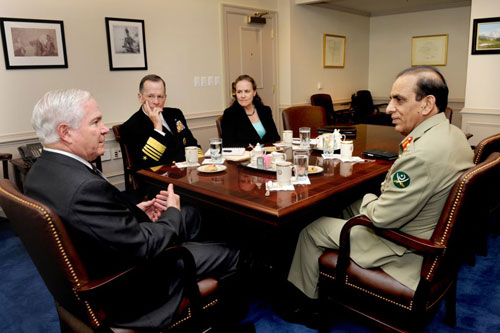
[Photo: Pakistani Chief of the Army Staff Gen. Ashfaq Parvez Kayani meets with US Secretary of Defense Robert M. Gates (left), US Chairman of the Joint Chiefs of Staff Adm. Mike Mullen and US Under Secretary of Defense for Policy Michele Flournoy on March 22.]

Here is some food for thought for those still doubting the extent of American influence in Pakistan. In previous posts, I cautioned against taking the fragmented leaks (and media reports/spins) at face value. But for the below story, I don't think we need to read against the grain too much to understand the nature of American hold in Pakistan (and the moral bankruptcy of our leaders). The American influence is quite evident from the perceptions and interactions of Pakistan's political and military leaders mentioned in the story, who all have plenty of experience of being in the upper echelon of power to know where the levers actually lie. In the final analysis, Washington and Pakistani military establishment remain the two most powerful forces shaping the future of Pakistani politics. (On the nature of Pak-US relations and Zardari's role in it, see previous posts here, here, and here).

[Edit October 8, 2011: A latest Dawn.com report reads, 'Musharraf hires US lobbyist for $25,000 a month'. The report quotes from the contract signed between Musharraf's representative and the lobbying firm. The firm is supposed to "develop a strategy to represent the interest of Gen (retd) Pervez Musharraf in the US." See the full report here]

Pakistan's president Asif Ali Zardari 'prepared for assassination'
Declan Walsh, The Guardian, November 30, 2010
Source

Excerpt:

[Zardari] fears a fresh army coup. Zardari said he was concerned that Kayani might "take me out", Biden reported to Gordon Brown during a meeting in Chile in 2009. Brown said he thought it unlikely.

The observations on Pakistan's often beleaguered president are part of several portraits about prominent Pakistani politicians that are dotted with insight, colour and some surprises.

In November 2007 Maulana Fazlur Rehman, leader of the country's most fiercely pro-Taliban religious party, hosted a jovial dinner for Patterson at which he sought her backing to become prime minister and expressed a desire to visit America.

"All important parties in Pakistan had to get the approval" of the US, said his aide Abdul Ghafoor Haideri. After the meeting Patterson commented on the mullah's famously wily political skills. "He has made it clear that … his still significant number of votes are up for sale."

The cables also highlight the contradictions of other prominent Pakistanis. Officials noted that Amin Fahim, a Bhutto supporter hoping to become prime minister, led a religious Islamic group "while enjoying an occasional bloody mary".

The opposition leader, Nawaz Sharif had a "notoriously difficult personality" while his family is noted to have "relied primarily on the army and intelligence agencies for political elevation".

America's perceived influence on Pakistani power politics is a frequent theme. In a May 2008 meeting with a visiting American congressional delegation, Zardari said: "We won't act without consulting with you."

Sharif repeatedly told the US ambassador he was "pro-American", despite his often critical public stance. He thanked the US for "arranging" to have Kayani appointed as army chief. "The best thing America has done recently," he said.

"The fact that a former prime minister believes the US could control the appointment of Pakistan's chief of army staff speaks volumes about the myth of American influence here," the ambassador noted tartly afterwards.But some dispatches make it clear that the Americans do wield great clout. After General Pervez Musharraf resigned as president in 2008, ambassador Patterson pressed Zardari to grant him immunity from prosecution. "We believed, as we had often said, that Musharraf should have a dignified retirement and not be hounded out of the country," she said.

The US – and Kayani – worried that Zardari would renege on his word. "Zardari is walking tall these days, hopefully not too tall to forget his promise to Kayani and to us on an immunity deal," wrote Patterson.

If Zardari didn't protect Musharraf then it would make him look bad. "I have to bring the army along with me," he said, also noting that the delay "does nothing for Zardari's reputation for trustworthiness".

The notable exception to that US influence, however, is the former cricketer Imran Khan, who delivered a long lecture to visiting US politicians about the iniquities of US policy.

Welcoming the group at his grand home outside Islamabad, Khan hosted an "hour-long, largely one-sided, and somewhat uncomfortable conversation".

To defeat the Taliban the US had to understand the "tribal character" of the militants, he said, and described the Pakistani drive against the Taliban in 2009 as "stage-managed" for US consumption.

There are apercus in the cables into the often inscrutable military leaders. Kayani is "direct, frank, and thoughtful" and has "fond memories" of time spent on a military training course in the US. It is also noted that "he smokes heavily and can be difficult to understand as he tends to mumble." The Inter-Services Intelligence chief, Lieutenant General Ahmad Shuja Pasha, was "usually more emotional" than Kayani.

US diplomats also have a ringside seat to civilian wrangles. In February 2009 Zardari aide Farahnaz Ispahani said the president was "very unhappy" with the way the prime minister, Yousaf Raza Gilani, had "gone off the reservation". In 2008 Zardari said Fahim "had spent most of the [election] campaign in Dubai (with his latest 22 year-old wife) and was simply too lazy to be prime minister".

The cables also record embarrassing mistakes in the embassy's efforts to manage its relationships with Pakistan's power elite. Six months after his dinner with the ambassador, Rehman was less enamoured of US policy when the FBI issued a notice suggesting he had orchestrated a suicide bombing in Islamabad.

The embassy asked the FBI to urgently recall the notice – he had been confused with another man with a similar name. Rehman was a "frequent and co-operative interlocutor with post and professes his support for co-operation with the United States", the request said.

Thursday, December 2, 2010

The leaked fragments can also be misleading

The leaked cables can be insightful not for what they tell us at face value but what we can extract from them after a careful scrutiny. Otherwise, these fragments of documents, even in instances where they are authentic, can be very misleading. Jeremy Scahill engages in such a critical exercise in a recent piece published in The Nation (December 1, 2010). I quote two passages:

"A special operations veteran and a former CIA operative with direct experience in Pakistan have told The Nation that JSOC has long engaged in combat in Pakistan—which raises a question: How in-the-loop is the US embassy about the activities of JSOC in Pakistan? Just because Ambassador Anne Patterson approves a cable saying that US special ops forces have only done two operations with Pakistani forces and plays this up as a major-league development doesn't make it true. JSOC has conducted operations across the globe without the direct knowledge of the US ambassador. In 2006, the US military and Pakistan struck a deal that authorized JSOC to enter Pakistan to hunt Osama bin Laden and other Al Qaeda leaders with the understanding that Pakistan would deny it had given permission. JSOC has struck multiple times inside Pakistan over the years, regardless of what Ambassador Patterson's cables may say." ...

"Since the Nation story originally ran, Blackwater has continued to work under the Obama administration. In June, the company won a $100 million global contract with the CIA and continues to operate in Afghanistan, where it protects senior US officials and trains Afghan forces. Earlier this year, Blackwater's owner, Erik Prince, put the company up for sale and moved to the Abu Dhabi in the United Arab Emirates. Whether Blackwater or former Blackwater operatives continue to work in Pakistan is not known. What is clear is that there is great reason to believe that the October 2009 cable from Ambassador Anne Patterson describing US special operations forces activities in Pakistan represents only a tiny glimpse into one of the darkest corners of current US policy in Pakistan." (Jeremy Scahill, The Nation, Dec 1, 2010)

See an interview (DemocracyNow!, Dec 2, 2010) with Scahill on the same issue below.


[In a previous post, I comment on the Hersh's New Yorker piece which Scahill mentions in the above clip. There I also link my comments on the nature of Pak-US relationship and the role of the current civilian government in it.]

Moreover,

Not many people will go through all the leaked documents. They will mostly hear what the mainstream media and political groups choose to focus on.

Source, intent, editorial choices, fragmented form of cables, politics of the editors in what they release and what they do not, their timing, targets, then media spins and selective appropriation by politicians... I haven't seen many reports that engage in these critical considerations.

For how media can put a spin on these leaks, see the following story from The Real News (Dec 2, 2010): "New York Times Beats Drums for War".

The Logic of 'Suicide Terrorism'

Below see some neat insights from a bona-fide scholar, Richard Pape (Univ. of Chicago). But keep in mind the distinction between the common people and the power elites in the US. The 'misunderstanding' that is referred to in the article applies mostly to the common people. The power elites, specifically those sitting in the top seats of important institutions (government, defense, media, think tanks, corporations) in Washington and New York, are more than aware of the reality on the ground. The common people are influenced by those misunderstandings whereas the power elites influence those misunderstandings and shape them in the way they want.

In the following, I quote the parts that I found most interesting. Readers interested in this topic may also want to look at the following piece, "Good Muslim, Bad Muslim." On power elites, Thomas Dye's "Who's Running America" is a useful source (hope they get the 'Obama update' out soon). On "anti-Americanism" see a previous post, here.

It's the Occupation, Stupid
Robert Pape, Foreign Policy, October 18, 2010
Source

Extensive research into the causes of suicide terrorism proves Islam isn't to blame -- the root of the problem is foreign military occupations.

“For nearly a decade, Americans have been waging a long war against terrorism without much serious public debate about what is truly motivating terrorists to kill them. In the immediate aftermath of the 9/11 attacks, this was perfectly explicable -- the need to destroy al Qaeda's camps in Afghanistan was too urgent to await sober analyses of root causes.

But, the absence of public debate did not stop the great need to know or, perhaps better to say, to "understand" the events of that terrible day. In the years before 9/11, few Americans gave much thought to what drives terrorism -- a subject long relegated to the fringes of the media, government, and universities. And few were willing to wait for new studies, the collection of facts, and the dispassionate assessment of alternative causes. Terrorism produces fear and anger, and these emotions are not patient.

A simple narrative was readily available, and a powerful conventional wisdom began to exert its grip. Because the 9/11 hijackers were all Muslims, it was easy to presume that Islamic fundamentalism was the central motivating force driving the 19 hijackers to kill themselves in order to kill Americans. Within weeks after the 9/11 attacks, surveys of American attitudes show that this presumption was fast congealing into a hard reality in the public mind. Americans immediately wondered, "Why do they hate us?" and almost as immediately came to the conclusion that it was because of "who we are, not what we do." As President George W. Bush said in his first address to Congress after the 9/11 attacks: "They hate our freedoms: our freedom of religion, our freedom of speech, our freedom to vote and assemble and disagree with each other."

Thus was unleashed the "war on terror."

The narrative of Islamic fundamentalism did more than explain why America was attacked and encourage war against Iraq. It also pointed toward a simple, grand solution. If Islamic fundamentalism was driving the threat and if its roots grew from the culture of the Arab world, then America had a clear mission: To transform Arab societies -- with Western political institutions and social norms as the ultimate antidote to the virus of Islamic extremism.

This narrative had a powerful effect on support for the invasion of Iraq. Opinion polls show that for years before the invasion, more than 90 percent of the U.S. public believed that Saddam Hussein was harboring weapons of mass destruction (WMD). But this belief alone was not enough to push significant numbers to support war.

What really changed after 9/11 was the fear that anti-American Muslims desperately wanted to kill Americans and so any risk that such extremists would get weapons of mass destruction suddenly seemed too great. Although few Americans feared Islam before 9/11, by the spring of 2003, a near majority -- 49 percent -- strongly perceived that half or more of the world's 1.4 billion Muslims were deeply anti-American, and a similar fraction also believed that Islam itself promoted violence. No wonder there was little demand by congressional committees or the public at large for a detailed review of intelligence on Iraq's WMD prior to the invasion.

The goal of transforming Arab societies into true Western democracies had powerful effects on U.S. commitments to Afghanistan and Iraq. Constitutions had to be written; elections held; national armies built; entire economies restructured. Traditional barriers against women had to be torn down. Most important, all these changes also required domestic security, which meant maintaining approximately 150,000 U.S. and coalition ground troops in Iraq for many years and increasing the number of U.S. and Western troops in Afghanistan each year from 2003 on.”

Put differently, adopting the goal of transforming Muslim countries is what created the long-term military occupation of Iraq and Afghanistan. Yes, the United States would almost surely have sought to create a stable order after toppling the regimes in these countries in any case. However, in both, America's plans quickly went far beyond merely changing leaders or ruling parties; only by creating Western-style democracies in the Muslim world could Americans defeat terrorism once and for all.

There's just one problem: We now know that this narrative is not true.

New research provides strong evidence that … [m]ore than 95 percent of all suicide attacks are in response to foreign occupation, according to extensive research that we conducted at the University of Chicago's Project on Security and Terrorism, where we examined every one of the over 2,200 suicide attacks across the world from 1980 to the present day. As the United States has occupied Afghanistan and Iraq, which have a combined population of about 60 million, total suicide attacks worldwide have risen dramatically -- from about 300 from 1980 to 2003, to 1,800 from 2004 to 2009. Further, over 90 percent of suicide attacks worldwide are now anti-American. The vast majority of suicide terrorists hail from the local region threatened by foreign troops, which is why 90 percent of suicide attackers in Afghanistan are Afghans.

Israelis have their own narrative about terrorism, which holds that Arab fanatics seek to destroy the Jewish state because of what it is, not what it does. But since Israel withdrew its army from Lebanon in May 2000, there has not been a single Lebanese suicide attack. Similarly, since Israel withdrew from Gaza and large parts of the West Bank, Palestinian suicide attacks are down over 90 percent.

Some have disputed the causal link between foreign occupation and suicide terrorism, pointing out that some occupations by foreign powers have not resulted in suicide bombings -- for example, critics often cite post-World War II Japan and Germany. Our research provides sufficient evidence to address these criticisms by outlining the two factors that determine the likelihood of suicide terrorism being employed against an occupying force.

The first factor is social distance between the occupier and occupied. The wider the social distance, the more the occupied community may fear losing its way of life. Although other differences may matter, research shows that resistance to occupations is especially likely to escalate to suicide terrorism when there is a difference between the predominant religion of the occupier and the predominant religion of the occupied.

Religious difference matters not because some religions are predisposed to suicide attacks. Indeed, there are religious differences even in purely secular suicide attack campaigns, such as the LTTE (Hindu) against the Sinhalese (Buddhists).

Rather, religious difference matters because it enables terrorist leaders to claim that the occupier is motivated by a religious agenda that can scare both secular and religious members of a local community -- this is why Osama bin Laden never misses an opportunity to describe U.S. occupiers as "crusaders" motivated by a Christian agenda to convert Muslims, steal their resources, and change the local population's way of life.

The second factor is prior rebellion. Suicide terrorism is typically a strategy of last resort, often used by weak actors when other, non-suicidal methods of resistance to occupation fail. This is why we see suicide attack campaigns so often evolve from ordinary terrorist or guerrilla campaigns, as in the cases of Israel and Palestine, the Kurdish rebellion in Turkey, or the LTTE in Sri Lanka.”

…

“The first step is recognizing that occupations in the Muslim world don't make Americans any safer -- in fact, they are at the heart of the problem.”