Has IAEA found new evidence or discovered undisclosed sites in Iran recently that's fueling its growing concern over Iran's nuclear program, or is it the change in IAEA's leadership that explains the different attitude? The renowned journalist Seymour Hersh writes in the New Yorker on Nov 18, 2011:
"The shift in tone at the I.A.E.A. seems linked to a change at the top. The I.A.E.A.’s report had extra weight because the Agency has had a reputation for years as a reliable arbiter on Iran. Mohammed ElBaradei, who retired as the I.A.E.A.’s Director General two years ago, was viewed internationally, although not always in Washington, as an honest broker—a view that lead to the awarding of a Nobel Peace Prize in 2005. ElBaradei’s replacement is Yukiya Amano of Japan. Late last year, a classified U.S. Embassy cable from Vienna, the site of the I.A.E.A. headquarters, described Amano as being “ready for prime time.” According to the cable, which was obtained by WikiLeaks, in a meeting in September, 2009, with Glyn Davies, the American permanent representative to the I.A.E.A., said, “Amano reminded Ambassador on several occasions that he would need to make concessions to the G-77 [the group of developing countries], which correctly required him to be fair-minded and independent, but that he was solidly in the U.S. court on every strategic decision, from high-level personnel appointments to the handling of Iran’s alleged nuclear weapons program.” The cable added that Amano’s “willingness to speak candidly with U.S. interlocutors on his strategy … bodes well for our future relationship.”"
See the full text here
----
Showing posts with label USA. Show all posts
Showing posts with label USA. Show all posts
Saturday, November 26, 2011

Thursday, October 13, 2011
The whoo-scary Iranian terror plot
Watching the US corporate media coverage of this Iranian terror plot is like watching "Wag the Dog" movie again - except that the enemy plot in the movie had less holes and was more convincing than the one in the present episode.
The “very scary” Iranian Terror plot
Glenn Greenwald
http://politics.salon.com/2011/10/12/the_very_scary_iranian_terror_plot/singleton/
The most difficult challenge in writing about the Iranian Terror Plot unveiled yesterday is to take it seriously enough to analyze it. Iranian Muslims in the Quds Force sending marauding bands of Mexican drug cartel assassins onto sacred American soil to commit Terrorism — against Saudi Arabia and possibly Israel — is what Bill Kristol and John Bolton would feverishly dream up while dropping acid and madly cackling at the possibility that they could get someone to believe it. But since the U.S. Government rolled out its Most Serious Officials with Very Serious Faces to make these accusations, many people (therefore) do believe it; after all, U.S. government accusations = Truth. All Serious people know that. And in the ensuing reaction one finds virtually every dynamic typically shaping discussions of Terrorism and U.S. foreign policy.
Iranian Terror Plot: Fake, Fake, Fake
Justin Raimondo
http://original.antiwar.com/justin/2011/10/11/iranian-terror-plot-fake-fake-fake/
News Media Hypes the “Iran Did It” Line, Ignores Holes in the Story
John Glaser
http://www.antiwar.com/blog/2011/10/12/news-media-hypes-the-iran-did-it-line-ignores-holes-in-the-story/
The “very scary” Iranian Terror plot
Glenn Greenwald
http://politics.salon.com/2011/10/12/the_very_scary_iranian_terror_plot/singleton/
The most difficult challenge in writing about the Iranian Terror Plot unveiled yesterday is to take it seriously enough to analyze it. Iranian Muslims in the Quds Force sending marauding bands of Mexican drug cartel assassins onto sacred American soil to commit Terrorism — against Saudi Arabia and possibly Israel — is what Bill Kristol and John Bolton would feverishly dream up while dropping acid and madly cackling at the possibility that they could get someone to believe it. But since the U.S. Government rolled out its Most Serious Officials with Very Serious Faces to make these accusations, many people (therefore) do believe it; after all, U.S. government accusations = Truth. All Serious people know that. And in the ensuing reaction one finds virtually every dynamic typically shaping discussions of Terrorism and U.S. foreign policy.
Iranian Terror Plot: Fake, Fake, Fake
Justin Raimondo
http://original.antiwar.com/justin/2011/10/11/iranian-terror-plot-fake-fake-fake/
News Media Hypes the “Iran Did It” Line, Ignores Holes in the Story
John Glaser
http://www.antiwar.com/blog/2011/10/12/news-media-hypes-the-iran-did-it-line-ignores-holes-in-the-story/
Friday, May 27, 2011
The early beginnings of the Afghan War
Below, see a well-known and important article from The Nation that sets the record straight on how the 'Afghan war' started.
The American provocation may be true, but it is also true that the Soviet invasion of Afghanistan was part of the larger Soviet ambition of reaching the warm waters of the Indian Ocean. The Soviet-US politics should be viewed in the context of ongoing 'Cold War' which began long before the 1979 provocations and invasion.
On a critical note: The article seems to rely on the (false) assumption that 9/11 as well as Al-Qaeda were products (or 'blowback') of the Afghan war. Quite the contrary, the Taliban and Al-Qaeda are separate entities with different geographic origins, leadership, and goals. They may have developed connections, but they (or some of their factions) also have been at odds with each other in Afghanistan and Pakistan.
'Blowback,' the Prequel
Eric Alterman, The Nation, October 25, 2001
Source
The story of what historians call the second cold war often begins with the Soviet invasion of Afghanistan in December 1979, which shocked Americans into their own overreaction in Central America and Africa, as well as into arming the mujahedeen resistance. Today, it is a truth universally acknowledged in the punditocracy that while the United States may have played an indirect role in the creation of the Taliban and perhaps even the bin Laden terrorist network through our support for the radical Islamic guerrillas in Afghanistan, we did so only in response to that act of Soviet aggression. As Tim Russert explained on Meet the Press, "We had little choice." Speaking on CNN, former US Ambassador to Afghanistan Peter Tomsen speaks of our "successful policy with the ordnance we sent to the mujahedeen to defeat the Soviets." Writing on "The 'Blowback' Myth" in The Weekly Standard, one Thomas Henriksen of the Hoover Institution rehearses the Soviet invasion and then notes, "First President Carter, then, more decisively, Ronald Reagan moved to support the Afghan resistance."
The American provocation may be true, but it is also true that the Soviet invasion of Afghanistan was part of the larger Soviet ambition of reaching the warm waters of the Indian Ocean. The Soviet-US politics should be viewed in the context of ongoing 'Cold War' which began long before the 1979 provocations and invasion.
On a critical note: The article seems to rely on the (false) assumption that 9/11 as well as Al-Qaeda were products (or 'blowback') of the Afghan war. Quite the contrary, the Taliban and Al-Qaeda are separate entities with different geographic origins, leadership, and goals. They may have developed connections, but they (or some of their factions) also have been at odds with each other in Afghanistan and Pakistan.
'Blowback,' the Prequel
Eric Alterman, The Nation, October 25, 2001
Source
The story of what historians call the second cold war often begins with the Soviet invasion of Afghanistan in December 1979, which shocked Americans into their own overreaction in Central America and Africa, as well as into arming the mujahedeen resistance. Today, it is a truth universally acknowledged in the punditocracy that while the United States may have played an indirect role in the creation of the Taliban and perhaps even the bin Laden terrorist network through our support for the radical Islamic guerrillas in Afghanistan, we did so only in response to that act of Soviet aggression. As Tim Russert explained on Meet the Press, "We had little choice." Speaking on CNN, former US Ambassador to Afghanistan Peter Tomsen speaks of our "successful policy with the ordnance we sent to the mujahedeen to defeat the Soviets." Writing on "The 'Blowback' Myth" in The Weekly Standard, one Thomas Henriksen of the Hoover Institution rehearses the Soviet invasion and then notes, "First President Carter, then, more decisively, Ronald Reagan moved to support the Afghan resistance."
The truth is that the United States began a program of covert aid to the Afghan guerrillas six months before the Soviets invaded.
First revealed by former Director of Central Intelligence Robert Gates in his 1996 memoir From the Shadows, the $500 million in nonlethal aid was designed to counter the billions the Soviets were pouring into the puppet regime they had installed in Kabul. Some on the American side were willing--perhaps even eager--to lure the Soviets into a Vietnam-like entanglement. Others viewed the program as a way of destabilizing the puppet government and countering the Soviets, whose undeniable aggression in the area was helping to reheat the cold war to a dangerous boil.
According to Gates's recounting, a key meeting took place on March 30, 1979. Under Secretary of Defense Walter Slocumbe wondered aloud whether "there was value in keeping the Afghan insurgency going, 'sucking the Soviets into a Vietnamese quagmire.'" Arnold Horelick, CIA Soviet expert, warned that this was just what we could expect. In a 1998 conversation with Le Nouvel Observateur, former National Security Adviser Zbigniew Brzezinski admitted, "We didn't push the Russians to intervene, but we knowingly increased the probability that they would."
Yet Carter, who signed the finding authorizing the covert program on July 3, 1979, today explains that it was definitely "not my intention" to inspire a Soviet invasion. Cyrus Vance, who was then Secretary of State, is not well enough to be interviewed, but his close aide Marshall Shulman insists that the State Department worked hard to dissuade the Soviets from invading and would never have undertaken a program to encourage it, though he says he was unaware of the covert program at the time. Indeed, Vance hardly seems to be represented at all in Gates's recounting, although Brzezinski doubts that Carter would have approved the aid unless Vance "approved, however unenthusiastically."
No one I interviewed--those who did not mind the idea of a Soviet invasion, and those who sought to avoid it--argues that Carter himself wished to provoke one. Gates, who was then an aide to Brzezinski, says the President did not think "strategically" in that fashion. "He was simply reacting to everything the Soviets were doing in that part of the world and felt it required some kind of response. This was it." Brzezinski, similarly, says he did not sell the plan to Carter on these terms. The President understood, he explained on the phone, that "the Soviets had engineered a Communist coup and they were providing direct assistance in Kabul. We were facing a serious crisis in Iran, and the entire Persian Gulf was at stake. In that context, giving some money to the mujahedeen seemed justified." Why Carter actually approved the aid remains unclear, however. Carter, it should be added, does not seem to remember much about the initial finding. Otherwise, he would not have asked his aide to fax me the pages from his memoir Keeping Faith, which ignores it entirely, and like the rest of the pre-Gates memoirs of the period, professes great shock and horror regarding the onset of the Soviet tanks.
The news of the covert program has provoked considerable confusion among those who seek to blame the United States for the September 11 massacre. Proponents of an overly schematic "blowback" scenario, including at least one vocal supporter of the Soviet "rape" of Afghanistan, have seized Brzezinski's comments to claim that Osama bin Laden is merely one of America's "chickens coming home to roost." This is both simplistic and obscene. Blowback exists in absolutely every aspect of life, because nothing comes without unintended consequences. Does it make sense to blame the destruction of the World Trade Center on a $500 million nonlethal aid program that took place more than twenty years ago? We cannot even know for certain why the Soviets decided on their invasion.
Nor can we ever know for certain whether the US officials wished to inspire one. Memories deceive, records get destroyed and even original documents can be written to be deliberately misleading, as were the period's official memoirs--save, ironically, that of Gates, the former spymaster. The covert action was undoubtedly approved by those involved for a host of reasons, some of which may be contradictory. Helping the Afghans resist Soviet domination was not exactly a controversial policy in 1979, though no one at the time could even dream that it might lead to the evil empire's eventual disintegration.
Brzezinski argues that even given the 20/20 hindsight after September 11, the covert aid remains justified. He shares the common view that America's most significant mistake was to abandon the nation to its unhappy fate following the Soviet withdrawal. Our terrorist problem, he insists, would be much worse with the Soviets still around to support their terrorist minions among the Palestinians, the Syrians, the Libyans, the Iraqis, etc.
Certainly this is much too kind to the Reagan-era military aid to Taliban-like elements. But a more accurate historical record can only lead to more intelligent debate about the future.
Monday, January 31, 2011
Translating the US State Dept.'s position on the Egyptian Uprising
See this quite penetrating 'translation' of the US State Department's position on the ongoing Egyptian uprising.
The political equations in the Middle East are changing. Power vs. powerlessness, dignity vs. humiliation, sovereignty vs. occupation are the logics that primarily define the politics of the masses against their dictatorial status-quo regimes and foreign encroachments. This is the appropriate analytical lens to understand the politics in most parts of of the Middle East and not 'sectarian-feuds' so much.

Above: Anti-government protesters carry posters in English reading “USA, why you support dictator”, center, referring to Egyptian President Hosni Mubarak and in Arabic reading “Down Omar Suleiman, Israel’s man”, referring to the recently-named Egyptian Vice-President, with links to CIA, left, at the demonstration in Tahrir square in downtown Cairo, Egypt, Sunday, Jan. 30, 2011. – AP Photo
The political equations in the Middle East are changing. Power vs. powerlessness, dignity vs. humiliation, sovereignty vs. occupation are the logics that primarily define the politics of the masses against their dictatorial status-quo regimes and foreign encroachments. This is the appropriate analytical lens to understand the politics in most parts of of the Middle East and not 'sectarian-feuds' so much.

Above: Anti-government protesters carry posters in English reading “USA, why you support dictator”, center, referring to Egyptian President Hosni Mubarak and in Arabic reading “Down Omar Suleiman, Israel’s man”, referring to the recently-named Egyptian Vice-President, with links to CIA, left, at the demonstration in Tahrir square in downtown Cairo, Egypt, Sunday, Jan. 30, 2011. – AP Photo
Monday, January 17, 2011
Incompetence or Conspiracy in Iraq?
In deliberating on the outcomes of Washington's misadventures in Iraq and Afghanistan, a strategy of analysis that many Washington pundits use is to prefer 'incompetence' over 'conspiracy' ("They really wanted to spread democracy, but they messed up!"). But below I quote an interview clip of Dick Cheney from 1994 which shows that the Neocons clearly knew what would happen in Iraq. And, not just that, I believe they knew the fault lines (polarized and exacerbated by Saddam's neo-tribal and sectarian policies) and pro-actively exploited them to create instability in the country to justify their prolonged presence (A close scrutiny of Paul Bremer's policies immediately after the occupation and of the presence of John Negroponte and Blackwater would provide ample illuminations. Washington did at first flirt with the idea of installing the puppet Ahmed Chalabi, while utilizing the ongoing instability as the pretext for its longer stay, but the plan failed due to Iraq's Ayatollah Ali Sistani's timely intervention calling for open elections in 2005.)
A longer stay in Iraq not only had financial incentives for the military-industrial complex, but also was crucial for Washington's long-term hegemonic ambitions for the region. (It is for similar reasons that Washington wants to maintain its presence in the so-called "Af-Pak" region. Having Obama in the White House hasn't 'changed' anything.)
But perhaps it was Israel that hoped to benefit the most from the instability in Iraq. Since at least 1967, Israel has followed the policy of carrot-and-stick, co-opting the cooperative Arab regimes (like Anwar Sadat's Egypt with the Camp David Accord in 1978 which was facilitated by Washington's aid in billions of dollars), and dividing and destabilizing the non-cooperative states. As a strategic policy for its immediate neighbors, Israel has persistently sought to see them politically and economically weak and preoccupied within themselves. That was one of the reasons why Israel indiscriminately bombarded the basic infrastructure and economically viable facilities in Beirut (and the rest of the country) in the Summer 2006. (The other reason was to turn the Lebanese factions against the resistance movement.) It was also Israel that in its air strike on June 7, 1981 destroyed an Iraqi nuclear plant near Baghdad and then tried to justify that as an act of "self-defense".
The first benefit that Israel hoped to see with the American invasion was an even weaker and fragmented Iraq (which would also destabilize Turkey, Iran, KSA, Syria, Lebanon). The second was a continued presence of American forces in the region. The third was the convergence of Israeli and Neocons' interest in targeting Iran, as they surely hoped that the road to Tehran went through Baghdad.
However, their plans did not always bear the fruits they desired.
A longer stay in Iraq not only had financial incentives for the military-industrial complex, but also was crucial for Washington's long-term hegemonic ambitions for the region. (It is for similar reasons that Washington wants to maintain its presence in the so-called "Af-Pak" region. Having Obama in the White House hasn't 'changed' anything.)
But perhaps it was Israel that hoped to benefit the most from the instability in Iraq. Since at least 1967, Israel has followed the policy of carrot-and-stick, co-opting the cooperative Arab regimes (like Anwar Sadat's Egypt with the Camp David Accord in 1978 which was facilitated by Washington's aid in billions of dollars), and dividing and destabilizing the non-cooperative states. As a strategic policy for its immediate neighbors, Israel has persistently sought to see them politically and economically weak and preoccupied within themselves. That was one of the reasons why Israel indiscriminately bombarded the basic infrastructure and economically viable facilities in Beirut (and the rest of the country) in the Summer 2006. (The other reason was to turn the Lebanese factions against the resistance movement.) It was also Israel that in its air strike on June 7, 1981 destroyed an Iraqi nuclear plant near Baghdad and then tried to justify that as an act of "self-defense".
The first benefit that Israel hoped to see with the American invasion was an even weaker and fragmented Iraq (which would also destabilize Turkey, Iran, KSA, Syria, Lebanon). The second was a continued presence of American forces in the region. The third was the convergence of Israeli and Neocons' interest in targeting Iran, as they surely hoped that the road to Tehran went through Baghdad.
However, their plans did not always bear the fruits they desired.
Friday, January 14, 2011
Pakistan's current political situation
Tariq Ali shares some neat bits in his latest piece published by the London Review of Books (Vol. 33, No. 2., Jan 20, 2011). Below I quote the excerpt that I thought was the most insightful. In the piece, he focuses on the politics of why the military has not taken over yet. But if the question is asked this way, "how come Zardari is still in power?", it would also point to Washington's active support (financial, diplomatic, etc.). Some credit also goes to Zardari's political maneuverings and his successes (so far) in soliciting support from the power-holders in the 'marginalized provinces'. Apparently, PML-N, the largest opposition party in the country with a strong hold in Punjab, also finds no other option but to support the status quo at the moment (for one, the military establishment has made it very clear on a number of occasions that it would not let PML-N's chief Nawaz Sharif come to power. A disappointed Sharif seemed to have pleaded with Washington, but, apparently, it was of no use.). For a background on the military-civilian relations, see also here and here.
Excerpt:
"Even before this killing [of Salman Taseer], Pakistan had been on the verge of yet another military takeover. It would make things so much easier if only they could give it another name: military democracy perhaps? General Kayani, whose term as chief of staff was extended last year with strong Pentagon approval, is said to be receiving petitions every day asking him to intervene and ‘save the country’. The petitioners are obviously aware that removing Zardari and replacing him with a nominee of the Sharif brothers’ Muslim League, the PPP’s long-term rivals, is unlikely to improve matters. Petitioning, combined with a complete breakdown of law and order in one or several spheres (suicide terrorism in Peshawar, violent ethnic clashes in Karachi, state violence in Quetta and now Taseer’s assassination), is usually followed by the news that a reluctant general has no longer been able to resist ‘popular’ pressure and with the reluctant agreement of the US Embassy a uniformed president has taken power. We’ve been here before, on four separate occasions. The military has never succeeded in taking the country forward. All that happens is that, instead of politicians, the officers take the cut. The government obviously thinks the threat is serious: some of Zardari’s cronies now speak openly at dinner parties of ‘evidence’ that proves military involvement in his wife Benazir Bhutto’s assassination. If the evidence exists, let’s have a look. Another straw in the wind: the political parties close to the ISI, Pakistan’s main intelligence agency, have withdrawn from the central government, accusing it of callousness and financial malfeasance. True, but hardly novel.
Another necessary prerequisite for a coup is popular disgust with a corrupt, inept and failing civilian government. This has now reached fever pitch. As well as the natural catastrophes that have afflicted the country there are local wars, disappearances, torture, crime, huge price rises in essential goods, unemployment, a breakdown of basic services – all the major cities go without electricity for hours at a stretch and oil lamps are much in demand in smaller towns, which are often without gas and electricity for up to 12 hours. Thanks to the loan conditions recently imposed by the IMF – part of a gear change in the ‘war on terror’ – there have been riots against the rise in fuel prices in several cities. Add to this Zardari’s uncontrollable greed and the irrepressible desire of his minions to mimic their master. Pakistan today is a kleptocracy. There is much talk in Islamabad of the despised prime minister’s neglected wife going on a shopping spree in London last month and finding solace in diamonds, picking up, on her way back home, a VAT rebate in the region of £100,000.
Can it get worse? Yes. And on every front. Take the Af-Pak war. Few now would dispute that its escalation has further destabilised Pakistan, increasing the flow of recruits to suicide bomber command. The CIA’s New Year message to Pakistan consisted of three drone attacks in North Waziristan, killing 19 people. There were 116 drone strikes in 2010, double the number ordered in the first year of the Obama presidency. Serious Pakistani newspapers, Dawn and the News, claim that 98 per cent of those killed in the strikes over the last five years – the number of deaths is estimated to be between two and three thousand – were civilians, a percentage endorsed by David Kilcullen, a former senior adviser to General Petraeus. The Brookings Institution gives a grim ratio of one militant killed for every ten civilians. The drones are operated by the CIA, which isn’t subject to military rules of engagement, with the result that drones are often used for revenge attacks, notably after the sensational Khost bombing of a CIA post in December 2009.
What stops the military from taking power immediately is that it would then be responsible for stopping the drone attacks and containing the insurgency that has resulted from the extension of the war into Pakistan. This is simply beyond it, which is why the generals would rather just blame the civilian government for everything. But if the situation worsens and growing public anger and economic desperation lead to wider street protests and an urban insurgency the military will be forced to intervene. It will also be forced to act if the Obama administration does as it threatens and sends troops across the Pakistan border on protect-and-destroy missions. Were this to happen a military takeover of the country might be the only way for the army to counter dissent within its ranks by redirecting the flow of black money and bribes (currently a monopoly of politicians) into military coffers. Pakistani officers who complain to Western intelligence operatives and journalists that a new violation of sovereignty might split the army do so largely as a way to exert pressure. There has been no serious breach in the military high command since the dismal failure of the 1951 Rawalpindi Conspiracy, the first and last radical nationalist attempt (backed by Communist intellectuals) to seize power within the army and take the country in an anti-imperialist direction. Since then, malcontents in the armed forces have always been rapidly identified and removed. Military perks and privileges – bonuses, land allocations, a presence in finance and industry – play an increasingly important part in keeping the army under control."
Excerpt:
"Even before this killing [of Salman Taseer], Pakistan had been on the verge of yet another military takeover. It would make things so much easier if only they could give it another name: military democracy perhaps? General Kayani, whose term as chief of staff was extended last year with strong Pentagon approval, is said to be receiving petitions every day asking him to intervene and ‘save the country’. The petitioners are obviously aware that removing Zardari and replacing him with a nominee of the Sharif brothers’ Muslim League, the PPP’s long-term rivals, is unlikely to improve matters. Petitioning, combined with a complete breakdown of law and order in one or several spheres (suicide terrorism in Peshawar, violent ethnic clashes in Karachi, state violence in Quetta and now Taseer’s assassination), is usually followed by the news that a reluctant general has no longer been able to resist ‘popular’ pressure and with the reluctant agreement of the US Embassy a uniformed president has taken power. We’ve been here before, on four separate occasions. The military has never succeeded in taking the country forward. All that happens is that, instead of politicians, the officers take the cut. The government obviously thinks the threat is serious: some of Zardari’s cronies now speak openly at dinner parties of ‘evidence’ that proves military involvement in his wife Benazir Bhutto’s assassination. If the evidence exists, let’s have a look. Another straw in the wind: the political parties close to the ISI, Pakistan’s main intelligence agency, have withdrawn from the central government, accusing it of callousness and financial malfeasance. True, but hardly novel.
Another necessary prerequisite for a coup is popular disgust with a corrupt, inept and failing civilian government. This has now reached fever pitch. As well as the natural catastrophes that have afflicted the country there are local wars, disappearances, torture, crime, huge price rises in essential goods, unemployment, a breakdown of basic services – all the major cities go without electricity for hours at a stretch and oil lamps are much in demand in smaller towns, which are often without gas and electricity for up to 12 hours. Thanks to the loan conditions recently imposed by the IMF – part of a gear change in the ‘war on terror’ – there have been riots against the rise in fuel prices in several cities. Add to this Zardari’s uncontrollable greed and the irrepressible desire of his minions to mimic their master. Pakistan today is a kleptocracy. There is much talk in Islamabad of the despised prime minister’s neglected wife going on a shopping spree in London last month and finding solace in diamonds, picking up, on her way back home, a VAT rebate in the region of £100,000.
Can it get worse? Yes. And on every front. Take the Af-Pak war. Few now would dispute that its escalation has further destabilised Pakistan, increasing the flow of recruits to suicide bomber command. The CIA’s New Year message to Pakistan consisted of three drone attacks in North Waziristan, killing 19 people. There were 116 drone strikes in 2010, double the number ordered in the first year of the Obama presidency. Serious Pakistani newspapers, Dawn and the News, claim that 98 per cent of those killed in the strikes over the last five years – the number of deaths is estimated to be between two and three thousand – were civilians, a percentage endorsed by David Kilcullen, a former senior adviser to General Petraeus. The Brookings Institution gives a grim ratio of one militant killed for every ten civilians. The drones are operated by the CIA, which isn’t subject to military rules of engagement, with the result that drones are often used for revenge attacks, notably after the sensational Khost bombing of a CIA post in December 2009.
What stops the military from taking power immediately is that it would then be responsible for stopping the drone attacks and containing the insurgency that has resulted from the extension of the war into Pakistan. This is simply beyond it, which is why the generals would rather just blame the civilian government for everything. But if the situation worsens and growing public anger and economic desperation lead to wider street protests and an urban insurgency the military will be forced to intervene. It will also be forced to act if the Obama administration does as it threatens and sends troops across the Pakistan border on protect-and-destroy missions. Were this to happen a military takeover of the country might be the only way for the army to counter dissent within its ranks by redirecting the flow of black money and bribes (currently a monopoly of politicians) into military coffers. Pakistani officers who complain to Western intelligence operatives and journalists that a new violation of sovereignty might split the army do so largely as a way to exert pressure. There has been no serious breach in the military high command since the dismal failure of the 1951 Rawalpindi Conspiracy, the first and last radical nationalist attempt (backed by Communist intellectuals) to seize power within the army and take the country in an anti-imperialist direction. Since then, malcontents in the armed forces have always been rapidly identified and removed. Military perks and privileges – bonuses, land allocations, a presence in finance and industry – play an increasingly important part in keeping the army under control."
Thursday, December 23, 2010
Taking Wikileaks for fact is problematic
Consider the headline of the below quoted Guardian story: "WikiLeaks cables: Lamb sales behind New Zealand's 'flap' with Israel".
What was an opinion of the US officials has been turned into a FACT in this story.
The contention is not this particular case (what was suggested in the story could be true), but of how the media is treating these leaks.
Not many news sources have cared to consider how diplomatic cables are written or look into the questions of "source, intent, editorial choices, fragmented form of cables, politics of the editors in what they release and what they do not, their timing, targets, then media spins and selective appropriation by politicians..." Without these critical considerations, the leaks can be very misleading.
Below, the Guardian story presents the understanding of US diplomats as a 'counter-fact' to the earlier established explanation of why New Zealand's relations with Israel soured. To further support its argument, the story cites another US embassy cable from the previous year. This is not cross-examination or triangulation; this is just circular reasoning in which the value of one cable is corroborated by another cable, both coming from the same source. The story is not a good example of investigative journalism from the Guardian.
WikiLeaks cables: Lamb sales behind New Zealand's 'flap' with Israel
Country's condemnation of Israeli intelligence agents in 2004 seen as attempt to increase exports to Arab states
Richard Adams, The Guardian, Dec 21, 2010
Source
US diplomats disparaged New Zealand's reaction to a suspected Israeli spy ring as a "flap" and accused New Zealand's government of grandstanding in order to sell more lamb to Arab countries, according to leaked cables.
What was an opinion of the US officials has been turned into a FACT in this story.
The contention is not this particular case (what was suggested in the story could be true), but of how the media is treating these leaks.
Not many news sources have cared to consider how diplomatic cables are written or look into the questions of "source, intent, editorial choices, fragmented form of cables, politics of the editors in what they release and what they do not, their timing, targets, then media spins and selective appropriation by politicians..." Without these critical considerations, the leaks can be very misleading.
Below, the Guardian story presents the understanding of US diplomats as a 'counter-fact' to the earlier established explanation of why New Zealand's relations with Israel soured. To further support its argument, the story cites another US embassy cable from the previous year. This is not cross-examination or triangulation; this is just circular reasoning in which the value of one cable is corroborated by another cable, both coming from the same source. The story is not a good example of investigative journalism from the Guardian.
WikiLeaks cables: Lamb sales behind New Zealand's 'flap' with Israel
Country's condemnation of Israeli intelligence agents in 2004 seen as attempt to increase exports to Arab states
Richard Adams, The Guardian, Dec 21, 2010
Source
US diplomats disparaged New Zealand's reaction to a suspected Israeli spy ring as a "flap" and accused New Zealand's government of grandstanding in order to sell more lamb to Arab countries, according to leaked cables.
The arrest and conviction in 2004 of two Israeli citizens, who were caught using the identity of a cerebral palsy sufferer to apply for a New Zealand passport, caused a serious rift between New Zealand and Israel, with allegations that the two men and others involved were Mossad agents.
"The New Zealand government views the act carried out by the Israeli intelligence agents as not only utterly unacceptable but also a breach of New Zealand sovereignty and international law," New Zealand's then-prime minister, Helen Clark, said after the arrests.
But US officials in Wellington told their colleagues in Washington that New Zealand had "little to lose" from the breakdown in diplomatic relations with Israel and was instead merely trying to bolster its exports to Arab states.
A confidential cable written in July 2004, after New Zealand imposed high-level diplomatic sanctions against Israel, comments: "The GoNZ [government of New Zealand] has little to lose by such stringent action, with limited contact and trade with Israel, and possibly something to gain in the Arab world, as the GoNZ is establishing an embassy in Egypt and actively pursuing trade with Arab states."
A cable two days later was even more pointed, saying: "Its overly strong reaction to Israel over this issue suggests the GNZ sees this flap as an opportunity to bolster its credibility with the Arab community, and by doing so, perhaps, help NZ lamb and other products gain greater access to a larger and more lucrative market."
The two Israelis were sentenced to six months in prison and ordered to pay a fine of $NZ50,000 (£24,000) to the Cerebral Palsy Society of New Zealand because the victim of the attempted identity theft was a tetraplegic, wheelchair-bound cerebral palsy sufferer in residential care.
Both men pleaded guilty but denied working for Mossad. The pair were released after serving just two months behind bars and deported in October 2004. Israel made a formal apology for what an Israeli government statement refered to as "the incident with the Mossad," and normal diplomatic relations were restored by late 2005.
To US diplomats, though, "New Zealand's public reaction is its strongest diplomatic retaliation in 20 years – since French spies bombed the Rainbow Warrior in Auckland harbor in 1985. Clark's limitations on diplomatic contact go further than the GoNZ reaction in 1985, however, and it was reported that she toughened the language of her response from that put forward by MFAT [New Zealand's ministry of foreign affairs and trade]."
Ironically, a 2003 US embassy cable from Wellington alleged that New Zealand agreed to deploy troops to Iraq in order to safeguard lucrative contracts for New Zealand diary exporters, a claim described by Clark – currently the head of the UN Development Programme – as "rubbish".
Tuesday, December 7, 2010
Reading the colonial diaries: The extent of American influence on Pakistan
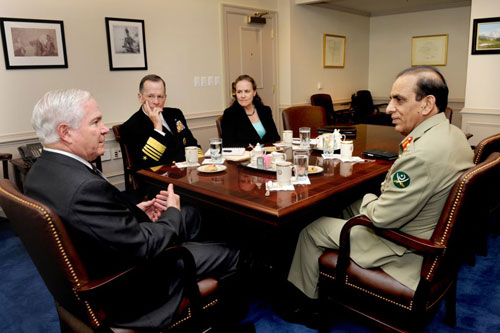 [Photo: Pakistani Chief of the Army Staff Gen. Ashfaq Parvez Kayani meets with US Secretary of Defense Robert M. Gates (left), US Chairman of the Joint Chiefs of Staff Adm. Mike Mullen and US Under Secretary of Defense for Policy Michele Flournoy on March 22.]
Here is some food for thought for those still doubting the extent of American influence in Pakistan. In previous posts, I cautioned against taking the fragmented leaks (and media reports/spins) at face value. But for the below story, I don't think we need to read against the grain too much to understand the nature of American hold in Pakistan (and the moral bankruptcy of our leaders). The American influence is quite evident from the perceptions and interactions of Pakistan's political and military leaders mentioned in the story, who all have plenty of experience of being in the upper echelon of power to know where the levers actually lie. In the final analysis, Washington and Pakistani military establishment remain the two most powerful forces shaping the future of Pakistani politics. (On the nature of Pak-US relations and Zardari's role in it, see previous posts here, here, and here).
[Edit October 8, 2011: A latest Dawn.com report reads, 'Musharraf hires US lobbyist for $25,000 a month'. The report quotes from the contract signed between Musharraf's representative and the lobbying firm. The firm is supposed to "develop a strategy to represent the interest of Gen (retd) Pervez Musharraf in the US." See the full report here]
Pakistan's president Asif Ali Zardari 'prepared for assassination'
Declan Walsh, The Guardian, November 30, 2010
Source
Excerpt:
[Zardari] fears a fresh army coup. Zardari said he was concerned that Kayani might "take me out", Biden reported to Gordon Brown during a meeting in Chile in 2009. Brown said he thought it unlikely.
The observations on Pakistan's often beleaguered president are part of several portraits about prominent Pakistani politicians that are dotted with insight, colour and some surprises.
In November 2007 Maulana Fazlur Rehman, leader of the country's most fiercely pro-Taliban religious party, hosted a jovial dinner for Patterson at which he sought her backing to become prime minister and expressed a desire to visit America.
"All important parties in Pakistan had to get the approval" of the US, said his aide Abdul Ghafoor Haideri. After the meeting Patterson commented on the mullah's famously wily political skills. "He has made it clear that … his still significant number of votes are up for sale."
The cables also highlight the contradictions of other prominent Pakistanis. Officials noted that Amin Fahim, a Bhutto supporter hoping to become prime minister, led a religious Islamic group "while enjoying an occasional bloody mary".
The opposition leader, Nawaz Sharif had a "notoriously difficult personality" while his family is noted to have "relied primarily on the army and intelligence agencies for political elevation".
America's perceived influence on Pakistani power politics is a frequent theme. In a May 2008 meeting with a visiting American congressional delegation, Zardari said: "We won't act without consulting with you."
Sharif repeatedly told the US ambassador he was "pro-American", despite his often critical public stance. He thanked the US for "arranging" to have Kayani appointed as army chief. "The best thing America has done recently," he said.
"The fact that a former prime minister believes the US could control the appointment of Pakistan's chief of army staff speaks volumes about the myth of American influence here," the ambassador noted tartly afterwards.But some dispatches make it clear that the Americans do wield great clout. After General Pervez Musharraf resigned as president in 2008, ambassador Patterson pressed Zardari to grant him immunity from prosecution. "We believed, as we had often said, that Musharraf should have a dignified retirement and not be hounded out of the country," she said.
The US – and Kayani – worried that Zardari would renege on his word. "Zardari is walking tall these days, hopefully not too tall to forget his promise to Kayani and to us on an immunity deal," wrote Patterson.
If Zardari didn't protect Musharraf then it would make him look bad. "I have to bring the army along with me," he said, also noting that the delay "does nothing for Zardari's reputation for trustworthiness".
The notable exception to that US influence, however, is the former cricketer Imran Khan, who delivered a long lecture to visiting US politicians about the iniquities of US policy.
Welcoming the group at his grand home outside Islamabad, Khan hosted an "hour-long, largely one-sided, and somewhat uncomfortable conversation".
To defeat the Taliban the US had to understand the "tribal character" of the militants, he said, and described the Pakistani drive against the Taliban in 2009 as "stage-managed" for US consumption.
There are apercus in the cables into the often inscrutable military leaders. Kayani is "direct, frank, and thoughtful" and has "fond memories" of time spent on a military training course in the US. It is also noted that "he smokes heavily and can be difficult to understand as he tends to mumble." The Inter-Services Intelligence chief, Lieutenant General Ahmad Shuja Pasha, was "usually more emotional" than Kayani.
US diplomats also have a ringside seat to civilian wrangles. In February 2009 Zardari aide Farahnaz Ispahani said the president was "very unhappy" with the way the prime minister, Yousaf Raza Gilani, had "gone off the reservation". In 2008 Zardari said Fahim "had spent most of the [election] campaign in Dubai (with his latest 22 year-old wife) and was simply too lazy to be prime minister".
The cables also record embarrassing mistakes in the embassy's efforts to manage its relationships with Pakistan's power elite. Six months after his dinner with the ambassador, Rehman was less enamoured of US policy when the FBI issued a notice suggesting he had orchestrated a suicide bombing in Islamabad.
The embassy asked the FBI to urgently recall the notice – he had been confused with another man with a similar name. Rehman was a "frequent and co-operative interlocutor with post and professes his support for co-operation with the United States", the request said.
Thursday, December 2, 2010
The leaked fragments can also be misleading
 The leaked cables can be insightful not for what they tell us at face value but what we can extract from them after a careful scrutiny. Otherwise, these fragments of documents, even in instances where they are authentic, can be very misleading. Jeremy Scahill engages in such a critical exercise in a recent piece published in The Nation (December 1, 2010). I quote two passages:
"A special operations veteran and a former CIA operative with direct experience in Pakistan have told The Nation that JSOC has long engaged in combat in Pakistan—which raises a question: How in-the-loop is the US embassy about the activities of JSOC in Pakistan? Just because Ambassador Anne Patterson approves a cable saying that US special ops forces have only done two operations with Pakistani forces and plays this up as a major-league development doesn't make it true. JSOC has conducted operations across the globe without the direct knowledge of the US ambassador. In 2006, the US military and Pakistan struck a deal that authorized JSOC to enter Pakistan to hunt Osama bin Laden and other Al Qaeda leaders with the understanding that Pakistan would deny it had given permission. JSOC has struck multiple times inside Pakistan over the years, regardless of what Ambassador Patterson's cables may say." ...
"Since the Nation story originally ran, Blackwater has continued to work under the Obama administration. In June, the company won a $100 million global contract with the CIA and continues to operate in Afghanistan, where it protects senior US officials and trains Afghan forces. Earlier this year, Blackwater's owner, Erik Prince, put the company up for sale and moved to the Abu Dhabi in the United Arab Emirates. Whether Blackwater or former Blackwater operatives continue to work in Pakistan is not known. What is clear is that there is great reason to believe that the October 2009 cable from Ambassador Anne Patterson describing US special operations forces activities in Pakistan represents only a tiny glimpse into one of the darkest corners of current US policy in Pakistan." (Jeremy Scahill, The Nation, Dec 1, 2010)
See an interview (DemocracyNow!, Dec 2, 2010) with Scahill on the same issue below.
[In a previous post, I comment on the Hersh's New Yorker piece which Scahill mentions in the above clip. There I also link my comments on the nature of Pak-US relationship and the role of the current civilian government in it.]
Moreover,
Not many people will go through all the leaked documents. They will mostly hear what the mainstream media and political groups choose to focus on.
Source, intent, editorial choices, fragmented form of cables, politics of the editors in what they release and what they do not, their timing, targets, then media spins and selective appropriation by politicians... I haven't seen many reports that engage in these critical considerations.
For how media can put a spin on these leaks, see the following story from The Real News (Dec 2, 2010): "New York Times Beats Drums for War".
The Logic of 'Suicide Terrorism'
Below see some neat insights from a bona-fide scholar, Richard Pape (Univ. of Chicago). But keep in mind the distinction between the common people and the power elites in the US. The 'misunderstanding' that is referred to in the article applies mostly to the common people. The power elites, specifically those sitting in the top seats of important institutions (government, defense, media, think tanks, corporations) in Washington and New York, are more than aware of the reality on the ground. The common people are influenced by those misunderstandings whereas the power elites influence those misunderstandings and shape them in the way they want.
In the following, I quote the parts that I found most interesting. Readers interested in this topic may also want to look at the following piece, "Good Muslim, Bad Muslim." On power elites, Thomas Dye's "Who's Running America" is a useful source (hope they get the 'Obama update' out soon). On "anti-Americanism" see a previous post, here.
It's the Occupation, Stupid
Robert Pape, Foreign Policy, October 18, 2010
Source
Extensive research into the causes of suicide terrorism proves Islam isn't to blame -- the root of the problem is foreign military occupations.
“For nearly a decade, Americans have been waging a long war against terrorism without much serious public debate about what is truly motivating terrorists to kill them. In the immediate aftermath of the 9/11 attacks, this was perfectly explicable -- the need to destroy al Qaeda's camps in Afghanistan was too urgent to await sober analyses of root causes.
But, the absence of public debate did not stop the great need to know or, perhaps better to say, to "understand" the events of that terrible day. In the years before 9/11, few Americans gave much thought to what drives terrorism -- a subject long relegated to the fringes of the media, government, and universities. And few were willing to wait for new studies, the collection of facts, and the dispassionate assessment of alternative causes. Terrorism produces fear and anger, and these emotions are not patient.
A simple narrative was readily available, and a powerful conventional wisdom began to exert its grip. Because the 9/11 hijackers were all Muslims, it was easy to presume that Islamic fundamentalism was the central motivating force driving the 19 hijackers to kill themselves in order to kill Americans. Within weeks after the 9/11 attacks, surveys of American attitudes show that this presumption was fast congealing into a hard reality in the public mind. Americans immediately wondered, "Why do they hate us?" and almost as immediately came to the conclusion that it was because of "who we are, not what we do." As President George W. Bush said in his first address to Congress after the 9/11 attacks: "They hate our freedoms: our freedom of religion, our freedom of speech, our freedom to vote and assemble and disagree with each other."
Thus was unleashed the "war on terror."
The narrative of Islamic fundamentalism did more than explain why America was attacked and encourage war against Iraq. It also pointed toward a simple, grand solution. If Islamic fundamentalism was driving the threat and if its roots grew from the culture of the Arab world, then America had a clear mission: To transform Arab societies -- with Western political institutions and social norms as the ultimate antidote to the virus of Islamic extremism.
This narrative had a powerful effect on support for the invasion of Iraq. Opinion polls show that for years before the invasion, more than 90 percent of the U.S. public believed that Saddam Hussein was harboring weapons of mass destruction (WMD). But this belief alone was not enough to push significant numbers to support war.
What really changed after 9/11 was the fear that anti-American Muslims desperately wanted to kill Americans and so any risk that such extremists would get weapons of mass destruction suddenly seemed too great. Although few Americans feared Islam before 9/11, by the spring of 2003, a near majority -- 49 percent -- strongly perceived that half or more of the world's 1.4 billion Muslims were deeply anti-American, and a similar fraction also believed that Islam itself promoted violence. No wonder there was little demand by congressional committees or the public at large for a detailed review of intelligence on Iraq's WMD prior to the invasion.
The goal of transforming Arab societies into true Western democracies had powerful effects on U.S. commitments to Afghanistan and Iraq. Constitutions had to be written; elections held; national armies built; entire economies restructured. Traditional barriers against women had to be torn down. Most important, all these changes also required domestic security, which meant maintaining approximately 150,000 U.S. and coalition ground troops in Iraq for many years and increasing the number of U.S. and Western troops in Afghanistan each year from 2003 on.”
Put differently, adopting the goal of transforming Muslim countries is what created the long-term military occupation of Iraq and Afghanistan. Yes, the United States would almost surely have sought to create a stable order after toppling the regimes in these countries in any case. However, in both, America's plans quickly went far beyond merely changing leaders or ruling parties; only by creating Western-style democracies in the Muslim world could Americans defeat terrorism once and for all.
There's just one problem: We now know that this narrative is not true.
New research provides strong evidence that … [m]ore than 95 percent of all suicide attacks are in response to foreign occupation, according to extensive research that we conducted at the University of Chicago's Project on Security and Terrorism, where we examined every one of the over 2,200 suicide attacks across the world from 1980 to the present day. As the United States has occupied Afghanistan and Iraq, which have a combined population of about 60 million, total suicide attacks worldwide have risen dramatically -- from about 300 from 1980 to 2003, to 1,800 from 2004 to 2009. Further, over 90 percent of suicide attacks worldwide are now anti-American. The vast majority of suicide terrorists hail from the local region threatened by foreign troops, which is why 90 percent of suicide attackers in Afghanistan are Afghans.
Israelis have their own narrative about terrorism, which holds that Arab fanatics seek to destroy the Jewish state because of what it is, not what it does. But since Israel withdrew its army from Lebanon in May 2000, there has not been a single Lebanese suicide attack. Similarly, since Israel withdrew from Gaza and large parts of the West Bank, Palestinian suicide attacks are down over 90 percent.
Some have disputed the causal link between foreign occupation and suicide terrorism, pointing out that some occupations by foreign powers have not resulted in suicide bombings -- for example, critics often cite post-World War II Japan and Germany. Our research provides sufficient evidence to address these criticisms by outlining the two factors that determine the likelihood of suicide terrorism being employed against an occupying force.
The first factor is social distance between the occupier and occupied. The wider the social distance, the more the occupied community may fear losing its way of life. Although other differences may matter, research shows that resistance to occupations is especially likely to escalate to suicide terrorism when there is a difference between the predominant religion of the occupier and the predominant religion of the occupied.
Religious difference matters not because some religions are predisposed to suicide attacks. Indeed, there are religious differences even in purely secular suicide attack campaigns, such as the LTTE (Hindu) against the Sinhalese (Buddhists).
Rather, religious difference matters because it enables terrorist leaders to claim that the occupier is motivated by a religious agenda that can scare both secular and religious members of a local community -- this is why Osama bin Laden never misses an opportunity to describe U.S. occupiers as "crusaders" motivated by a Christian agenda to convert Muslims, steal their resources, and change the local population's way of life.
The second factor is prior rebellion. Suicide terrorism is typically a strategy of last resort, often used by weak actors when other, non-suicidal methods of resistance to occupation fail. This is why we see suicide attack campaigns so often evolve from ordinary terrorist or guerrilla campaigns, as in the cases of Israel and Palestine, the Kurdish rebellion in Turkey, or the LTTE in Sri Lanka.”
…
“The first step is recognizing that occupations in the Muslim world don't make Americans any safer -- in fact, they are at the heart of the problem.”
In the following, I quote the parts that I found most interesting. Readers interested in this topic may also want to look at the following piece, "Good Muslim, Bad Muslim." On power elites, Thomas Dye's "Who's Running America" is a useful source (hope they get the 'Obama update' out soon). On "anti-Americanism" see a previous post, here.
It's the Occupation, Stupid
Robert Pape, Foreign Policy, October 18, 2010
Source
Extensive research into the causes of suicide terrorism proves Islam isn't to blame -- the root of the problem is foreign military occupations.
“For nearly a decade, Americans have been waging a long war against terrorism without much serious public debate about what is truly motivating terrorists to kill them. In the immediate aftermath of the 9/11 attacks, this was perfectly explicable -- the need to destroy al Qaeda's camps in Afghanistan was too urgent to await sober analyses of root causes.
But, the absence of public debate did not stop the great need to know or, perhaps better to say, to "understand" the events of that terrible day. In the years before 9/11, few Americans gave much thought to what drives terrorism -- a subject long relegated to the fringes of the media, government, and universities. And few were willing to wait for new studies, the collection of facts, and the dispassionate assessment of alternative causes. Terrorism produces fear and anger, and these emotions are not patient.
A simple narrative was readily available, and a powerful conventional wisdom began to exert its grip. Because the 9/11 hijackers were all Muslims, it was easy to presume that Islamic fundamentalism was the central motivating force driving the 19 hijackers to kill themselves in order to kill Americans. Within weeks after the 9/11 attacks, surveys of American attitudes show that this presumption was fast congealing into a hard reality in the public mind. Americans immediately wondered, "Why do they hate us?" and almost as immediately came to the conclusion that it was because of "who we are, not what we do." As President George W. Bush said in his first address to Congress after the 9/11 attacks: "They hate our freedoms: our freedom of religion, our freedom of speech, our freedom to vote and assemble and disagree with each other."
Thus was unleashed the "war on terror."
The narrative of Islamic fundamentalism did more than explain why America was attacked and encourage war against Iraq. It also pointed toward a simple, grand solution. If Islamic fundamentalism was driving the threat and if its roots grew from the culture of the Arab world, then America had a clear mission: To transform Arab societies -- with Western political institutions and social norms as the ultimate antidote to the virus of Islamic extremism.
This narrative had a powerful effect on support for the invasion of Iraq. Opinion polls show that for years before the invasion, more than 90 percent of the U.S. public believed that Saddam Hussein was harboring weapons of mass destruction (WMD). But this belief alone was not enough to push significant numbers to support war.
What really changed after 9/11 was the fear that anti-American Muslims desperately wanted to kill Americans and so any risk that such extremists would get weapons of mass destruction suddenly seemed too great. Although few Americans feared Islam before 9/11, by the spring of 2003, a near majority -- 49 percent -- strongly perceived that half or more of the world's 1.4 billion Muslims were deeply anti-American, and a similar fraction also believed that Islam itself promoted violence. No wonder there was little demand by congressional committees or the public at large for a detailed review of intelligence on Iraq's WMD prior to the invasion.
The goal of transforming Arab societies into true Western democracies had powerful effects on U.S. commitments to Afghanistan and Iraq. Constitutions had to be written; elections held; national armies built; entire economies restructured. Traditional barriers against women had to be torn down. Most important, all these changes also required domestic security, which meant maintaining approximately 150,000 U.S. and coalition ground troops in Iraq for many years and increasing the number of U.S. and Western troops in Afghanistan each year from 2003 on.”
Put differently, adopting the goal of transforming Muslim countries is what created the long-term military occupation of Iraq and Afghanistan. Yes, the United States would almost surely have sought to create a stable order after toppling the regimes in these countries in any case. However, in both, America's plans quickly went far beyond merely changing leaders or ruling parties; only by creating Western-style democracies in the Muslim world could Americans defeat terrorism once and for all.
There's just one problem: We now know that this narrative is not true.
New research provides strong evidence that … [m]ore than 95 percent of all suicide attacks are in response to foreign occupation, according to extensive research that we conducted at the University of Chicago's Project on Security and Terrorism, where we examined every one of the over 2,200 suicide attacks across the world from 1980 to the present day. As the United States has occupied Afghanistan and Iraq, which have a combined population of about 60 million, total suicide attacks worldwide have risen dramatically -- from about 300 from 1980 to 2003, to 1,800 from 2004 to 2009. Further, over 90 percent of suicide attacks worldwide are now anti-American. The vast majority of suicide terrorists hail from the local region threatened by foreign troops, which is why 90 percent of suicide attackers in Afghanistan are Afghans.
Israelis have their own narrative about terrorism, which holds that Arab fanatics seek to destroy the Jewish state because of what it is, not what it does. But since Israel withdrew its army from Lebanon in May 2000, there has not been a single Lebanese suicide attack. Similarly, since Israel withdrew from Gaza and large parts of the West Bank, Palestinian suicide attacks are down over 90 percent.
Some have disputed the causal link between foreign occupation and suicide terrorism, pointing out that some occupations by foreign powers have not resulted in suicide bombings -- for example, critics often cite post-World War II Japan and Germany. Our research provides sufficient evidence to address these criticisms by outlining the two factors that determine the likelihood of suicide terrorism being employed against an occupying force.
The first factor is social distance between the occupier and occupied. The wider the social distance, the more the occupied community may fear losing its way of life. Although other differences may matter, research shows that resistance to occupations is especially likely to escalate to suicide terrorism when there is a difference between the predominant religion of the occupier and the predominant religion of the occupied.
Religious difference matters not because some religions are predisposed to suicide attacks. Indeed, there are religious differences even in purely secular suicide attack campaigns, such as the LTTE (Hindu) against the Sinhalese (Buddhists).
Rather, religious difference matters because it enables terrorist leaders to claim that the occupier is motivated by a religious agenda that can scare both secular and religious members of a local community -- this is why Osama bin Laden never misses an opportunity to describe U.S. occupiers as "crusaders" motivated by a Christian agenda to convert Muslims, steal their resources, and change the local population's way of life.
The second factor is prior rebellion. Suicide terrorism is typically a strategy of last resort, often used by weak actors when other, non-suicidal methods of resistance to occupation fail. This is why we see suicide attack campaigns so often evolve from ordinary terrorist or guerrilla campaigns, as in the cases of Israel and Palestine, the Kurdish rebellion in Turkey, or the LTTE in Sri Lanka.”
…
“The first step is recognizing that occupations in the Muslim world don't make Americans any safer -- in fact, they are at the heart of the problem.”
Tuesday, November 30, 2010
On Critically Reading the Wikileaks

On Critically Reading the Wikileaks
Only a small proportion of the announced documents has been released so far by Wikileaks. As such, it is a bit early to conclusively suggest anything as to the value of these documents and their impact. While following the release, a few tentative thoughts came to mind that I want to share here in the interest of starting a constructive discussion. The examples I mention below are not from Wikileaks, but they are close to some of the released bits I have seen in news. The purpose here is not to analyze specific cables, but to elaborate a critical perspective for reading these leaks. (And, more broadly, for reading news on government- and corporate-owned media as well as non-corporate and user-generated forums like blogs and wikis.)
Rarely do diplomats speak out their minds in candid terms. The most sensitive information is almost always communicated in person, not over digital lines or mails. Therefore, one needs to think about not only what was said in these cables but also what was not said.
Even for communications over digital lines and mails, on important issues the US diplomats and other government officials usually use plain but coded language. The person sitting on the other end has to decipher the language and read between the lines. The dots can be hard to connect for an outsider, who may understand no more than just the apparent meaning of a leaked text. However, the added layers can be uncovered by placing such texts in the context of the politics and interests of the involved political players.
A person's perspective matters a lot for this reason. For example, a leak could suggest that, “Iran is a threat to regional stability and the Arab nations fear its nuclear capabilities.” Now, this message may mean one thing to a devout FOX News follower and another to the one critical of the American hegemonic ambitions and support to the status-quo regimes of the Middle East. Hence, the interpretation and value of such a statement depends on the perspective with which people judge it and how critically informed are those perspectives.
In my view, when Washington talks about ‘regional stability’, it first and foremost means the protection of the American and Israeli interests in the region. Iran is a ‘threat’ because it challenges those interests and supports the resistance movements in Palestine and Lebanon, among other things.
Words like ‘Al-Qaeda’ and ‘terrorist groups’ may also be codes in these cables which could refer to different groups in different countries. In Yemen, for example, they could also refer to the Houthi rebels who are challenging the regime of Ali Abdullah Saleh. Both Washington and Riyadh are against that and have provided heavy financial and military support to the regime against these rebels. In Egypt, such labels may also be used to refer to the Sunni opposition group, the Muslim Brotherhood, which has been repeatedly cracked down by the US-backed regime of Hosni Mubarak. Similarly, the terms “moderate states” and “moderate Muslims” are also codes that often refer to those who are in favor of and are protecting the American and Israeli interests in the region (for more on this, see “Good Muslim, Bad Muslim”).
One also needs to distinguish the Arab rulers from the Arab masses. Many Arab rulers surely fear Iran, but the majority of their people support Iran’s stance on the nuclear issue and Iran's support to the resistances in Palestine and Lebanon. In a recent poll carried out by Zogby International and the University of Maryland in the summer of 2010, the people in Saudi Arabia, Egypt, Jordan, Lebanon, Morocco, and the United Arab Emirates were asked to name the countries that they thought were the greatest threat to their security. 88% replied Israel, 77% the US, and only 10% Iran.
At times, factual-sounding statements in diplomatic communications may in reality be policy statements. For example, a statement that, “Iran will further isolate itself if it continues to pursue nuclear ambitions,” could very well be a statement of what they would like to see in case Iran does not follow their wishes, not necessarily what the ground reality is, even from their own perspective. Because, again, the same Summer 2010 poll suggests that a “majority of the Arab public now see a nuclear-armed Iran as being better for the Middle East.”
The poll results, moreover, suggest an increasing support for Iran in the Middle East on a number of critical issues that also discredits the argument of some US scholars that ‘old feuds between Shia and Sunnis’ define the political attitudes of the region. Yet, 'sectarian divisions' and 'specter of a rising Shia crescent', both codes for what they would like to promote, is continually used by both the US and Israeli diplomats and their supported status-quo regimes of the Middle East with the hope of dividing up the masses and re-aligning their politics on sectarian lines (for more on this, see “Bahrain and Pakistan: The Shia Dilemmas”).
Without a critical interrogation, and with media spins, these codes and policy objectives may in fact perpetuate themselves through these leaks. No surprise if due to the media coverage of some of the latest leaks, the general public in the US got the impression that 'all Arabs are against the Iranians and see the Iranian nuclear program as a threat to their security' and that the fault lines in the Middle East politics lie within their ‘ethno-sectarian’ divisions. Both the Neocons and the Hawkish-Pragmatists in Washington are surely going to capitalize on such a gross misunderstanding. For one, the U.S. Secretary of State, Hillary Clinton, stated last Monday (Nov 29, 2010): "So if anyone reading the stories about these alleged cables thinks carefully, what they will conclude is that the concern about Iran is well-founded, widely shared, and will continue to be at the source of the policy that we pursue with like-minded nations to try to prevent Iran from acquiring nuclear weapons."
Hence, in view of the above discussion, the leaked cables should not be taken at face value, even in instances where they may be authentic.
The Impact
Not many people will go through all the leaked documents. They will mostly hear what the mainstream media and political groups choose to focus on. The media spins and the politics of appropriation of these leaks, therefore, would make for an interesting discussion in coming days.
In Iran, for example, while quoting the leaks some have criticized the current government for its defiant stand on the nuclear issue which to them has resulted in Iran’s ‘increasing isolation’ in the international arena. While some others have expressed qualms about the veracity of these leaks in instances where they may suggest that direct US support was given to the post-election rioters (true or not, and whether they discredit any of the opposition's claims, that's another debate). President Ahmadinejad also has questioned the ‘legal value’ of the leaks.
What is troubling many governments is not necessarily the exposure of their 'ill-feelings' toward each other by Wikileaks. The governments already know these truths, and also that embassies and diplomats regularly do espionage for their respective governments. In the arena of international relations, interests and power largely drive politics, not feelings of good will. Mutual suspicion among states is often normal. Pak-US relations is one example (on the issues of the nuclear arsenal, ISI, and PPP/Zardari). Iran-Saudi relations is another (particularly on Iraq and Palestine-Lebanon).
The concern that many governments have with these leaks is that this politics is out in public and now more susceptible to media spins and the perceptions of their national and international masses. After the leaks, the thoughts and prejudices of people against other countries or their own governments may solidify (and in some instances, radically change), and it would become more difficult for these governments to put an all-friendly public face, or make pragmatic political shifts, or claim to support causes that they really don't (like the Saudi (non)support to the Palestinian cause. Also, the Saudi and other status-quo Middle Eastern regimes would not be happy if their geo-political interests appear too much in line with that of Israel).
Particularly for Washington, the leaks are not only an embarrassment in front of the world but they may also promote a further disillusion regarding Washington’s claim of championing democracy, freedom, and human rights. In this sense, the leaks are a direct attack on the propaganda machinery of its hegemonic ambitions. Hence, Washington might also charge Wikileaks with promoting "anti-Americanism", in addition to calling it "a crime", "risking lives of troops", "compromising national security", etc.
The Truth
Despite the huge uproar in the media, most of the fundamental strategic and policy related knowledge that has come out in the leaks so far was already known to the discerning observers; the leaks, surely, added further confirmation to it.
Among the things that the leaks confirm is that ‘Israel tried to plan the Gaza War with Egypt and PA’ (The Jerusalem Post, Nov 29, 2010). This suggests a) the Gaza massacre in 2008-9 was pre-meditated (we already knew it then, but now we have further support), and b) the Egyptian and the West Bank authorities knew about Israel's plan well ahead of time, even if, according to the leaks, the two (supposedly) did not say 'yes' to Israel. We do not know what was worked out in the later communications. Egypt and West Bank’s PA may have had logistical concerns but from looking at their policies during the massacre we know that their strategic interests were aligned with those of Israel. Egypt, for instance, refused to open its Rafah border to allow food and other daily supplies to the Gazans. For reading the leaks, this also suggests that the fragments of cables, even if they are authentic, can be very misleading if we do not scrutinize them with a critically informed perspective.
Wikileaks reports also "indicate that the US has mounted a secret effort to remove highly enriched uranium from a Pakistani reactor since 2007..." (CSMonitor, Nov 29, 2010). Indeed, this was one of the key issues that embittered the relationship between Washington and Pakistan’s powerful military establishment in the last few years and perhaps explains some of the dramatic political changes and turmoil. Yet, this nuclear connection was persistently and emphatically dismissed by some journalists in the liberal elite circles of Pakistan who might still call it a “conspiracy theory”.
One should not discount the possibility of a good number of forged and fragmented documents intentionally released to Wikileaks by government apparatuses. That reason alone is enough to suggest that Wikileaks cannot be a measure of truth per se, but it is the perspective with which one judges its content, and since there can be multiple perspectives, the truth of these leaks will remain contested. Further, the accuracy of some documents in the leaks should not be taken as a verification of the rest of the documents. On the question of verification, Wikileaks website itself suggests that the "simplest and most effective countermeasure is a worldwide community of informed users and editors who can scrutinize and discuss leaked documents.”
Lastly, in any review of these leaks, one should also interrogate the sources used and the background and politics of the people working for Wikileaks. Because these considerations have a huge impact on what Wikileaks editors choose to release (and what they do not), their timing, and their targets. Perhaps, their politics and agenda will become clearer with the release of more leaked documents.
---
For some bits on what has been released so far, check out the following report:
US embassy cables leak sparks global diplomatic crisis
David Leigh, The Guardian, Nov 28, 2010
Source
The United States was catapulted into a worldwide diplomatic crisis today, with the leaking to the Guardian and other international media of more than 250,000 classified cables from its embassies, many sent as recently as February this year.
At the start of a series of daily extracts from the US embassy cables – many designated "secret" – the Guardian can disclose that Arab leaders are privately urging an air strike on Iran and that US officials have been instructed to spy on the UN leadership.
These two revelations alone would be likely to reverberate around the world. But the secret dispatches, which were obtained by WikiLeaks, the whistleblowers' website, also reveal Washington's evaluation of many other highly sensitive international issues.
These include a shift in relations between China and North Korea, high-level concerns over Pakistan's growing instability, and details of clandestine US efforts to combat al-Qaida in Yemen.
Among scores of disclosures that are likely to cause uproar, the cables detail:
• Grave fears in Washington and London over the security of Pakistan's nuclear weapons programme, with officials warning that as the country faces economic collapse, government employees could smuggle out enough nuclear material for terrorists to build a bomb.
• Inappropriate remarks by Prince Andrew about a UK law enforcement agency and a foreign country.
• Suspicions of corruption in the Afghan government, with one cable alleging that vice-president Zia Massoud was carrying $52m in cash when he was stopped during a visit to the United Arab Emirates. Massoud denies taking money out of Afghanistan.
• How the hacker attacks which forced Google to quit China in January were orchestrated by a senior member of the Politburo who typed his own name into the global version of the search engine and found articles criticising him personally.
• Allegations that Russia and its intelligence agencies are using mafia bosses to carry out criminal operations, with one cable reporting that the relationship is so close that the country has become a "virtual mafia state".
• The extraordinarily close relationship between Vladimir Putin, the Russian prime minister, and Silvio Berlusconi, the Italian prime minister, which is causing intense US suspicion. Cables detail allegations of "lavish gifts", lucrative energy contracts and the use by Berlusconi of a "shadowy" Russian-speaking Italiango-between.
• Devastating criticism of the UK's military operations in Afghanistan by US commanders, the Afghan president and local officials in Helmand. The dispatches reveal particular contempt for the failure to impose security around Sangin – the town which has claimed more British lives than any other in the country.
The US has particularly intimate dealings with Britain, and some of the dispatches from the London embassy in Grosvenor Square will make uncomfortable reading in Whitehall and Westminster. They range from political criticisms of David Cameron to requests for specific intelligence about individual MPs.
The cables contain specific allegations of corruption, as well as harsh criticism by US embassy staff of their host governments, from Caribbean islands to China and Russia. The material includes a reference to Putin as an "alpha-dog" and Hamid Karzai as being "driven by paranoia", while Angela Merkel allegedly "avoids risk and is rarely creative". There is also a comparison between Mahmoud Ahmadinejad and Adolf Hitler.
The cables names Saudi donors as the biggest financiers of terror groups, and provide an extraordinarily detailed account of an agreement between Washington and Yemen to cover up the use of US planes to bomb al-Qaida targets. One cable records that during a meeting in January with General David Petraeus, then US commander in the Middle East, Yemeni president Abdullah Saleh said: "We'll continue saying they are our bombs, not yours."
Other revelations include a description of a near "environmental disaster" last year over a rogue shipment of enriched uranium, technical details of secret US-Russian nuclear missile negotiations in Geneva, and a profile of Libya's Muammar Gaddafi, who they say is accompanied everywhere by a "voluptuous blonde" Ukrainian nurse.
Clinton led a frantic damage limitation exercise this weekend as Washington prepared foreign governments for the revelations, contacting leaders in Germany, Saudi Arabia, the Gulf, France and Afghanistan.
US ambassadors in other capitals were instructed to brief their hosts in advance of the release of unflattering pen-portraits or nakedly frank accounts of transactions with the US which they had thought would be kept quiet. Washington now faces a difficult task in convincing contacts around the world that any future conversations will remain confidential.
As the cables were published, the White House released a statement condemning their release. "Such disclosures put at risk our diplomats, intelligence professionals, and people around the world who come to the US for assistance in promoting democracy and open government. By releasing stolen and classified documents, WikiLeaks has put at risk not only the cause of human rights but also the lives and work of these individuals."
In London, a Foreign Office spokesman said: "We condemn any unauthorised release of this classified information, just as we condemn leaks of classified material in the UK. They can damage national security, are not in the national interest and, as the US have said, may put lives at risk. We have a very strong relationship with the US government. That will continue."
The US ambassador to Britain, Louis Susman, said: "We have briefed the UK government and other friends and allies around the world about the potential impact of these disclosures … I am confident that our uniquely productive relationship with the United Kingdom will remain close and strong, focused on promoting our shared objectives and values."
Sir Christopher Meyer, who was British ambassador to the US in the Blair years, thought the leaks would have little impact on diplomatic behaviour. "This won't restrain dips' [diplomats'] candour," he said. "But people will be looking at the security of electronic communications and archives. Paper would have been impossible to steal in these quantities."
The state department's legal adviser has written to the founder of WikiLeaks, Julian Assange and his London lawyer, warning that the cables were obtained illegally and that the publication would place at risk "the lives of countless innocent individuals … ongoing military operations … and co-operation between countries".
The electronic archive of embassy dispatches from around the world was allegedly downloaded by a US soldier earlier this year and passed to WikiLeaks. Assange made it available to the Guardian and four other news organisations: the New York Times, Der Spiegel in Germany, Le Monde in France and El País in Spain. All five plan to publish extracts from the most significant cables, but have decided neither to "dump" the entire dataset into the public domain, nor to publish names that would endanger innocent individuals. WikiLeaks says that, contrary to the state department's fears, it also initially intends to post only limited cable extracts, and to redact identities.
The cables published today reveal how the US uses its embassies as part of a global espionage network, with diplomats tasked to obtain not just information from the people they meet, but personal details, such as frequent flyer numbers, credit card details and even DNA material.
Classified "human intelligence directives" issued in the name of Clinton or her predecessor, Condoleezza Rice, instruct officials to gather information on military installations, weapons markings, vehicle details of political leaders as well as iris scans, fingerprints and DNA.
The most controversial target was the UN leadership. That directive requested the specification of telecoms and IT systems used by top officials and their staff and details of "private VIP networks used for official communication, to include upgrades, security measures, passwords, personal encryption keys".
PJ Crowley, the state department spokesman in Washington, said: "Let me assure you: our diplomats are just that, diplomats. They do not engage in intelligence activities. They represent our country around the world, maintain open and transparent contact with other governments as well as public and private figures, and report home. That's what diplomats have done for hundreds of years."
The acting deputy spokesman for Ban Ki-moon, Farhan Haq, said the UN chief had no immediate comment. "We are aware of the reports."
The dispatches also shed light on older diplomatic issues. One cable, for example, reveals, that Nelson Mandela was "furious" when a top adviser stopped him meeting Margaret Thatcher shortly after his release from prison to explain why the ANC objected to her policy of "constructive engagement" with the apartheid regime.
"We understand Mandela was keen for a Thatcher meeting but that [appointments secretary Zwelakhe] Sisulu argued successfully against it," according to the cable. It continues: "Mandela has on several occasions expressed his eagerness for an early meeting with Thatcher to express the ANC's objections to her policy. We were consequently surprised when the meeting didn't materialise on his mid-April visit to London and suspected that ANC hardliners had nixed Mandela's plans."
The US embassy cables are marked "Sipdis" – secret internet protocol distribution. They were compiled as part of a programme under which selected dispatches, considered moderately secret but suitable for sharing with other agencies, would be automatically loaded on to secure embassy websites, and linked with the military's Siprnet internet system.
They are classified at various levels up to "secret noforn" [no foreigners]. More than 11,000 are marked secret, while around 9,000 of the cables are marked noforn.
More than 3 million US government personnel and soldiers, many extremely junior, are cleared to have potential access to this material, even though the cables contain the identities of foreign informants, often sensitive contacts in dictatorial regimes. Some are marked "protect" or "strictly protect".
Last spring, 22-year-old intelligence analyst Bradley Manning was charged with leaking many of these cables, along with a gun-camera video of an Apache helicopter crew mistakenly killing two Reuters news agency employees in Baghdad in 2007, which was subsequently posted by WikiLeaks. Manning is facing a courtmartial.
In July and October WikiLeaks also published thousands of leaked military reports from Afghanistan and Iraq. These were made available for analysis beforehand to the Guardian, along with Der Spiegel and the New York Times.
A former hacker, Adrian Lamo, who reported Manning to the US authorities, said the soldier had told him in chat messages that the cables revealed "how the first world exploits the third, in detail".
He also said, according to Lamo, that Clinton "and several thousand diplomats around the world are going to have a heart attack when they wake up one morning and find an entire repository of classified foreign policy is available in searchable format to the public … Everywhere there's a US post … there's a diplomatic scandal that will be revealed".
Asked why such sensitive material was posted on a network accessible to thousands of government employees, the state department spokesman told the Guardian: "The 9/11 attacks and their aftermath revealed gaps in intra-governmental information sharing. Since the attacks of 9/11, the US government has taken significant steps to facilitate information sharing. These efforts were focused on giving diplomatic, military, law enforcement and intelligence specialists quicker and easier access to more data to more effectively do their jobs."
He added: "We have been taking aggressive action in recent weeks and months to enhance the security of our systems and to prevent the leak of information."
Sunday, November 28, 2010
Nasrallah charges the STL with using faulty evidence and neglecting Israel's role
For a background analysis of the situation, see here . To watch the full speech with translation, see here.
Further,
'Israel spies waging war on Hezbollah'
PressTV, Nov 28, 2010
Source
Hezbollah has accused the US-backed UN tribunal, investigating the assassination of the country's former premier, of disregard for Israel's role in the murder.
On Sunday, the Lebanese resistance movement's Secretary General Seyyed Hassan Nasrallah delivered a speech, accusing the Special Tribunal for Lebanon of using faulty procedures, including issuing convictions in absentia and hiding witness identities.
"In international tribunals, we never have sentences made in absentia. Indictments are made, but they never hold a trial until the accused comes [and is] present in front of the judge," he said.
Withholding the identity of the witnesses, Nasrallah said, means "those who are accused can never question the witness. They can never ask the witness "where did you see me? What are accusing me [of]? Based upon what?"
The former Lebanese leader Rafiq Hariri was killed alongside more than 20 other people in a massive car bombing in the Lebanese capital, Beirut on February 14, 2005.
Nasrallah said in July, 2010 that he had been informed by the slain leader's son and successor, Saad Hariri, that STL "will accuse some undisciplined [Hezbollah] members." Nasrallah has rejected the allegation, warning that the plot was part of "a dangerous project that is targeting the resistance."
During his speech, the resistance leader questioned the neutrality of the court, saying the United Nations Security Council is an instrument in the hands of Washington.
In an August speech, he presented evidence proving that Israel had masterminded Hariri's assassination. The televised address featured a video captured by Israeli unmanned aerial vehicles, as well as recorded confessions by Israeli fifth columnists, substantiating that Tel Aviv had been behind the killing.
On Monday, leading Lebanese newspaper As-Safir also warned of the "intensive" pressure, Washington is applying under the slogan of "no discussions before indictment is issued."
Political analysts have warned that such indictments are meant to sow discord in Lebanon.
Hezbollah would accept the indictment issued by the tribunal only if it is supported by credible evidence, Nasrallah said.
He further broached the issue of Tel Aviv's spying on Beirut.
Nasrallah confirmed the news about Israeli-waged intelligence warfare against the country, which aims to incriminate members of the resistance movement in espionage.
He recounted how Tel Aviv would "implant" phone lines in the telephone devices used by Hezbollah members.
Aided by technical experts and the Lebanese Army Intelligence, the movement carried out "a comprehensive investigation" into the matter.
"We discovered that there are two phone lines in the telephone. One, which belongs to the individual and another, which was planted by the Israelis," Nasrallah said.
"And in your telephones, they can plant numbers, which you have no idea about and they can make phone calls by these numbers. The Israelis can make phone calls to these numbers and hence they can make it look like you're a spy…."
A Friday report by the leading Lebanese daily As-Safir showed that Israeli infiltrators used duplicated numbers to contact the telephone devices.
The newspaper warned that the application of the numbers, which appeared to be coming in from Austria, marked "serious chapters" of Israel's ability to control Lebanon's telecommunications sector.
The report, however, hailed that members of Hezbollah's security service, the Army Intelligence bureau and a number of employees at the country's Telecommunications Ministry had been able to cope with Tel Aviv's techniques and advanced software.
The act of domestic defense, it added, was enabled through several tests and tryouts.
On Tuesday, Hassan Fadlallah, a parliamentarian representing the resistance said Israel had arranged for the sale of doctored phones to some Hezbollah members, enabling wiretapping of their communications and dispatch of Tel Aviv-desired texts, Lebanese portal Naharnet reported.
"After a lengthy, complex investigation ... it was revealed that three resistance members were using local mobile phones which had been deliberately sold to them after being implanted with secret Israeli lines" by a Tel Aviv-hired Lebanese, said Fadlallah, who also chairs the parliament's media and telecommunications committee.
Also on Tuesday, Lebanon's Minister of Telecommunications Charbel Nahas said Beirut had found new evidence confirming the infiltration of Israeli espionage apparatuses into the telecommunications sector.
The resistance leader similarly spoke of the infiltration, adding that Tel Aviv was using wiretapping against all Lebanese people.
Lebanon has arrested more than 100 people, including members of the country's security forces and telecommunications personnel, since April 2009 on suspicion of spying for Israel.
Beirut has also filed a complaint to the United Nations over Israel's espionage activities within the country, expressing concerns that Israeli agents have gone as far as spying on the Lebanese President Michel Sleiman and other top officials.
The letter bewailed that the spy networks "constitute an aggression on Lebanon and on its sovereignty in a clear violation of international resolutions, particularly [the United Nations Security Council] resolution 1701."
The resolution ended Tel Aviv's 2006 war on Lebanon that killed about 1,200 Lebanese, most of them civilians.
Israeli agents had been responsible for targeted killings, the letter said.
A number of the suspected Israeli operatives, captured in Lebanon, have admitted to their roles in helping Israel identify targets inside Lebanon, mostly belonging to Hezbollah.
Nasrallah further criticized some Lebanese official for remaining silent on Israeli espionage activities in Lebanon.
HN/PKH/MMN
Further,
'Israel spies waging war on Hezbollah'
PressTV, Nov 28, 2010
Source
Hezbollah has accused the US-backed UN tribunal, investigating the assassination of the country's former premier, of disregard for Israel's role in the murder.
On Sunday, the Lebanese resistance movement's Secretary General Seyyed Hassan Nasrallah delivered a speech, accusing the Special Tribunal for Lebanon of using faulty procedures, including issuing convictions in absentia and hiding witness identities.
"In international tribunals, we never have sentences made in absentia. Indictments are made, but they never hold a trial until the accused comes [and is] present in front of the judge," he said.
Withholding the identity of the witnesses, Nasrallah said, means "those who are accused can never question the witness. They can never ask the witness "where did you see me? What are accusing me [of]? Based upon what?"
The former Lebanese leader Rafiq Hariri was killed alongside more than 20 other people in a massive car bombing in the Lebanese capital, Beirut on February 14, 2005.
Nasrallah said in July, 2010 that he had been informed by the slain leader's son and successor, Saad Hariri, that STL "will accuse some undisciplined [Hezbollah] members." Nasrallah has rejected the allegation, warning that the plot was part of "a dangerous project that is targeting the resistance."
During his speech, the resistance leader questioned the neutrality of the court, saying the United Nations Security Council is an instrument in the hands of Washington.
In an August speech, he presented evidence proving that Israel had masterminded Hariri's assassination. The televised address featured a video captured by Israeli unmanned aerial vehicles, as well as recorded confessions by Israeli fifth columnists, substantiating that Tel Aviv had been behind the killing.
On Monday, leading Lebanese newspaper As-Safir also warned of the "intensive" pressure, Washington is applying under the slogan of "no discussions before indictment is issued."
Political analysts have warned that such indictments are meant to sow discord in Lebanon.
Hezbollah would accept the indictment issued by the tribunal only if it is supported by credible evidence, Nasrallah said.
He further broached the issue of Tel Aviv's spying on Beirut.
Nasrallah confirmed the news about Israeli-waged intelligence warfare against the country, which aims to incriminate members of the resistance movement in espionage.
He recounted how Tel Aviv would "implant" phone lines in the telephone devices used by Hezbollah members.
Aided by technical experts and the Lebanese Army Intelligence, the movement carried out "a comprehensive investigation" into the matter.
"We discovered that there are two phone lines in the telephone. One, which belongs to the individual and another, which was planted by the Israelis," Nasrallah said.
"And in your telephones, they can plant numbers, which you have no idea about and they can make phone calls by these numbers. The Israelis can make phone calls to these numbers and hence they can make it look like you're a spy…."
A Friday report by the leading Lebanese daily As-Safir showed that Israeli infiltrators used duplicated numbers to contact the telephone devices.
The newspaper warned that the application of the numbers, which appeared to be coming in from Austria, marked "serious chapters" of Israel's ability to control Lebanon's telecommunications sector.
The report, however, hailed that members of Hezbollah's security service, the Army Intelligence bureau and a number of employees at the country's Telecommunications Ministry had been able to cope with Tel Aviv's techniques and advanced software.
The act of domestic defense, it added, was enabled through several tests and tryouts.
On Tuesday, Hassan Fadlallah, a parliamentarian representing the resistance said Israel had arranged for the sale of doctored phones to some Hezbollah members, enabling wiretapping of their communications and dispatch of Tel Aviv-desired texts, Lebanese portal Naharnet reported.
"After a lengthy, complex investigation ... it was revealed that three resistance members were using local mobile phones which had been deliberately sold to them after being implanted with secret Israeli lines" by a Tel Aviv-hired Lebanese, said Fadlallah, who also chairs the parliament's media and telecommunications committee.
Also on Tuesday, Lebanon's Minister of Telecommunications Charbel Nahas said Beirut had found new evidence confirming the infiltration of Israeli espionage apparatuses into the telecommunications sector.
The resistance leader similarly spoke of the infiltration, adding that Tel Aviv was using wiretapping against all Lebanese people.
Lebanon has arrested more than 100 people, including members of the country's security forces and telecommunications personnel, since April 2009 on suspicion of spying for Israel.
Beirut has also filed a complaint to the United Nations over Israel's espionage activities within the country, expressing concerns that Israeli agents have gone as far as spying on the Lebanese President Michel Sleiman and other top officials.
The letter bewailed that the spy networks "constitute an aggression on Lebanon and on its sovereignty in a clear violation of international resolutions, particularly [the United Nations Security Council] resolution 1701."
The resolution ended Tel Aviv's 2006 war on Lebanon that killed about 1,200 Lebanese, most of them civilians.
Israeli agents had been responsible for targeted killings, the letter said.
A number of the suspected Israeli operatives, captured in Lebanon, have admitted to their roles in helping Israel identify targets inside Lebanon, mostly belonging to Hezbollah.
Nasrallah further criticized some Lebanese official for remaining silent on Israeli espionage activities in Lebanon.
HN/PKH/MMN
Wednesday, October 27, 2010
Fisk: Wikileaks and the Shaming of America
The shaming of America
Robert Fisk, The Independent, Sunday, 24 October 2010
Source
As usual, the Arabs knew. They knew all about the mass torture, the promiscuous shooting of civilians, the outrageous use of air power against family homes, the vicious American and British mercenaries, the cemeteries of the innocent dead. All of Iraq knew. Because they were the victims.
Only we could pretend we did not know. Only we in the West could counter every claim, every allegation against the Americans or British with some worthy general – the ghastly US military spokesman Mark Kimmitt and the awful chairman of the Joint Chiefs, Peter Pace, come to mind – to ring-fence us with lies. Find a man who'd been tortured and you'd be told it was terrorist propaganda; discover a house full of children killed by an American air strike and that, too, would be terrorist propaganda, or "collateral damage", or a simple phrase: "We have nothing on that."
Of course, we all knew they always did have something. And yesterday's ocean of military memos proves it yet again. Al-Jazeera has gone to extraordinary lengths to track down the actual Iraqi families whose men and women are recorded as being wasted at US checkpoints – I've identified one because I reported it in 2004, the bullet-smashed car, the two dead journalists, even the name of the local US captain – and it was The Independent on Sunday that first alerted the world to the hordes of indisciplined gunmen being flown to Baghdad to protect diplomats and generals. These mercenaries, who murdered their way around the cities of Iraq, abused me when I told them I was writing about them way back in 2003.
It's always tempting to avoid a story by saying "nothing new". The "old story" idea is used by governments to dampen journalistic interest as it can be used by us to cover journalistic idleness. And it's true that reporters have seen some of this stuff before. The "evidence" of Iranian involvement in bomb-making in southern Iraq was farmed out to The New York Times's Michael Gordon by the Pentagon in February 2007. The raw material, which we can now read, is far more doubtful than the Pentagon-peddled version. Iranian military material was still lying around all over Iraq from the 1980-88 Iran-Iraq war and most of the attacks on Americans were at that stage carried out by Sunni insurgents. The reports suggesting that Syria allowed insurgents to pass through their territory, by the way, are correct. I have spoken to the families of Palestinian suicide bombers whose sons made their way to Iraq from Lebanon via the Lebanese village of Majdal Aanjar and then via the northern Syrian city of Aleppo to attack the Americans.
But, written in bleak militarese as it may be, here is the evidence of America's shame. This is material that can be used by lawyers in courts. If 66,081 – I loved the "81" bit – is the highest American figure available for dead civilians, then the real civilian mortality score is infinitely higher since this records only those civilians the Americans knew of. Some of them were brought to the Baghdad mortuary in my presence, and it was the senior official there who told me that the Iraqi ministry of health had banned doctors from performing any post-mortems on dead civilians brought in by American troops. Now why should that be? Because some had been tortured to death by Iraqis working for the Americans? Did this hook up with the 1,300 independent US reports of torture in Iraqi police stations?
The Americans scored no better last time round. In Kuwait, US troops could hear Palestinians being tortured by Kuwaitis in police stations after the liberation of the city from Saddam Hussein's legions in 1991. A member of the Kuwaiti royal family was involved in the torture. US forces did not intervene. They just complained to the royal family. Soldiers are always being told not to intervene. After all, what was Lieutenant Avi Grabovsky of the Israeli army told when he reported to his officer in September 1982 that Israel's Phalangist allies had just murdered some women and children? "We know, it's not to our liking, and don't interfere," Grabovsky was told by his battalion commander. This was during the Sabra and Chatila refugee camp massacre.
The quotation comes from Israel's 1983 Kahan commission report – heaven knows what we could read if WikiLeaks got its hands on the barrels of military files in the Israeli defence ministry (or the Syrian version, for that matter). But, of course, back in those days, we didn't know how to use a computer, let alone how to write on it. And that, of course, is one of the important lessons of the whole WikiLeaks phenomenon.
Back in the First World War or the Second World War or Vietnam, you wrote your military reports on paper. They may have been typed in triplicate but you could number your copies, trace any spy and prevent the leaks. The Pentagon Papers was actually written on paper. You needed to find a mole to get them. But paper could always be destroyed, weeded, trashed, all copies destroyed. At the end of the 1914-18 war, for example, a British second lieutenant shot a Chinese man after Chinese workers had looted a French military train. The Chinese man had pulled a knife on the soldier. But during the 1930s, the British soldier's file was "weeded" three times and so no trace of the incident survives. A faint ghost of it remains only in a regimental war diary which records Chinese involvement in the looting of "French provision trains". The only reason I know of the killing is that my father was the British lieutenant and told me the story before he died. No WikiLeaks then.
But I do suspect this massive hoard of material from the Iraq war has serious implications for journalists as well as armies. What is the future of the Seymour Hershes and the old-style investigative journalism that The Sunday Times used to practise? What is the point of sending teams of reporters to examine war crimes and meet military "deep throats", if almost half a million secret military documents are going to float up in front of you on a screen?
We still haven't got to the bottom of the WikiLeaks story, and I rather suspect that there are more than just a few US soldiers involved in this latest revelation. Who knows if it doesn't go close to the top? In its investigations, for example, al-Jazeera found an extract from a run-of-the-mill Pentagon press conference in November 2005. Peter Pace, the uninspiring chairman of the Joint Chiefs of Staff, is briefing journalists on how soldiers should react to the cruel treatment of prisoners, pointing out proudly that an American soldier's duty is to intervene if he sees evidence of torture. Then the camera moves to the far more sinister figure of Defence Secretary Donald Rumsfeld, who suddenly interrupts – almost in a mutter, and to Pace's consternation – "I don't think you mean they (American soldiers) have an obligation to physically stop it. It's to report it."
The significance of this remark – cryptically sadistic in its way – was lost on the journos, of course. But the secret Frago 242 memo now makes much more sense of the press conference. Presumably sent by General Ricardo Sanchez, this is the instruction that tells soldiers: "Provided the initial report confirms US forces were not involved in the detainee abuse, no further investigation will be conducted unless directed by HHQ [Higher Headquarters]." Abu Ghraib happened under Sanchez's watch in Iraq. It was also Sanchez, by the way, who couldn't explain to me at a press conference why his troops had killed Saddam's sons in a gun battle in Mosul rather than capture them.
So Sanchez's message, it seems, must have had Rumsfeld's imprimatur. And so General David Petraeus – widely loved by the US press corps – was presumably responsible for the dramatic increase in US air strikes over two years; 229 bombing attacks in Iraq in 2006, but 1,447 in 2007. Interestingly enough, US air strikes in Afghanistan have risen by 172 per cent since Petraeus took over there. Which makes it all the more astonishing that the Pentagon is now bleating that WikiLeaks may have blood on its hands. The Pentagon has been covered in blood since the dropping of the atom bomb on Hiroshima in 1945, and for an institution that ordered the illegal invasion of Iraq in 2003 – wasn't that civilian death toll more than 66,000 by their own count, out of a total of 109,000 recorded? – to claim that WikiLeaks is culpable of homicide is preposterous.
The truth, of course, is that if this vast treasury of secret reports had proved that the body count was much lower than trumpeted by the press, that US soldiers never tolerated Iraqi police torture, rarely shot civilians at checkpoints and always brought killer mercenaries to account, US generals would be handing these files out to journalists free of charge on the steps of the Pentagon. They are furious not because secrecy has been breached, or because blood may be spilt, but because they have been caught out telling the lies we always knew they told.
US official documents detail extraordinary scale of wrongdoing
WikiLeaks yesterday released on its website some 391,832 US military messages documenting actions and reports in Iraq over the period 2004-2009. Here are the main points:
Prisoners abused, raped and murdered
Hundreds of incidents of abuse and torture of prisoners by Iraqi security services, up to and including rape and murder. Since these are itemised in US reports, American authorities now face accusations of failing to investigate them. UN leaders and campaigners are calling for an official investigation.
Civilian death toll cover-up
Coalition leaders have always said "we don't do death tolls", but the documents reveal many deaths were logged. Respected British group Iraq Body Count says that, after preliminary examination of a sample of the documents, there are an estimated 15,000 extra civilian deaths, raising their total to 122,000.
The shooting of men trying to surrender
In February 2007, an Apache helicopter killed two Iraqis, suspected of firing mortars, as they tried to surrender. A military lawyer is quoted as saying: "They cannot surrender to aircraft and are still valid targets."
Private security firm abuses
Britain's Bureau of Investigative Journalism says it found documents detailing new cases of alleged wrongful killings of civilians involving Blackwater, since renamed Xe Services. Despite this, Xe retains extensive US contracts in Afghanistan.
Al-Qa'ida's use of children and "mentally handicapped" for bombing
A teenage boy with Down's syndrome who killed six and injured 34 in a suicide attack in Diyala was said to be an example of an ongoing al-Qa'ida strategy to recruit those with learning difficulties. A doctor is alleged to have sold a list of female patients with learning difficulties to insurgents.
Hundreds of civilians killed at checkpoints
Out of the 832 deaths recorded at checkpoints in Iraq between 2004 and 2009, analysis by the Bureau of Investigative Journalism suggests 681 were civilians. Fifty families were shot at and 30 children killed. Only 120 insurgents were killed in checkpoint incidents.
Iranian influence
Reports detail US concerns that Iranian agents had trained, armed and directed militants in Iraq. In one document, the US military warns a militia commander believed to be behind the deaths of US troops and kidnapping of Iraqi officials was trained by Iran's Islamic Revolutionary Guard.
Robert Fisk, The Independent, Sunday, 24 October 2010
Source
As usual, the Arabs knew. They knew all about the mass torture, the promiscuous shooting of civilians, the outrageous use of air power against family homes, the vicious American and British mercenaries, the cemeteries of the innocent dead. All of Iraq knew. Because they were the victims.
Only we could pretend we did not know. Only we in the West could counter every claim, every allegation against the Americans or British with some worthy general – the ghastly US military spokesman Mark Kimmitt and the awful chairman of the Joint Chiefs, Peter Pace, come to mind – to ring-fence us with lies. Find a man who'd been tortured and you'd be told it was terrorist propaganda; discover a house full of children killed by an American air strike and that, too, would be terrorist propaganda, or "collateral damage", or a simple phrase: "We have nothing on that."
Of course, we all knew they always did have something. And yesterday's ocean of military memos proves it yet again. Al-Jazeera has gone to extraordinary lengths to track down the actual Iraqi families whose men and women are recorded as being wasted at US checkpoints – I've identified one because I reported it in 2004, the bullet-smashed car, the two dead journalists, even the name of the local US captain – and it was The Independent on Sunday that first alerted the world to the hordes of indisciplined gunmen being flown to Baghdad to protect diplomats and generals. These mercenaries, who murdered their way around the cities of Iraq, abused me when I told them I was writing about them way back in 2003.
It's always tempting to avoid a story by saying "nothing new". The "old story" idea is used by governments to dampen journalistic interest as it can be used by us to cover journalistic idleness. And it's true that reporters have seen some of this stuff before. The "evidence" of Iranian involvement in bomb-making in southern Iraq was farmed out to The New York Times's Michael Gordon by the Pentagon in February 2007. The raw material, which we can now read, is far more doubtful than the Pentagon-peddled version. Iranian military material was still lying around all over Iraq from the 1980-88 Iran-Iraq war and most of the attacks on Americans were at that stage carried out by Sunni insurgents. The reports suggesting that Syria allowed insurgents to pass through their territory, by the way, are correct. I have spoken to the families of Palestinian suicide bombers whose sons made their way to Iraq from Lebanon via the Lebanese village of Majdal Aanjar and then via the northern Syrian city of Aleppo to attack the Americans.
But, written in bleak militarese as it may be, here is the evidence of America's shame. This is material that can be used by lawyers in courts. If 66,081 – I loved the "81" bit – is the highest American figure available for dead civilians, then the real civilian mortality score is infinitely higher since this records only those civilians the Americans knew of. Some of them were brought to the Baghdad mortuary in my presence, and it was the senior official there who told me that the Iraqi ministry of health had banned doctors from performing any post-mortems on dead civilians brought in by American troops. Now why should that be? Because some had been tortured to death by Iraqis working for the Americans? Did this hook up with the 1,300 independent US reports of torture in Iraqi police stations?
The Americans scored no better last time round. In Kuwait, US troops could hear Palestinians being tortured by Kuwaitis in police stations after the liberation of the city from Saddam Hussein's legions in 1991. A member of the Kuwaiti royal family was involved in the torture. US forces did not intervene. They just complained to the royal family. Soldiers are always being told not to intervene. After all, what was Lieutenant Avi Grabovsky of the Israeli army told when he reported to his officer in September 1982 that Israel's Phalangist allies had just murdered some women and children? "We know, it's not to our liking, and don't interfere," Grabovsky was told by his battalion commander. This was during the Sabra and Chatila refugee camp massacre.
The quotation comes from Israel's 1983 Kahan commission report – heaven knows what we could read if WikiLeaks got its hands on the barrels of military files in the Israeli defence ministry (or the Syrian version, for that matter). But, of course, back in those days, we didn't know how to use a computer, let alone how to write on it. And that, of course, is one of the important lessons of the whole WikiLeaks phenomenon.
Back in the First World War or the Second World War or Vietnam, you wrote your military reports on paper. They may have been typed in triplicate but you could number your copies, trace any spy and prevent the leaks. The Pentagon Papers was actually written on paper. You needed to find a mole to get them. But paper could always be destroyed, weeded, trashed, all copies destroyed. At the end of the 1914-18 war, for example, a British second lieutenant shot a Chinese man after Chinese workers had looted a French military train. The Chinese man had pulled a knife on the soldier. But during the 1930s, the British soldier's file was "weeded" three times and so no trace of the incident survives. A faint ghost of it remains only in a regimental war diary which records Chinese involvement in the looting of "French provision trains". The only reason I know of the killing is that my father was the British lieutenant and told me the story before he died. No WikiLeaks then.
But I do suspect this massive hoard of material from the Iraq war has serious implications for journalists as well as armies. What is the future of the Seymour Hershes and the old-style investigative journalism that The Sunday Times used to practise? What is the point of sending teams of reporters to examine war crimes and meet military "deep throats", if almost half a million secret military documents are going to float up in front of you on a screen?
We still haven't got to the bottom of the WikiLeaks story, and I rather suspect that there are more than just a few US soldiers involved in this latest revelation. Who knows if it doesn't go close to the top? In its investigations, for example, al-Jazeera found an extract from a run-of-the-mill Pentagon press conference in November 2005. Peter Pace, the uninspiring chairman of the Joint Chiefs of Staff, is briefing journalists on how soldiers should react to the cruel treatment of prisoners, pointing out proudly that an American soldier's duty is to intervene if he sees evidence of torture. Then the camera moves to the far more sinister figure of Defence Secretary Donald Rumsfeld, who suddenly interrupts – almost in a mutter, and to Pace's consternation – "I don't think you mean they (American soldiers) have an obligation to physically stop it. It's to report it."
The significance of this remark – cryptically sadistic in its way – was lost on the journos, of course. But the secret Frago 242 memo now makes much more sense of the press conference. Presumably sent by General Ricardo Sanchez, this is the instruction that tells soldiers: "Provided the initial report confirms US forces were not involved in the detainee abuse, no further investigation will be conducted unless directed by HHQ [Higher Headquarters]." Abu Ghraib happened under Sanchez's watch in Iraq. It was also Sanchez, by the way, who couldn't explain to me at a press conference why his troops had killed Saddam's sons in a gun battle in Mosul rather than capture them.
So Sanchez's message, it seems, must have had Rumsfeld's imprimatur. And so General David Petraeus – widely loved by the US press corps – was presumably responsible for the dramatic increase in US air strikes over two years; 229 bombing attacks in Iraq in 2006, but 1,447 in 2007. Interestingly enough, US air strikes in Afghanistan have risen by 172 per cent since Petraeus took over there. Which makes it all the more astonishing that the Pentagon is now bleating that WikiLeaks may have blood on its hands. The Pentagon has been covered in blood since the dropping of the atom bomb on Hiroshima in 1945, and for an institution that ordered the illegal invasion of Iraq in 2003 – wasn't that civilian death toll more than 66,000 by their own count, out of a total of 109,000 recorded? – to claim that WikiLeaks is culpable of homicide is preposterous.
The truth, of course, is that if this vast treasury of secret reports had proved that the body count was much lower than trumpeted by the press, that US soldiers never tolerated Iraqi police torture, rarely shot civilians at checkpoints and always brought killer mercenaries to account, US generals would be handing these files out to journalists free of charge on the steps of the Pentagon. They are furious not because secrecy has been breached, or because blood may be spilt, but because they have been caught out telling the lies we always knew they told.
US official documents detail extraordinary scale of wrongdoing
WikiLeaks yesterday released on its website some 391,832 US military messages documenting actions and reports in Iraq over the period 2004-2009. Here are the main points:
Prisoners abused, raped and murdered
Hundreds of incidents of abuse and torture of prisoners by Iraqi security services, up to and including rape and murder. Since these are itemised in US reports, American authorities now face accusations of failing to investigate them. UN leaders and campaigners are calling for an official investigation.
Civilian death toll cover-up
Coalition leaders have always said "we don't do death tolls", but the documents reveal many deaths were logged. Respected British group Iraq Body Count says that, after preliminary examination of a sample of the documents, there are an estimated 15,000 extra civilian deaths, raising their total to 122,000.
The shooting of men trying to surrender
In February 2007, an Apache helicopter killed two Iraqis, suspected of firing mortars, as they tried to surrender. A military lawyer is quoted as saying: "They cannot surrender to aircraft and are still valid targets."
Private security firm abuses
Britain's Bureau of Investigative Journalism says it found documents detailing new cases of alleged wrongful killings of civilians involving Blackwater, since renamed Xe Services. Despite this, Xe retains extensive US contracts in Afghanistan.
Al-Qa'ida's use of children and "mentally handicapped" for bombing
A teenage boy with Down's syndrome who killed six and injured 34 in a suicide attack in Diyala was said to be an example of an ongoing al-Qa'ida strategy to recruit those with learning difficulties. A doctor is alleged to have sold a list of female patients with learning difficulties to insurgents.
Hundreds of civilians killed at checkpoints
Out of the 832 deaths recorded at checkpoints in Iraq between 2004 and 2009, analysis by the Bureau of Investigative Journalism suggests 681 were civilians. Fifty families were shot at and 30 children killed. Only 120 insurgents were killed in checkpoint incidents.
Iranian influence
Reports detail US concerns that Iranian agents had trained, armed and directed militants in Iraq. In one document, the US military warns a militia commander believed to be behind the deaths of US troops and kidnapping of Iraqi officials was trained by Iran's Islamic Revolutionary Guard.
Subscribe to:
Posts (Atom)