Below, see two pieces on the media coverage of the recent Afghan massacre. In the first piece, Fisks suggests that frustration and revenge may be more common among the US soldiers, instead of exceptions among few individuals, because of losing the Afghan war. But the media presented the massacre in exactly the latter terms, as exceptions. I would add that the soldiers could also be driven by revenge just because of it, and a sense of national superiority and tribalism, for these attitudes are strongly cultivated in their military training. Also see Omid Safi's piece quoted below with my comments.
Madness is not the reason for this massacre
Robert Fisk, March 17, 2012,
http://www.independent.co.uk/opinion/commentators/fisk/robert-fisk-madness-is-not-the-reason-for-this-massacre-7575737.html
I'm getting a bit tired of the "deranged" soldier story. It was predictable, of course. The 38-year-old staff sergeant who massacred 16 Afghan civilians, including nine children, near Kandahar this week had no sooner returned to base than the defence experts and the think-tank boys and girls announced that he was "deranged". Not an evil, wicked, mindless terrorist – which he would be, of course, if he had been an Afghan, especially a Taliban – but merely a guy who went crazy.
This was the same nonsense used to describe the murderous US soldiers who ran amok in the Iraqi town of Haditha. It was the same word used about Israeli soldier Baruch Goldstein who massacred 25 Palestinians in Hebron – something I pointed out in this paper only hours before the staff sergeant became suddenly "deranged" in Kandahar province.
"Apparently deranged", "probably deranged", journalists announced, a soldier who "might have suffered some kind of breakdown" (The Guardian), a "rogue US soldier" (Financial Times) whose "rampage" (The New York Times) was "doubtless [sic] perpetrated in an act of madness" (Le Figaro). Really? Are we supposed to believe this stuff? Surely, if he was entirely deranged, our staff sergeant would have killed 16 of his fellow Americans. He would have slaughtered his mates and then set fire to their bodies. But, no, he didn't kill Americans. He chose to kill Afghans. There was a choice involved. So why did he kill Afghans? We learned yesterday that the soldier had recently seen one of his mates with his legs blown off. But so what?
The Afghan narrative has been curiously lobotomised – censored, even – by those who have been trying to explain this appalling massacre in Kandahar. They remembered the Koran burnings – when American troops in Bagram chucked Korans on a bonfire – and the deaths of six Nato soldiers, two of them Americans, which followed. But blow me down if they didn't forget – and this applies to every single report on the latest killings – a remarkable and highly significant statement from the US army's top commander in Afghanistan, General John Allen, exactly 22 days ago. Indeed, it was so unusual a statement that I clipped the report of Allen's words from my morning paper and placed it inside my briefcase for future reference.
Allen told his men that "now is not the time for revenge for the deaths of two US soldiers killed in Thursday's riots". They should, he said, "resist whatever urge they might have to strike back" after an Afghan soldier killed the two Americans. "There will be moments like this when you're searching for the meaning of this loss," Allen continued. "There will be moments like this, when your emotions are governed by anger and a desire to strike back. Now is not the time for revenge, now is the time to look deep inside your souls, remember your mission, remember your discipline, remember who you are."
Now this was an extraordinary plea to come from the US commander in Afghanistan. The top general had to tell his supposedly well-disciplined, elite, professional army not to "take vengeance" on the Afghans they are supposed to be helping/protecting/nurturing/training, etc. He had to tell his soldiers not to commit murder. I know that generals would say this kind of thing in Vietnam. But Afghanistan? Has it come to this? I rather fear it has. Because – however much I dislike generals – I've met quite a number of them and, by and large, they have a pretty good idea of what's going on in the ranks. And I suspect that Allen had already been warned by his junior officers that his soldiers had been enraged by the killings that followed the Koran burnings – and might decide to go on a revenge spree. Hence he tried desperately – in a statement that was as shocking as it was revealing – to pre-empt exactly the massacre which took place last Sunday.
Yet it was totally wiped from the memory box by the "experts" when they had to tell us about these killings. No suggestion that General Allen had said these words was allowed into their stories, not a single reference – because, of course, this would have taken our staff sergeant out of the "deranged" bracket and given him a possible motive for his killings. As usual, the journos had got into bed with the military to create a madman rather than a murderous soldier. Poor chap. Off his head. Didn't know what he was doing. No wonder he was whisked out of Afghanistan at such speed.
We've all had our little massacres. There was My Lai, and our very own little My Lai, at a Malayan village called Batang Kali where the Scots Guards – involved in a conflict against ruthless communist insurgents – murdered 24 unarmed rubber workers in 1948. Of course, one can say that the French in Algeria were worse than the Americans in Afghanistan – one French artillery unit is said to have "disappeared" 2,000 Algerians in six months – but that is like saying that we are better than Saddam Hussein. True, but what a baseline for morality. And that's what it's about. Discipline. Morality. Courage. The courage not to kill in revenge. But when you are losing a war that you are pretending to win – I am, of course, talking about Afghanistan – I guess that's too much to hope. General Allen seems to have been wasting his time.
--------
--------
Below, also see Omid Safi's piece on the Afghan massacre. Omid Safi compares the media coverage of the Afghan massacre to the coverage of the 2009 Fort-Hood-shooting (by a person from Muslim background). Safi limits himself to criticizing the media's double standards. He also hopes that, "future investigations would demonstrate that Hasan’s actions were indeed the actions of a lone person, not part of a broader campaign."
I feel that he could have made a more incisive argument there, questioning if the Fort Hood issue should be seen as a "Muslim" issue at all. Furthermore, he could have scrutinized the pressure and politics that compell American Muslims to respond to Fort-Hood-like events in an apologetic way. In other words, why is it that American Muslims as a collectivity feel threatened and compelled to issue apologetic statements (to the general Americans) anytime someone does something in any part of the world.
Also, are there good and bad Muslim causes from an Islamic perspective, some of which may have resorted to violent struggle as their mode of resistance? Would the American Muslims support the good resistance causes that involve killing of oppressors -- for instance, that in Palestine and Lebanon? And how would that synchronize with the moral compass that Safi presents at the end of his piece? Could such a compass also de-legitimize the legit movements (in addition to removing the messy history from the equation in each case, putting the oppressor and oppressed, powerful and powerless, all on the same level)? (On these critical questions, also see: Good Muslim, Bad Muslim: Cracking the Media Code from IslamicInsights.com).
There may be a lead in the MLK quote that Safi refers to while describing his moral compass. To quote MLK in full: "I have a dream that my four little children will one day live in a nation where they will not be judged by the color of their skin, but by the content of their character." The "content of character" may be a way to add the needed distinctions to Safi's moral compass. How do we judge the good and bad character and from whose perspective and with what assumptions and politics would be the key questions.
When Americans Kill vs. When Muslims Kill
by Omid Safi, Mar 19, 2012
http://www.religionnews.com/blogs/omid-safi/when-americans-kill-vs.-when-muslims-killl3
The news from Afghanistan over the last few weeks has been heart-wrenching, devastating, and infuriating. An American soldier named Robert Bales (on the left in the image below) walked into the midst of an Afghan civilian community, and shot 16 people dead, including 9 children and 3 women.
The shooting in Afghanistan has eerie echoes of the Fort Hood Shooting from November 5th, 2009, when an American Muslim military member, Nidal Malik Hasan, opened fire inside a military base, and killed 13 people.
And yet the media coverage of the two episodes has been diametrically opposed. When Americans kills, it is portrayed as an aberration, an act of a tormented and troubled individual. When Muslims kill, it is covered as a signal of a communal, global genocidal tendency. Let’s go over some details.
Here is how Fox covered the shootings by Major Malik Nadal in the Fort Hood shootings:
The murders at Ft. Hood are about the radicalization of individuals by an extremist ideology -- jihadism -- which fuels acts of terror.
The main question we should be asking is when did Hasan become radicalized and who indoctrinated him?
Fox’s “analysis” was written by Walid Phares, the same person that Mitt Romney had picked as his Middle East foreign policy adviser. The very same person who has been identified as a major Islamophobes, and involved in massacres in Middle East.
Phares and Fox News take great pains to point out that Nadal’s actions are not about one individual man, but part of a grander Islamist war against America. Here is what they say:
Instead it is part of a wider ideological war, generated by radicalization and inciting individuals to perform such acts.
"Lone wolf" or not, organized or not, fully self-aware perpetrator or not, influenced by overseas radicals or not, this massacre of servicemen has moved America from stage to another.
Of course future investigations would demonstrate that Hasan’s actions were indeed the actions of a lone person, not part of a broader campaign.
In short, when a deranged Muslim kills Americans, Fox News tells us that it is “the largest terror act since 9/11,” and "it's jihadist evil and terrorism." When a deranged American kills Muslims, such as the actions of Robert Bales in Afghanistan in February 2012, Fox News and its subsidiaries behave in an entirely different fashion. We are offered the following litany of explanations and justifications:
*There was alcohol involved.
* it is an isolated act of a “troubled” person that in no way shape or form reflects on the noble ideals of America or Americans.
*The soldier was housed in the “most troubled” base in America.
*He was on his fourth tour of duty, and neither he nor his family wanted to go back.
*he simply “snapped.”
*He was experiencing martial difficulties.
The headline from Fox news read: “Money, career woes reportedly plagued Afghan Killing Suspect.” The first sentence of the article reads: “Bypassed for a promotion and struggling to pay for his house, Robert Bales was eyeing a way out of his job at a Washington state military base months before he allegedly gunned down 16 civilians in an Afghan war zone, records and interviews showed as a deeper picture emerged Saturday of the Army sergeant's financial troubles and brushes with the law.”
In short, the assumption that when we Americans kill, it is an aberration from our good nature. Even if the act is abominable, it is said to be purely an individual act totally disconnected from any larger institutional or political context. However, when Muslims kill, it is a sign of a world-wide, evil ideology of jihad and terrorism.
I have searched in vain to find a commentator in the United States that grasps the above double standard, and have not so far seen that insight in a mainstream American press. The only place I have seen it is in the UK, by Robert Fisk: Fisk correctly points that that most Western journalists use descriptions like how Robert Bailes was “"Apparently deranged", "probably deranged", "might have suffered some kind of breakdown" (The Guardian), a "rogue US soldier" (Financial Times) whose rampage was "doubtless [sic] perpetrated in an act of madness" (Le Figaro).
It is these types of double standards that are at the heart of the hypocrisy of our current situation vis-à-vis Islam and Muslims. What we should be saying is simply this: the life of each and every person in the world, civilian or military, American, Afghani, Palestinian, Israeli, Iraqi, Iranian, male or female, rich or poor, gay or straight, carries exactly and identically the same intrinsic value. Just as Dr. King taught us that the measure of a character is not connected to the color of our skin, we should be demanding that the measure of a human life is not connected to the nationality of the victim or the assailant. All human lives are sacred, all are sacrosanct. And all violations of human lives are equally morally repugnant.
Taking that type of an approach would restore a sense of dignity and honor to our standing in the world community, and it would allow us to recover the moral dignity that we have squandered over the last ten years.
----
About Omid Safi: Safi is a bona fide scholar on Sufism and used to be part of the (now defunct) Progressive Muslim Union (PMU) of North America. He emphasizes compassion, love, and theological plurality drawing from the resources of various sufi traditions. On PMU-NA, see (with a pinch of salt):
http://en.wikipedia.org/wiki/Progressive_Muslim_Union
http://www.theamericanmuslim.org/tam.php/features/articles/mwu_muslim_wakeup_and_pmu_progressive_muslims_union_progressive_voices/
http://pmunadebate.blogspot.com/2005/07/omid-safi-declares-takfir-on-irshad.html
Showing posts with label War on Terror. Show all posts
Showing posts with label War on Terror. Show all posts
Thursday, March 22, 2012

Sunday, March 4, 2012
Shia killing on the rise in Pakistan
 The last two months have witnessed a surge in Shia killing, with tragic instances in Kohistan (K-PK), Parachinar (FATA), Khanpur (Punjab), and Quetta, Karachi, and D.I. Khan. The causes, again, are complex, and the local, national, and international forces all appear entangled. For one, I doubt that Jundallah (based in the Balochistan province, which claimed responsibility of the Kohistan attack on Feb 28) could have done this attack without support of the local militant groups in that remote area of the Khyber-Pakhtunkhwa province (that is, if Jundallah did indeed carry out this attack). Jundallah's Washington connection is also well known. The attackers were also said to be wearing army uniforms.
On the interconnections among various militant groups and their foreign supporters as identified in wikileaks cables, see here.
The Pakistani media -- and police -- often frames the target killing of the Shias as a "sectarian conflict". The label implies that Pakistani Sunni and Shia communities are fighting against each other. That is far from the truth. The label also hides the fact that both Shias and Sunnis have been killed by the same militant groups (for instance, see here and here). The label, moreover, gives a sense of symmetry ("Sunnis kill Shias, then Shias kill Sunnis"), whereas in reality a disproportionally high number of Shias have been killed or injured in recent years. It is more appropriate to call the recent surge as "Shia" killing, not "sectarian" killing. Each incident also requires a nuanced analysis of the causes (consider, for instance, the entangled causes surrounding the December 2009 Ashura blast in Karachi).

Saudis and UAE fund extremist groups in Southern Punjab, Pakistan - Wikileaks
With a pinch of salt, check out these two videos. The first is by Dawn News in Urdu, uploaded on youtube on May 22, 2011, that quotes a leaked cable of Bryan D. Hunt, a US diplomat in the Lahore consulate. The report suggests that some extremist groups in Southern Punjab receive more than 10 million dollars annually directly from Saudi Arabia and UAE.
The report, however, maligns whole maslaks (Islamic schools of thought) instead of focusing on the specific extremist-leaning organizations (belonging to these maslaks or otherwise), like Sipahe Sahaba, Jamatud Dawa, Jaish-e-Mohammad, and Tehrik-e-Taliban Pakistan. The following cable from the same diplomat, published by Dawn, names these specific groups. It also emphasizes the mutual connection among these groups (the connection extends beyond Southern Punjab). The cable also suggests that Qaddhafi's Libya may also have supported the extremist groups in Pakistan.
http://www.dawn.com/2011/05/26/2009-was-qaddafi-funding-sipahe-sahaba.html
Next, another clip in Urdu, uploaded on youtube on March 2, 2012, where some Ahle Hadith ulama reject and protest the militant agenda of Lashkar-e-Tayiba and Jamatud Dawa. (This particular clip does not contain any condemnation of these militant groups' anti-Shia ideology and activities.)
The report, however, maligns whole maslaks (Islamic schools of thought) instead of focusing on the specific extremist-leaning organizations (belonging to these maslaks or otherwise), like Sipahe Sahaba, Jamatud Dawa, Jaish-e-Mohammad, and Tehrik-e-Taliban Pakistan. The following cable from the same diplomat, published by Dawn, names these specific groups. It also emphasizes the mutual connection among these groups (the connection extends beyond Southern Punjab). The cable also suggests that Qaddhafi's Libya may also have supported the extremist groups in Pakistan.
http://www.dawn.com/2011/05/26/2009-was-qaddafi-funding-sipahe-sahaba.html
Next, another clip in Urdu, uploaded on youtube on March 2, 2012, where some Ahle Hadith ulama reject and protest the militant agenda of Lashkar-e-Tayiba and Jamatud Dawa. (This particular clip does not contain any condemnation of these militant groups' anti-Shia ideology and activities.)
Thursday, October 13, 2011
The whoo-scary Iranian terror plot
Watching the US corporate media coverage of this Iranian terror plot is like watching "Wag the Dog" movie again - except that the enemy plot in the movie had less holes and was more convincing than the one in the present episode.
The “very scary” Iranian Terror plot
Glenn Greenwald
http://politics.salon.com/2011/10/12/the_very_scary_iranian_terror_plot/singleton/
The most difficult challenge in writing about the Iranian Terror Plot unveiled yesterday is to take it seriously enough to analyze it. Iranian Muslims in the Quds Force sending marauding bands of Mexican drug cartel assassins onto sacred American soil to commit Terrorism — against Saudi Arabia and possibly Israel — is what Bill Kristol and John Bolton would feverishly dream up while dropping acid and madly cackling at the possibility that they could get someone to believe it. But since the U.S. Government rolled out its Most Serious Officials with Very Serious Faces to make these accusations, many people (therefore) do believe it; after all, U.S. government accusations = Truth. All Serious people know that. And in the ensuing reaction one finds virtually every dynamic typically shaping discussions of Terrorism and U.S. foreign policy.
Iranian Terror Plot: Fake, Fake, Fake
Justin Raimondo
http://original.antiwar.com/justin/2011/10/11/iranian-terror-plot-fake-fake-fake/
News Media Hypes the “Iran Did It” Line, Ignores Holes in the Story
John Glaser
http://www.antiwar.com/blog/2011/10/12/news-media-hypes-the-iran-did-it-line-ignores-holes-in-the-story/
The “very scary” Iranian Terror plot
Glenn Greenwald
http://politics.salon.com/2011/10/12/the_very_scary_iranian_terror_plot/singleton/
The most difficult challenge in writing about the Iranian Terror Plot unveiled yesterday is to take it seriously enough to analyze it. Iranian Muslims in the Quds Force sending marauding bands of Mexican drug cartel assassins onto sacred American soil to commit Terrorism — against Saudi Arabia and possibly Israel — is what Bill Kristol and John Bolton would feverishly dream up while dropping acid and madly cackling at the possibility that they could get someone to believe it. But since the U.S. Government rolled out its Most Serious Officials with Very Serious Faces to make these accusations, many people (therefore) do believe it; after all, U.S. government accusations = Truth. All Serious people know that. And in the ensuing reaction one finds virtually every dynamic typically shaping discussions of Terrorism and U.S. foreign policy.
Iranian Terror Plot: Fake, Fake, Fake
Justin Raimondo
http://original.antiwar.com/justin/2011/10/11/iranian-terror-plot-fake-fake-fake/
News Media Hypes the “Iran Did It” Line, Ignores Holes in the Story
John Glaser
http://www.antiwar.com/blog/2011/10/12/news-media-hypes-the-iran-did-it-line-ignores-holes-in-the-story/
Monday, May 30, 2011
Western guns and training used to crush the Arab spring
The NYTimes deserves credit for rigorously and scathingly going after the private security firm, Blackwater, and its founder, Erik Prince, in the last few years. The latest has been its reporting of a 800-member foreign militia that Erik Prince is building for the UAE:
Secret Desert Force Set Up by Blackwater’s Founder (NYTimes, May 14, 2011)
http://www.nytimes.com/2011/05/15/world/middleeast/15prince.html
I wish that the NYTimes had similarly scrutinized the military training and arms sales done under the official stamp of the US government and Congress. The US logistical support, troops training, and counter-insurgency equipments have facilitated far too many dictatorial regimes in their attempts to suppress the legitimate concerns of their people.
US Congress notified over $60bn arms sale to Saudi Arabia (The Guardian, October 21, 2010)
http://www.guardian.co.uk/world/2010/oct/21/us-congress-notified-arms-sale-saudi-arabia
Also See: U.S. Arms Sales Agreements with the Middle East, 1999-2006 (Statistics)
Further, the NYTimes could also cover similar support given by other so-called pro-democratic, western countries to dictatorial regimes around the world. For instance,
UK training Saudi forces used to crush Arab spring (The Guardian, May 28, 2011)
http://www.guardian.co.uk/world/2011/may/28/uk-training-saudi-troops
Secret Desert Force Set Up by Blackwater’s Founder (NYTimes, May 14, 2011)
http://www.nytimes.com/2011/05/15/world/middleeast/15prince.html
I wish that the NYTimes had similarly scrutinized the military training and arms sales done under the official stamp of the US government and Congress. The US logistical support, troops training, and counter-insurgency equipments have facilitated far too many dictatorial regimes in their attempts to suppress the legitimate concerns of their people.
US Congress notified over $60bn arms sale to Saudi Arabia (The Guardian, October 21, 2010)
http://www.guardian.co.uk/world/2010/oct/21/us-congress-notified-arms-sale-saudi-arabia
Also See: U.S. Arms Sales Agreements with the Middle East, 1999-2006 (Statistics)
Further, the NYTimes could also cover similar support given by other so-called pro-democratic, western countries to dictatorial regimes around the world. For instance,
UK training Saudi forces used to crush Arab spring (The Guardian, May 28, 2011)
http://www.guardian.co.uk/world/2011/may/28/uk-training-saudi-troops
Friday, May 27, 2011
The early beginnings of the Afghan War
Below, see a well-known and important article from The Nation that sets the record straight on how the 'Afghan war' started.
The American provocation may be true, but it is also true that the Soviet invasion of Afghanistan was part of the larger Soviet ambition of reaching the warm waters of the Indian Ocean. The Soviet-US politics should be viewed in the context of ongoing 'Cold War' which began long before the 1979 provocations and invasion.
On a critical note: The article seems to rely on the (false) assumption that 9/11 as well as Al-Qaeda were products (or 'blowback') of the Afghan war. Quite the contrary, the Taliban and Al-Qaeda are separate entities with different geographic origins, leadership, and goals. They may have developed connections, but they (or some of their factions) also have been at odds with each other in Afghanistan and Pakistan.
'Blowback,' the Prequel
Eric Alterman, The Nation, October 25, 2001
Source
The story of what historians call the second cold war often begins with the Soviet invasion of Afghanistan in December 1979, which shocked Americans into their own overreaction in Central America and Africa, as well as into arming the mujahedeen resistance. Today, it is a truth universally acknowledged in the punditocracy that while the United States may have played an indirect role in the creation of the Taliban and perhaps even the bin Laden terrorist network through our support for the radical Islamic guerrillas in Afghanistan, we did so only in response to that act of Soviet aggression. As Tim Russert explained on Meet the Press, "We had little choice." Speaking on CNN, former US Ambassador to Afghanistan Peter Tomsen speaks of our "successful policy with the ordnance we sent to the mujahedeen to defeat the Soviets." Writing on "The 'Blowback' Myth" in The Weekly Standard, one Thomas Henriksen of the Hoover Institution rehearses the Soviet invasion and then notes, "First President Carter, then, more decisively, Ronald Reagan moved to support the Afghan resistance."
The American provocation may be true, but it is also true that the Soviet invasion of Afghanistan was part of the larger Soviet ambition of reaching the warm waters of the Indian Ocean. The Soviet-US politics should be viewed in the context of ongoing 'Cold War' which began long before the 1979 provocations and invasion.
On a critical note: The article seems to rely on the (false) assumption that 9/11 as well as Al-Qaeda were products (or 'blowback') of the Afghan war. Quite the contrary, the Taliban and Al-Qaeda are separate entities with different geographic origins, leadership, and goals. They may have developed connections, but they (or some of their factions) also have been at odds with each other in Afghanistan and Pakistan.
'Blowback,' the Prequel
Eric Alterman, The Nation, October 25, 2001
Source
The story of what historians call the second cold war often begins with the Soviet invasion of Afghanistan in December 1979, which shocked Americans into their own overreaction in Central America and Africa, as well as into arming the mujahedeen resistance. Today, it is a truth universally acknowledged in the punditocracy that while the United States may have played an indirect role in the creation of the Taliban and perhaps even the bin Laden terrorist network through our support for the radical Islamic guerrillas in Afghanistan, we did so only in response to that act of Soviet aggression. As Tim Russert explained on Meet the Press, "We had little choice." Speaking on CNN, former US Ambassador to Afghanistan Peter Tomsen speaks of our "successful policy with the ordnance we sent to the mujahedeen to defeat the Soviets." Writing on "The 'Blowback' Myth" in The Weekly Standard, one Thomas Henriksen of the Hoover Institution rehearses the Soviet invasion and then notes, "First President Carter, then, more decisively, Ronald Reagan moved to support the Afghan resistance."
The truth is that the United States began a program of covert aid to the Afghan guerrillas six months before the Soviets invaded.
First revealed by former Director of Central Intelligence Robert Gates in his 1996 memoir From the Shadows, the $500 million in nonlethal aid was designed to counter the billions the Soviets were pouring into the puppet regime they had installed in Kabul. Some on the American side were willing--perhaps even eager--to lure the Soviets into a Vietnam-like entanglement. Others viewed the program as a way of destabilizing the puppet government and countering the Soviets, whose undeniable aggression in the area was helping to reheat the cold war to a dangerous boil.
According to Gates's recounting, a key meeting took place on March 30, 1979. Under Secretary of Defense Walter Slocumbe wondered aloud whether "there was value in keeping the Afghan insurgency going, 'sucking the Soviets into a Vietnamese quagmire.'" Arnold Horelick, CIA Soviet expert, warned that this was just what we could expect. In a 1998 conversation with Le Nouvel Observateur, former National Security Adviser Zbigniew Brzezinski admitted, "We didn't push the Russians to intervene, but we knowingly increased the probability that they would."
Yet Carter, who signed the finding authorizing the covert program on July 3, 1979, today explains that it was definitely "not my intention" to inspire a Soviet invasion. Cyrus Vance, who was then Secretary of State, is not well enough to be interviewed, but his close aide Marshall Shulman insists that the State Department worked hard to dissuade the Soviets from invading and would never have undertaken a program to encourage it, though he says he was unaware of the covert program at the time. Indeed, Vance hardly seems to be represented at all in Gates's recounting, although Brzezinski doubts that Carter would have approved the aid unless Vance "approved, however unenthusiastically."
No one I interviewed--those who did not mind the idea of a Soviet invasion, and those who sought to avoid it--argues that Carter himself wished to provoke one. Gates, who was then an aide to Brzezinski, says the President did not think "strategically" in that fashion. "He was simply reacting to everything the Soviets were doing in that part of the world and felt it required some kind of response. This was it." Brzezinski, similarly, says he did not sell the plan to Carter on these terms. The President understood, he explained on the phone, that "the Soviets had engineered a Communist coup and they were providing direct assistance in Kabul. We were facing a serious crisis in Iran, and the entire Persian Gulf was at stake. In that context, giving some money to the mujahedeen seemed justified." Why Carter actually approved the aid remains unclear, however. Carter, it should be added, does not seem to remember much about the initial finding. Otherwise, he would not have asked his aide to fax me the pages from his memoir Keeping Faith, which ignores it entirely, and like the rest of the pre-Gates memoirs of the period, professes great shock and horror regarding the onset of the Soviet tanks.
The news of the covert program has provoked considerable confusion among those who seek to blame the United States for the September 11 massacre. Proponents of an overly schematic "blowback" scenario, including at least one vocal supporter of the Soviet "rape" of Afghanistan, have seized Brzezinski's comments to claim that Osama bin Laden is merely one of America's "chickens coming home to roost." This is both simplistic and obscene. Blowback exists in absolutely every aspect of life, because nothing comes without unintended consequences. Does it make sense to blame the destruction of the World Trade Center on a $500 million nonlethal aid program that took place more than twenty years ago? We cannot even know for certain why the Soviets decided on their invasion.
Nor can we ever know for certain whether the US officials wished to inspire one. Memories deceive, records get destroyed and even original documents can be written to be deliberately misleading, as were the period's official memoirs--save, ironically, that of Gates, the former spymaster. The covert action was undoubtedly approved by those involved for a host of reasons, some of which may be contradictory. Helping the Afghans resist Soviet domination was not exactly a controversial policy in 1979, though no one at the time could even dream that it might lead to the evil empire's eventual disintegration.
Brzezinski argues that even given the 20/20 hindsight after September 11, the covert aid remains justified. He shares the common view that America's most significant mistake was to abandon the nation to its unhappy fate following the Soviet withdrawal. Our terrorist problem, he insists, would be much worse with the Soviets still around to support their terrorist minions among the Palestinians, the Syrians, the Libyans, the Iraqis, etc.
Certainly this is much too kind to the Reagan-era military aid to Taliban-like elements. But a more accurate historical record can only lead to more intelligent debate about the future.
Friday, January 14, 2011
Pakistan's current political situation
Tariq Ali shares some neat bits in his latest piece published by the London Review of Books (Vol. 33, No. 2., Jan 20, 2011). Below I quote the excerpt that I thought was the most insightful. In the piece, he focuses on the politics of why the military has not taken over yet. But if the question is asked this way, "how come Zardari is still in power?", it would also point to Washington's active support (financial, diplomatic, etc.). Some credit also goes to Zardari's political maneuverings and his successes (so far) in soliciting support from the power-holders in the 'marginalized provinces'. Apparently, PML-N, the largest opposition party in the country with a strong hold in Punjab, also finds no other option but to support the status quo at the moment (for one, the military establishment has made it very clear on a number of occasions that it would not let PML-N's chief Nawaz Sharif come to power. A disappointed Sharif seemed to have pleaded with Washington, but, apparently, it was of no use.). For a background on the military-civilian relations, see also here and here.
Excerpt:
"Even before this killing [of Salman Taseer], Pakistan had been on the verge of yet another military takeover. It would make things so much easier if only they could give it another name: military democracy perhaps? General Kayani, whose term as chief of staff was extended last year with strong Pentagon approval, is said to be receiving petitions every day asking him to intervene and ‘save the country’. The petitioners are obviously aware that removing Zardari and replacing him with a nominee of the Sharif brothers’ Muslim League, the PPP’s long-term rivals, is unlikely to improve matters. Petitioning, combined with a complete breakdown of law and order in one or several spheres (suicide terrorism in Peshawar, violent ethnic clashes in Karachi, state violence in Quetta and now Taseer’s assassination), is usually followed by the news that a reluctant general has no longer been able to resist ‘popular’ pressure and with the reluctant agreement of the US Embassy a uniformed president has taken power. We’ve been here before, on four separate occasions. The military has never succeeded in taking the country forward. All that happens is that, instead of politicians, the officers take the cut. The government obviously thinks the threat is serious: some of Zardari’s cronies now speak openly at dinner parties of ‘evidence’ that proves military involvement in his wife Benazir Bhutto’s assassination. If the evidence exists, let’s have a look. Another straw in the wind: the political parties close to the ISI, Pakistan’s main intelligence agency, have withdrawn from the central government, accusing it of callousness and financial malfeasance. True, but hardly novel.
Another necessary prerequisite for a coup is popular disgust with a corrupt, inept and failing civilian government. This has now reached fever pitch. As well as the natural catastrophes that have afflicted the country there are local wars, disappearances, torture, crime, huge price rises in essential goods, unemployment, a breakdown of basic services – all the major cities go without electricity for hours at a stretch and oil lamps are much in demand in smaller towns, which are often without gas and electricity for up to 12 hours. Thanks to the loan conditions recently imposed by the IMF – part of a gear change in the ‘war on terror’ – there have been riots against the rise in fuel prices in several cities. Add to this Zardari’s uncontrollable greed and the irrepressible desire of his minions to mimic their master. Pakistan today is a kleptocracy. There is much talk in Islamabad of the despised prime minister’s neglected wife going on a shopping spree in London last month and finding solace in diamonds, picking up, on her way back home, a VAT rebate in the region of £100,000.
Can it get worse? Yes. And on every front. Take the Af-Pak war. Few now would dispute that its escalation has further destabilised Pakistan, increasing the flow of recruits to suicide bomber command. The CIA’s New Year message to Pakistan consisted of three drone attacks in North Waziristan, killing 19 people. There were 116 drone strikes in 2010, double the number ordered in the first year of the Obama presidency. Serious Pakistani newspapers, Dawn and the News, claim that 98 per cent of those killed in the strikes over the last five years – the number of deaths is estimated to be between two and three thousand – were civilians, a percentage endorsed by David Kilcullen, a former senior adviser to General Petraeus. The Brookings Institution gives a grim ratio of one militant killed for every ten civilians. The drones are operated by the CIA, which isn’t subject to military rules of engagement, with the result that drones are often used for revenge attacks, notably after the sensational Khost bombing of a CIA post in December 2009.
What stops the military from taking power immediately is that it would then be responsible for stopping the drone attacks and containing the insurgency that has resulted from the extension of the war into Pakistan. This is simply beyond it, which is why the generals would rather just blame the civilian government for everything. But if the situation worsens and growing public anger and economic desperation lead to wider street protests and an urban insurgency the military will be forced to intervene. It will also be forced to act if the Obama administration does as it threatens and sends troops across the Pakistan border on protect-and-destroy missions. Were this to happen a military takeover of the country might be the only way for the army to counter dissent within its ranks by redirecting the flow of black money and bribes (currently a monopoly of politicians) into military coffers. Pakistani officers who complain to Western intelligence operatives and journalists that a new violation of sovereignty might split the army do so largely as a way to exert pressure. There has been no serious breach in the military high command since the dismal failure of the 1951 Rawalpindi Conspiracy, the first and last radical nationalist attempt (backed by Communist intellectuals) to seize power within the army and take the country in an anti-imperialist direction. Since then, malcontents in the armed forces have always been rapidly identified and removed. Military perks and privileges – bonuses, land allocations, a presence in finance and industry – play an increasingly important part in keeping the army under control."
Excerpt:
"Even before this killing [of Salman Taseer], Pakistan had been on the verge of yet another military takeover. It would make things so much easier if only they could give it another name: military democracy perhaps? General Kayani, whose term as chief of staff was extended last year with strong Pentagon approval, is said to be receiving petitions every day asking him to intervene and ‘save the country’. The petitioners are obviously aware that removing Zardari and replacing him with a nominee of the Sharif brothers’ Muslim League, the PPP’s long-term rivals, is unlikely to improve matters. Petitioning, combined with a complete breakdown of law and order in one or several spheres (suicide terrorism in Peshawar, violent ethnic clashes in Karachi, state violence in Quetta and now Taseer’s assassination), is usually followed by the news that a reluctant general has no longer been able to resist ‘popular’ pressure and with the reluctant agreement of the US Embassy a uniformed president has taken power. We’ve been here before, on four separate occasions. The military has never succeeded in taking the country forward. All that happens is that, instead of politicians, the officers take the cut. The government obviously thinks the threat is serious: some of Zardari’s cronies now speak openly at dinner parties of ‘evidence’ that proves military involvement in his wife Benazir Bhutto’s assassination. If the evidence exists, let’s have a look. Another straw in the wind: the political parties close to the ISI, Pakistan’s main intelligence agency, have withdrawn from the central government, accusing it of callousness and financial malfeasance. True, but hardly novel.
Another necessary prerequisite for a coup is popular disgust with a corrupt, inept and failing civilian government. This has now reached fever pitch. As well as the natural catastrophes that have afflicted the country there are local wars, disappearances, torture, crime, huge price rises in essential goods, unemployment, a breakdown of basic services – all the major cities go without electricity for hours at a stretch and oil lamps are much in demand in smaller towns, which are often without gas and electricity for up to 12 hours. Thanks to the loan conditions recently imposed by the IMF – part of a gear change in the ‘war on terror’ – there have been riots against the rise in fuel prices in several cities. Add to this Zardari’s uncontrollable greed and the irrepressible desire of his minions to mimic their master. Pakistan today is a kleptocracy. There is much talk in Islamabad of the despised prime minister’s neglected wife going on a shopping spree in London last month and finding solace in diamonds, picking up, on her way back home, a VAT rebate in the region of £100,000.
Can it get worse? Yes. And on every front. Take the Af-Pak war. Few now would dispute that its escalation has further destabilised Pakistan, increasing the flow of recruits to suicide bomber command. The CIA’s New Year message to Pakistan consisted of three drone attacks in North Waziristan, killing 19 people. There were 116 drone strikes in 2010, double the number ordered in the first year of the Obama presidency. Serious Pakistani newspapers, Dawn and the News, claim that 98 per cent of those killed in the strikes over the last five years – the number of deaths is estimated to be between two and three thousand – were civilians, a percentage endorsed by David Kilcullen, a former senior adviser to General Petraeus. The Brookings Institution gives a grim ratio of one militant killed for every ten civilians. The drones are operated by the CIA, which isn’t subject to military rules of engagement, with the result that drones are often used for revenge attacks, notably after the sensational Khost bombing of a CIA post in December 2009.
What stops the military from taking power immediately is that it would then be responsible for stopping the drone attacks and containing the insurgency that has resulted from the extension of the war into Pakistan. This is simply beyond it, which is why the generals would rather just blame the civilian government for everything. But if the situation worsens and growing public anger and economic desperation lead to wider street protests and an urban insurgency the military will be forced to intervene. It will also be forced to act if the Obama administration does as it threatens and sends troops across the Pakistan border on protect-and-destroy missions. Were this to happen a military takeover of the country might be the only way for the army to counter dissent within its ranks by redirecting the flow of black money and bribes (currently a monopoly of politicians) into military coffers. Pakistani officers who complain to Western intelligence operatives and journalists that a new violation of sovereignty might split the army do so largely as a way to exert pressure. There has been no serious breach in the military high command since the dismal failure of the 1951 Rawalpindi Conspiracy, the first and last radical nationalist attempt (backed by Communist intellectuals) to seize power within the army and take the country in an anti-imperialist direction. Since then, malcontents in the armed forces have always been rapidly identified and removed. Military perks and privileges – bonuses, land allocations, a presence in finance and industry – play an increasingly important part in keeping the army under control."
Tuesday, December 7, 2010
Reading the colonial diaries: The extent of American influence on Pakistan
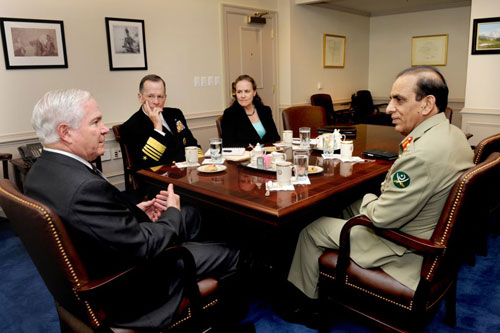 [Photo: Pakistani Chief of the Army Staff Gen. Ashfaq Parvez Kayani meets with US Secretary of Defense Robert M. Gates (left), US Chairman of the Joint Chiefs of Staff Adm. Mike Mullen and US Under Secretary of Defense for Policy Michele Flournoy on March 22.]
Here is some food for thought for those still doubting the extent of American influence in Pakistan. In previous posts, I cautioned against taking the fragmented leaks (and media reports/spins) at face value. But for the below story, I don't think we need to read against the grain too much to understand the nature of American hold in Pakistan (and the moral bankruptcy of our leaders). The American influence is quite evident from the perceptions and interactions of Pakistan's political and military leaders mentioned in the story, who all have plenty of experience of being in the upper echelon of power to know where the levers actually lie. In the final analysis, Washington and Pakistani military establishment remain the two most powerful forces shaping the future of Pakistani politics. (On the nature of Pak-US relations and Zardari's role in it, see previous posts here, here, and here).
[Edit October 8, 2011: A latest Dawn.com report reads, 'Musharraf hires US lobbyist for $25,000 a month'. The report quotes from the contract signed between Musharraf's representative and the lobbying firm. The firm is supposed to "develop a strategy to represent the interest of Gen (retd) Pervez Musharraf in the US." See the full report here]
Pakistan's president Asif Ali Zardari 'prepared for assassination'
Declan Walsh, The Guardian, November 30, 2010
Source
Excerpt:
[Zardari] fears a fresh army coup. Zardari said he was concerned that Kayani might "take me out", Biden reported to Gordon Brown during a meeting in Chile in 2009. Brown said he thought it unlikely.
The observations on Pakistan's often beleaguered president are part of several portraits about prominent Pakistani politicians that are dotted with insight, colour and some surprises.
In November 2007 Maulana Fazlur Rehman, leader of the country's most fiercely pro-Taliban religious party, hosted a jovial dinner for Patterson at which he sought her backing to become prime minister and expressed a desire to visit America.
"All important parties in Pakistan had to get the approval" of the US, said his aide Abdul Ghafoor Haideri. After the meeting Patterson commented on the mullah's famously wily political skills. "He has made it clear that … his still significant number of votes are up for sale."
The cables also highlight the contradictions of other prominent Pakistanis. Officials noted that Amin Fahim, a Bhutto supporter hoping to become prime minister, led a religious Islamic group "while enjoying an occasional bloody mary".
The opposition leader, Nawaz Sharif had a "notoriously difficult personality" while his family is noted to have "relied primarily on the army and intelligence agencies for political elevation".
America's perceived influence on Pakistani power politics is a frequent theme. In a May 2008 meeting with a visiting American congressional delegation, Zardari said: "We won't act without consulting with you."
Sharif repeatedly told the US ambassador he was "pro-American", despite his often critical public stance. He thanked the US for "arranging" to have Kayani appointed as army chief. "The best thing America has done recently," he said.
"The fact that a former prime minister believes the US could control the appointment of Pakistan's chief of army staff speaks volumes about the myth of American influence here," the ambassador noted tartly afterwards.But some dispatches make it clear that the Americans do wield great clout. After General Pervez Musharraf resigned as president in 2008, ambassador Patterson pressed Zardari to grant him immunity from prosecution. "We believed, as we had often said, that Musharraf should have a dignified retirement and not be hounded out of the country," she said.
The US – and Kayani – worried that Zardari would renege on his word. "Zardari is walking tall these days, hopefully not too tall to forget his promise to Kayani and to us on an immunity deal," wrote Patterson.
If Zardari didn't protect Musharraf then it would make him look bad. "I have to bring the army along with me," he said, also noting that the delay "does nothing for Zardari's reputation for trustworthiness".
The notable exception to that US influence, however, is the former cricketer Imran Khan, who delivered a long lecture to visiting US politicians about the iniquities of US policy.
Welcoming the group at his grand home outside Islamabad, Khan hosted an "hour-long, largely one-sided, and somewhat uncomfortable conversation".
To defeat the Taliban the US had to understand the "tribal character" of the militants, he said, and described the Pakistani drive against the Taliban in 2009 as "stage-managed" for US consumption.
There are apercus in the cables into the often inscrutable military leaders. Kayani is "direct, frank, and thoughtful" and has "fond memories" of time spent on a military training course in the US. It is also noted that "he smokes heavily and can be difficult to understand as he tends to mumble." The Inter-Services Intelligence chief, Lieutenant General Ahmad Shuja Pasha, was "usually more emotional" than Kayani.
US diplomats also have a ringside seat to civilian wrangles. In February 2009 Zardari aide Farahnaz Ispahani said the president was "very unhappy" with the way the prime minister, Yousaf Raza Gilani, had "gone off the reservation". In 2008 Zardari said Fahim "had spent most of the [election] campaign in Dubai (with his latest 22 year-old wife) and was simply too lazy to be prime minister".
The cables also record embarrassing mistakes in the embassy's efforts to manage its relationships with Pakistan's power elite. Six months after his dinner with the ambassador, Rehman was less enamoured of US policy when the FBI issued a notice suggesting he had orchestrated a suicide bombing in Islamabad.
The embassy asked the FBI to urgently recall the notice – he had been confused with another man with a similar name. Rehman was a "frequent and co-operative interlocutor with post and professes his support for co-operation with the United States", the request said.
Thursday, December 2, 2010
The leaked fragments can also be misleading
 The leaked cables can be insightful not for what they tell us at face value but what we can extract from them after a careful scrutiny. Otherwise, these fragments of documents, even in instances where they are authentic, can be very misleading. Jeremy Scahill engages in such a critical exercise in a recent piece published in The Nation (December 1, 2010). I quote two passages:
"A special operations veteran and a former CIA operative with direct experience in Pakistan have told The Nation that JSOC has long engaged in combat in Pakistan—which raises a question: How in-the-loop is the US embassy about the activities of JSOC in Pakistan? Just because Ambassador Anne Patterson approves a cable saying that US special ops forces have only done two operations with Pakistani forces and plays this up as a major-league development doesn't make it true. JSOC has conducted operations across the globe without the direct knowledge of the US ambassador. In 2006, the US military and Pakistan struck a deal that authorized JSOC to enter Pakistan to hunt Osama bin Laden and other Al Qaeda leaders with the understanding that Pakistan would deny it had given permission. JSOC has struck multiple times inside Pakistan over the years, regardless of what Ambassador Patterson's cables may say." ...
"Since the Nation story originally ran, Blackwater has continued to work under the Obama administration. In June, the company won a $100 million global contract with the CIA and continues to operate in Afghanistan, where it protects senior US officials and trains Afghan forces. Earlier this year, Blackwater's owner, Erik Prince, put the company up for sale and moved to the Abu Dhabi in the United Arab Emirates. Whether Blackwater or former Blackwater operatives continue to work in Pakistan is not known. What is clear is that there is great reason to believe that the October 2009 cable from Ambassador Anne Patterson describing US special operations forces activities in Pakistan represents only a tiny glimpse into one of the darkest corners of current US policy in Pakistan." (Jeremy Scahill, The Nation, Dec 1, 2010)
See an interview (DemocracyNow!, Dec 2, 2010) with Scahill on the same issue below.
[In a previous post, I comment on the Hersh's New Yorker piece which Scahill mentions in the above clip. There I also link my comments on the nature of Pak-US relationship and the role of the current civilian government in it.]
Moreover,
Not many people will go through all the leaked documents. They will mostly hear what the mainstream media and political groups choose to focus on.
Source, intent, editorial choices, fragmented form of cables, politics of the editors in what they release and what they do not, their timing, targets, then media spins and selective appropriation by politicians... I haven't seen many reports that engage in these critical considerations.
For how media can put a spin on these leaks, see the following story from The Real News (Dec 2, 2010): "New York Times Beats Drums for War".
The Logic of 'Suicide Terrorism'
Below see some neat insights from a bona-fide scholar, Richard Pape (Univ. of Chicago). But keep in mind the distinction between the common people and the power elites in the US. The 'misunderstanding' that is referred to in the article applies mostly to the common people. The power elites, specifically those sitting in the top seats of important institutions (government, defense, media, think tanks, corporations) in Washington and New York, are more than aware of the reality on the ground. The common people are influenced by those misunderstandings whereas the power elites influence those misunderstandings and shape them in the way they want.
In the following, I quote the parts that I found most interesting. Readers interested in this topic may also want to look at the following piece, "Good Muslim, Bad Muslim." On power elites, Thomas Dye's "Who's Running America" is a useful source (hope they get the 'Obama update' out soon). On "anti-Americanism" see a previous post, here.
It's the Occupation, Stupid
Robert Pape, Foreign Policy, October 18, 2010
Source
Extensive research into the causes of suicide terrorism proves Islam isn't to blame -- the root of the problem is foreign military occupations.
“For nearly a decade, Americans have been waging a long war against terrorism without much serious public debate about what is truly motivating terrorists to kill them. In the immediate aftermath of the 9/11 attacks, this was perfectly explicable -- the need to destroy al Qaeda's camps in Afghanistan was too urgent to await sober analyses of root causes.
But, the absence of public debate did not stop the great need to know or, perhaps better to say, to "understand" the events of that terrible day. In the years before 9/11, few Americans gave much thought to what drives terrorism -- a subject long relegated to the fringes of the media, government, and universities. And few were willing to wait for new studies, the collection of facts, and the dispassionate assessment of alternative causes. Terrorism produces fear and anger, and these emotions are not patient.
A simple narrative was readily available, and a powerful conventional wisdom began to exert its grip. Because the 9/11 hijackers were all Muslims, it was easy to presume that Islamic fundamentalism was the central motivating force driving the 19 hijackers to kill themselves in order to kill Americans. Within weeks after the 9/11 attacks, surveys of American attitudes show that this presumption was fast congealing into a hard reality in the public mind. Americans immediately wondered, "Why do they hate us?" and almost as immediately came to the conclusion that it was because of "who we are, not what we do." As President George W. Bush said in his first address to Congress after the 9/11 attacks: "They hate our freedoms: our freedom of religion, our freedom of speech, our freedom to vote and assemble and disagree with each other."
Thus was unleashed the "war on terror."
The narrative of Islamic fundamentalism did more than explain why America was attacked and encourage war against Iraq. It also pointed toward a simple, grand solution. If Islamic fundamentalism was driving the threat and if its roots grew from the culture of the Arab world, then America had a clear mission: To transform Arab societies -- with Western political institutions and social norms as the ultimate antidote to the virus of Islamic extremism.
This narrative had a powerful effect on support for the invasion of Iraq. Opinion polls show that for years before the invasion, more than 90 percent of the U.S. public believed that Saddam Hussein was harboring weapons of mass destruction (WMD). But this belief alone was not enough to push significant numbers to support war.
What really changed after 9/11 was the fear that anti-American Muslims desperately wanted to kill Americans and so any risk that such extremists would get weapons of mass destruction suddenly seemed too great. Although few Americans feared Islam before 9/11, by the spring of 2003, a near majority -- 49 percent -- strongly perceived that half or more of the world's 1.4 billion Muslims were deeply anti-American, and a similar fraction also believed that Islam itself promoted violence. No wonder there was little demand by congressional committees or the public at large for a detailed review of intelligence on Iraq's WMD prior to the invasion.
The goal of transforming Arab societies into true Western democracies had powerful effects on U.S. commitments to Afghanistan and Iraq. Constitutions had to be written; elections held; national armies built; entire economies restructured. Traditional barriers against women had to be torn down. Most important, all these changes also required domestic security, which meant maintaining approximately 150,000 U.S. and coalition ground troops in Iraq for many years and increasing the number of U.S. and Western troops in Afghanistan each year from 2003 on.”
Put differently, adopting the goal of transforming Muslim countries is what created the long-term military occupation of Iraq and Afghanistan. Yes, the United States would almost surely have sought to create a stable order after toppling the regimes in these countries in any case. However, in both, America's plans quickly went far beyond merely changing leaders or ruling parties; only by creating Western-style democracies in the Muslim world could Americans defeat terrorism once and for all.
There's just one problem: We now know that this narrative is not true.
New research provides strong evidence that … [m]ore than 95 percent of all suicide attacks are in response to foreign occupation, according to extensive research that we conducted at the University of Chicago's Project on Security and Terrorism, where we examined every one of the over 2,200 suicide attacks across the world from 1980 to the present day. As the United States has occupied Afghanistan and Iraq, which have a combined population of about 60 million, total suicide attacks worldwide have risen dramatically -- from about 300 from 1980 to 2003, to 1,800 from 2004 to 2009. Further, over 90 percent of suicide attacks worldwide are now anti-American. The vast majority of suicide terrorists hail from the local region threatened by foreign troops, which is why 90 percent of suicide attackers in Afghanistan are Afghans.
Israelis have their own narrative about terrorism, which holds that Arab fanatics seek to destroy the Jewish state because of what it is, not what it does. But since Israel withdrew its army from Lebanon in May 2000, there has not been a single Lebanese suicide attack. Similarly, since Israel withdrew from Gaza and large parts of the West Bank, Palestinian suicide attacks are down over 90 percent.
Some have disputed the causal link between foreign occupation and suicide terrorism, pointing out that some occupations by foreign powers have not resulted in suicide bombings -- for example, critics often cite post-World War II Japan and Germany. Our research provides sufficient evidence to address these criticisms by outlining the two factors that determine the likelihood of suicide terrorism being employed against an occupying force.
The first factor is social distance between the occupier and occupied. The wider the social distance, the more the occupied community may fear losing its way of life. Although other differences may matter, research shows that resistance to occupations is especially likely to escalate to suicide terrorism when there is a difference between the predominant religion of the occupier and the predominant religion of the occupied.
Religious difference matters not because some religions are predisposed to suicide attacks. Indeed, there are religious differences even in purely secular suicide attack campaigns, such as the LTTE (Hindu) against the Sinhalese (Buddhists).
Rather, religious difference matters because it enables terrorist leaders to claim that the occupier is motivated by a religious agenda that can scare both secular and religious members of a local community -- this is why Osama bin Laden never misses an opportunity to describe U.S. occupiers as "crusaders" motivated by a Christian agenda to convert Muslims, steal their resources, and change the local population's way of life.
The second factor is prior rebellion. Suicide terrorism is typically a strategy of last resort, often used by weak actors when other, non-suicidal methods of resistance to occupation fail. This is why we see suicide attack campaigns so often evolve from ordinary terrorist or guerrilla campaigns, as in the cases of Israel and Palestine, the Kurdish rebellion in Turkey, or the LTTE in Sri Lanka.”
…
“The first step is recognizing that occupations in the Muslim world don't make Americans any safer -- in fact, they are at the heart of the problem.”
In the following, I quote the parts that I found most interesting. Readers interested in this topic may also want to look at the following piece, "Good Muslim, Bad Muslim." On power elites, Thomas Dye's "Who's Running America" is a useful source (hope they get the 'Obama update' out soon). On "anti-Americanism" see a previous post, here.
It's the Occupation, Stupid
Robert Pape, Foreign Policy, October 18, 2010
Source
Extensive research into the causes of suicide terrorism proves Islam isn't to blame -- the root of the problem is foreign military occupations.
“For nearly a decade, Americans have been waging a long war against terrorism without much serious public debate about what is truly motivating terrorists to kill them. In the immediate aftermath of the 9/11 attacks, this was perfectly explicable -- the need to destroy al Qaeda's camps in Afghanistan was too urgent to await sober analyses of root causes.
But, the absence of public debate did not stop the great need to know or, perhaps better to say, to "understand" the events of that terrible day. In the years before 9/11, few Americans gave much thought to what drives terrorism -- a subject long relegated to the fringes of the media, government, and universities. And few were willing to wait for new studies, the collection of facts, and the dispassionate assessment of alternative causes. Terrorism produces fear and anger, and these emotions are not patient.
A simple narrative was readily available, and a powerful conventional wisdom began to exert its grip. Because the 9/11 hijackers were all Muslims, it was easy to presume that Islamic fundamentalism was the central motivating force driving the 19 hijackers to kill themselves in order to kill Americans. Within weeks after the 9/11 attacks, surveys of American attitudes show that this presumption was fast congealing into a hard reality in the public mind. Americans immediately wondered, "Why do they hate us?" and almost as immediately came to the conclusion that it was because of "who we are, not what we do." As President George W. Bush said in his first address to Congress after the 9/11 attacks: "They hate our freedoms: our freedom of religion, our freedom of speech, our freedom to vote and assemble and disagree with each other."
Thus was unleashed the "war on terror."
The narrative of Islamic fundamentalism did more than explain why America was attacked and encourage war against Iraq. It also pointed toward a simple, grand solution. If Islamic fundamentalism was driving the threat and if its roots grew from the culture of the Arab world, then America had a clear mission: To transform Arab societies -- with Western political institutions and social norms as the ultimate antidote to the virus of Islamic extremism.
This narrative had a powerful effect on support for the invasion of Iraq. Opinion polls show that for years before the invasion, more than 90 percent of the U.S. public believed that Saddam Hussein was harboring weapons of mass destruction (WMD). But this belief alone was not enough to push significant numbers to support war.
What really changed after 9/11 was the fear that anti-American Muslims desperately wanted to kill Americans and so any risk that such extremists would get weapons of mass destruction suddenly seemed too great. Although few Americans feared Islam before 9/11, by the spring of 2003, a near majority -- 49 percent -- strongly perceived that half or more of the world's 1.4 billion Muslims were deeply anti-American, and a similar fraction also believed that Islam itself promoted violence. No wonder there was little demand by congressional committees or the public at large for a detailed review of intelligence on Iraq's WMD prior to the invasion.
The goal of transforming Arab societies into true Western democracies had powerful effects on U.S. commitments to Afghanistan and Iraq. Constitutions had to be written; elections held; national armies built; entire economies restructured. Traditional barriers against women had to be torn down. Most important, all these changes also required domestic security, which meant maintaining approximately 150,000 U.S. and coalition ground troops in Iraq for many years and increasing the number of U.S. and Western troops in Afghanistan each year from 2003 on.”
Put differently, adopting the goal of transforming Muslim countries is what created the long-term military occupation of Iraq and Afghanistan. Yes, the United States would almost surely have sought to create a stable order after toppling the regimes in these countries in any case. However, in both, America's plans quickly went far beyond merely changing leaders or ruling parties; only by creating Western-style democracies in the Muslim world could Americans defeat terrorism once and for all.
There's just one problem: We now know that this narrative is not true.
New research provides strong evidence that … [m]ore than 95 percent of all suicide attacks are in response to foreign occupation, according to extensive research that we conducted at the University of Chicago's Project on Security and Terrorism, where we examined every one of the over 2,200 suicide attacks across the world from 1980 to the present day. As the United States has occupied Afghanistan and Iraq, which have a combined population of about 60 million, total suicide attacks worldwide have risen dramatically -- from about 300 from 1980 to 2003, to 1,800 from 2004 to 2009. Further, over 90 percent of suicide attacks worldwide are now anti-American. The vast majority of suicide terrorists hail from the local region threatened by foreign troops, which is why 90 percent of suicide attackers in Afghanistan are Afghans.
Israelis have their own narrative about terrorism, which holds that Arab fanatics seek to destroy the Jewish state because of what it is, not what it does. But since Israel withdrew its army from Lebanon in May 2000, there has not been a single Lebanese suicide attack. Similarly, since Israel withdrew from Gaza and large parts of the West Bank, Palestinian suicide attacks are down over 90 percent.
Some have disputed the causal link between foreign occupation and suicide terrorism, pointing out that some occupations by foreign powers have not resulted in suicide bombings -- for example, critics often cite post-World War II Japan and Germany. Our research provides sufficient evidence to address these criticisms by outlining the two factors that determine the likelihood of suicide terrorism being employed against an occupying force.
The first factor is social distance between the occupier and occupied. The wider the social distance, the more the occupied community may fear losing its way of life. Although other differences may matter, research shows that resistance to occupations is especially likely to escalate to suicide terrorism when there is a difference between the predominant religion of the occupier and the predominant religion of the occupied.
Religious difference matters not because some religions are predisposed to suicide attacks. Indeed, there are religious differences even in purely secular suicide attack campaigns, such as the LTTE (Hindu) against the Sinhalese (Buddhists).
Rather, religious difference matters because it enables terrorist leaders to claim that the occupier is motivated by a religious agenda that can scare both secular and religious members of a local community -- this is why Osama bin Laden never misses an opportunity to describe U.S. occupiers as "crusaders" motivated by a Christian agenda to convert Muslims, steal their resources, and change the local population's way of life.
The second factor is prior rebellion. Suicide terrorism is typically a strategy of last resort, often used by weak actors when other, non-suicidal methods of resistance to occupation fail. This is why we see suicide attack campaigns so often evolve from ordinary terrorist or guerrilla campaigns, as in the cases of Israel and Palestine, the Kurdish rebellion in Turkey, or the LTTE in Sri Lanka.”
…
“The first step is recognizing that occupations in the Muslim world don't make Americans any safer -- in fact, they are at the heart of the problem.”
Wednesday, October 27, 2010
Fisk: Wikileaks and the Shaming of America
The shaming of America
Robert Fisk, The Independent, Sunday, 24 October 2010
Source
As usual, the Arabs knew. They knew all about the mass torture, the promiscuous shooting of civilians, the outrageous use of air power against family homes, the vicious American and British mercenaries, the cemeteries of the innocent dead. All of Iraq knew. Because they were the victims.
Only we could pretend we did not know. Only we in the West could counter every claim, every allegation against the Americans or British with some worthy general – the ghastly US military spokesman Mark Kimmitt and the awful chairman of the Joint Chiefs, Peter Pace, come to mind – to ring-fence us with lies. Find a man who'd been tortured and you'd be told it was terrorist propaganda; discover a house full of children killed by an American air strike and that, too, would be terrorist propaganda, or "collateral damage", or a simple phrase: "We have nothing on that."
Of course, we all knew they always did have something. And yesterday's ocean of military memos proves it yet again. Al-Jazeera has gone to extraordinary lengths to track down the actual Iraqi families whose men and women are recorded as being wasted at US checkpoints – I've identified one because I reported it in 2004, the bullet-smashed car, the two dead journalists, even the name of the local US captain – and it was The Independent on Sunday that first alerted the world to the hordes of indisciplined gunmen being flown to Baghdad to protect diplomats and generals. These mercenaries, who murdered their way around the cities of Iraq, abused me when I told them I was writing about them way back in 2003.
It's always tempting to avoid a story by saying "nothing new". The "old story" idea is used by governments to dampen journalistic interest as it can be used by us to cover journalistic idleness. And it's true that reporters have seen some of this stuff before. The "evidence" of Iranian involvement in bomb-making in southern Iraq was farmed out to The New York Times's Michael Gordon by the Pentagon in February 2007. The raw material, which we can now read, is far more doubtful than the Pentagon-peddled version. Iranian military material was still lying around all over Iraq from the 1980-88 Iran-Iraq war and most of the attacks on Americans were at that stage carried out by Sunni insurgents. The reports suggesting that Syria allowed insurgents to pass through their territory, by the way, are correct. I have spoken to the families of Palestinian suicide bombers whose sons made their way to Iraq from Lebanon via the Lebanese village of Majdal Aanjar and then via the northern Syrian city of Aleppo to attack the Americans.
But, written in bleak militarese as it may be, here is the evidence of America's shame. This is material that can be used by lawyers in courts. If 66,081 – I loved the "81" bit – is the highest American figure available for dead civilians, then the real civilian mortality score is infinitely higher since this records only those civilians the Americans knew of. Some of them were brought to the Baghdad mortuary in my presence, and it was the senior official there who told me that the Iraqi ministry of health had banned doctors from performing any post-mortems on dead civilians brought in by American troops. Now why should that be? Because some had been tortured to death by Iraqis working for the Americans? Did this hook up with the 1,300 independent US reports of torture in Iraqi police stations?
The Americans scored no better last time round. In Kuwait, US troops could hear Palestinians being tortured by Kuwaitis in police stations after the liberation of the city from Saddam Hussein's legions in 1991. A member of the Kuwaiti royal family was involved in the torture. US forces did not intervene. They just complained to the royal family. Soldiers are always being told not to intervene. After all, what was Lieutenant Avi Grabovsky of the Israeli army told when he reported to his officer in September 1982 that Israel's Phalangist allies had just murdered some women and children? "We know, it's not to our liking, and don't interfere," Grabovsky was told by his battalion commander. This was during the Sabra and Chatila refugee camp massacre.
The quotation comes from Israel's 1983 Kahan commission report – heaven knows what we could read if WikiLeaks got its hands on the barrels of military files in the Israeli defence ministry (or the Syrian version, for that matter). But, of course, back in those days, we didn't know how to use a computer, let alone how to write on it. And that, of course, is one of the important lessons of the whole WikiLeaks phenomenon.
Back in the First World War or the Second World War or Vietnam, you wrote your military reports on paper. They may have been typed in triplicate but you could number your copies, trace any spy and prevent the leaks. The Pentagon Papers was actually written on paper. You needed to find a mole to get them. But paper could always be destroyed, weeded, trashed, all copies destroyed. At the end of the 1914-18 war, for example, a British second lieutenant shot a Chinese man after Chinese workers had looted a French military train. The Chinese man had pulled a knife on the soldier. But during the 1930s, the British soldier's file was "weeded" three times and so no trace of the incident survives. A faint ghost of it remains only in a regimental war diary which records Chinese involvement in the looting of "French provision trains". The only reason I know of the killing is that my father was the British lieutenant and told me the story before he died. No WikiLeaks then.
But I do suspect this massive hoard of material from the Iraq war has serious implications for journalists as well as armies. What is the future of the Seymour Hershes and the old-style investigative journalism that The Sunday Times used to practise? What is the point of sending teams of reporters to examine war crimes and meet military "deep throats", if almost half a million secret military documents are going to float up in front of you on a screen?
We still haven't got to the bottom of the WikiLeaks story, and I rather suspect that there are more than just a few US soldiers involved in this latest revelation. Who knows if it doesn't go close to the top? In its investigations, for example, al-Jazeera found an extract from a run-of-the-mill Pentagon press conference in November 2005. Peter Pace, the uninspiring chairman of the Joint Chiefs of Staff, is briefing journalists on how soldiers should react to the cruel treatment of prisoners, pointing out proudly that an American soldier's duty is to intervene if he sees evidence of torture. Then the camera moves to the far more sinister figure of Defence Secretary Donald Rumsfeld, who suddenly interrupts – almost in a mutter, and to Pace's consternation – "I don't think you mean they (American soldiers) have an obligation to physically stop it. It's to report it."
The significance of this remark – cryptically sadistic in its way – was lost on the journos, of course. But the secret Frago 242 memo now makes much more sense of the press conference. Presumably sent by General Ricardo Sanchez, this is the instruction that tells soldiers: "Provided the initial report confirms US forces were not involved in the detainee abuse, no further investigation will be conducted unless directed by HHQ [Higher Headquarters]." Abu Ghraib happened under Sanchez's watch in Iraq. It was also Sanchez, by the way, who couldn't explain to me at a press conference why his troops had killed Saddam's sons in a gun battle in Mosul rather than capture them.
So Sanchez's message, it seems, must have had Rumsfeld's imprimatur. And so General David Petraeus – widely loved by the US press corps – was presumably responsible for the dramatic increase in US air strikes over two years; 229 bombing attacks in Iraq in 2006, but 1,447 in 2007. Interestingly enough, US air strikes in Afghanistan have risen by 172 per cent since Petraeus took over there. Which makes it all the more astonishing that the Pentagon is now bleating that WikiLeaks may have blood on its hands. The Pentagon has been covered in blood since the dropping of the atom bomb on Hiroshima in 1945, and for an institution that ordered the illegal invasion of Iraq in 2003 – wasn't that civilian death toll more than 66,000 by their own count, out of a total of 109,000 recorded? – to claim that WikiLeaks is culpable of homicide is preposterous.
The truth, of course, is that if this vast treasury of secret reports had proved that the body count was much lower than trumpeted by the press, that US soldiers never tolerated Iraqi police torture, rarely shot civilians at checkpoints and always brought killer mercenaries to account, US generals would be handing these files out to journalists free of charge on the steps of the Pentagon. They are furious not because secrecy has been breached, or because blood may be spilt, but because they have been caught out telling the lies we always knew they told.
US official documents detail extraordinary scale of wrongdoing
WikiLeaks yesterday released on its website some 391,832 US military messages documenting actions and reports in Iraq over the period 2004-2009. Here are the main points:
Prisoners abused, raped and murdered
Hundreds of incidents of abuse and torture of prisoners by Iraqi security services, up to and including rape and murder. Since these are itemised in US reports, American authorities now face accusations of failing to investigate them. UN leaders and campaigners are calling for an official investigation.
Civilian death toll cover-up
Coalition leaders have always said "we don't do death tolls", but the documents reveal many deaths were logged. Respected British group Iraq Body Count says that, after preliminary examination of a sample of the documents, there are an estimated 15,000 extra civilian deaths, raising their total to 122,000.
The shooting of men trying to surrender
In February 2007, an Apache helicopter killed two Iraqis, suspected of firing mortars, as they tried to surrender. A military lawyer is quoted as saying: "They cannot surrender to aircraft and are still valid targets."
Private security firm abuses
Britain's Bureau of Investigative Journalism says it found documents detailing new cases of alleged wrongful killings of civilians involving Blackwater, since renamed Xe Services. Despite this, Xe retains extensive US contracts in Afghanistan.
Al-Qa'ida's use of children and "mentally handicapped" for bombing
A teenage boy with Down's syndrome who killed six and injured 34 in a suicide attack in Diyala was said to be an example of an ongoing al-Qa'ida strategy to recruit those with learning difficulties. A doctor is alleged to have sold a list of female patients with learning difficulties to insurgents.
Hundreds of civilians killed at checkpoints
Out of the 832 deaths recorded at checkpoints in Iraq between 2004 and 2009, analysis by the Bureau of Investigative Journalism suggests 681 were civilians. Fifty families were shot at and 30 children killed. Only 120 insurgents were killed in checkpoint incidents.
Iranian influence
Reports detail US concerns that Iranian agents had trained, armed and directed militants in Iraq. In one document, the US military warns a militia commander believed to be behind the deaths of US troops and kidnapping of Iraqi officials was trained by Iran's Islamic Revolutionary Guard.
Robert Fisk, The Independent, Sunday, 24 October 2010
Source
As usual, the Arabs knew. They knew all about the mass torture, the promiscuous shooting of civilians, the outrageous use of air power against family homes, the vicious American and British mercenaries, the cemeteries of the innocent dead. All of Iraq knew. Because they were the victims.
Only we could pretend we did not know. Only we in the West could counter every claim, every allegation against the Americans or British with some worthy general – the ghastly US military spokesman Mark Kimmitt and the awful chairman of the Joint Chiefs, Peter Pace, come to mind – to ring-fence us with lies. Find a man who'd been tortured and you'd be told it was terrorist propaganda; discover a house full of children killed by an American air strike and that, too, would be terrorist propaganda, or "collateral damage", or a simple phrase: "We have nothing on that."
Of course, we all knew they always did have something. And yesterday's ocean of military memos proves it yet again. Al-Jazeera has gone to extraordinary lengths to track down the actual Iraqi families whose men and women are recorded as being wasted at US checkpoints – I've identified one because I reported it in 2004, the bullet-smashed car, the two dead journalists, even the name of the local US captain – and it was The Independent on Sunday that first alerted the world to the hordes of indisciplined gunmen being flown to Baghdad to protect diplomats and generals. These mercenaries, who murdered their way around the cities of Iraq, abused me when I told them I was writing about them way back in 2003.
It's always tempting to avoid a story by saying "nothing new". The "old story" idea is used by governments to dampen journalistic interest as it can be used by us to cover journalistic idleness. And it's true that reporters have seen some of this stuff before. The "evidence" of Iranian involvement in bomb-making in southern Iraq was farmed out to The New York Times's Michael Gordon by the Pentagon in February 2007. The raw material, which we can now read, is far more doubtful than the Pentagon-peddled version. Iranian military material was still lying around all over Iraq from the 1980-88 Iran-Iraq war and most of the attacks on Americans were at that stage carried out by Sunni insurgents. The reports suggesting that Syria allowed insurgents to pass through their territory, by the way, are correct. I have spoken to the families of Palestinian suicide bombers whose sons made their way to Iraq from Lebanon via the Lebanese village of Majdal Aanjar and then via the northern Syrian city of Aleppo to attack the Americans.
But, written in bleak militarese as it may be, here is the evidence of America's shame. This is material that can be used by lawyers in courts. If 66,081 – I loved the "81" bit – is the highest American figure available for dead civilians, then the real civilian mortality score is infinitely higher since this records only those civilians the Americans knew of. Some of them were brought to the Baghdad mortuary in my presence, and it was the senior official there who told me that the Iraqi ministry of health had banned doctors from performing any post-mortems on dead civilians brought in by American troops. Now why should that be? Because some had been tortured to death by Iraqis working for the Americans? Did this hook up with the 1,300 independent US reports of torture in Iraqi police stations?
The Americans scored no better last time round. In Kuwait, US troops could hear Palestinians being tortured by Kuwaitis in police stations after the liberation of the city from Saddam Hussein's legions in 1991. A member of the Kuwaiti royal family was involved in the torture. US forces did not intervene. They just complained to the royal family. Soldiers are always being told not to intervene. After all, what was Lieutenant Avi Grabovsky of the Israeli army told when he reported to his officer in September 1982 that Israel's Phalangist allies had just murdered some women and children? "We know, it's not to our liking, and don't interfere," Grabovsky was told by his battalion commander. This was during the Sabra and Chatila refugee camp massacre.
The quotation comes from Israel's 1983 Kahan commission report – heaven knows what we could read if WikiLeaks got its hands on the barrels of military files in the Israeli defence ministry (or the Syrian version, for that matter). But, of course, back in those days, we didn't know how to use a computer, let alone how to write on it. And that, of course, is one of the important lessons of the whole WikiLeaks phenomenon.
Back in the First World War or the Second World War or Vietnam, you wrote your military reports on paper. They may have been typed in triplicate but you could number your copies, trace any spy and prevent the leaks. The Pentagon Papers was actually written on paper. You needed to find a mole to get them. But paper could always be destroyed, weeded, trashed, all copies destroyed. At the end of the 1914-18 war, for example, a British second lieutenant shot a Chinese man after Chinese workers had looted a French military train. The Chinese man had pulled a knife on the soldier. But during the 1930s, the British soldier's file was "weeded" three times and so no trace of the incident survives. A faint ghost of it remains only in a regimental war diary which records Chinese involvement in the looting of "French provision trains". The only reason I know of the killing is that my father was the British lieutenant and told me the story before he died. No WikiLeaks then.
But I do suspect this massive hoard of material from the Iraq war has serious implications for journalists as well as armies. What is the future of the Seymour Hershes and the old-style investigative journalism that The Sunday Times used to practise? What is the point of sending teams of reporters to examine war crimes and meet military "deep throats", if almost half a million secret military documents are going to float up in front of you on a screen?
We still haven't got to the bottom of the WikiLeaks story, and I rather suspect that there are more than just a few US soldiers involved in this latest revelation. Who knows if it doesn't go close to the top? In its investigations, for example, al-Jazeera found an extract from a run-of-the-mill Pentagon press conference in November 2005. Peter Pace, the uninspiring chairman of the Joint Chiefs of Staff, is briefing journalists on how soldiers should react to the cruel treatment of prisoners, pointing out proudly that an American soldier's duty is to intervene if he sees evidence of torture. Then the camera moves to the far more sinister figure of Defence Secretary Donald Rumsfeld, who suddenly interrupts – almost in a mutter, and to Pace's consternation – "I don't think you mean they (American soldiers) have an obligation to physically stop it. It's to report it."
The significance of this remark – cryptically sadistic in its way – was lost on the journos, of course. But the secret Frago 242 memo now makes much more sense of the press conference. Presumably sent by General Ricardo Sanchez, this is the instruction that tells soldiers: "Provided the initial report confirms US forces were not involved in the detainee abuse, no further investigation will be conducted unless directed by HHQ [Higher Headquarters]." Abu Ghraib happened under Sanchez's watch in Iraq. It was also Sanchez, by the way, who couldn't explain to me at a press conference why his troops had killed Saddam's sons in a gun battle in Mosul rather than capture them.
So Sanchez's message, it seems, must have had Rumsfeld's imprimatur. And so General David Petraeus – widely loved by the US press corps – was presumably responsible for the dramatic increase in US air strikes over two years; 229 bombing attacks in Iraq in 2006, but 1,447 in 2007. Interestingly enough, US air strikes in Afghanistan have risen by 172 per cent since Petraeus took over there. Which makes it all the more astonishing that the Pentagon is now bleating that WikiLeaks may have blood on its hands. The Pentagon has been covered in blood since the dropping of the atom bomb on Hiroshima in 1945, and for an institution that ordered the illegal invasion of Iraq in 2003 – wasn't that civilian death toll more than 66,000 by their own count, out of a total of 109,000 recorded? – to claim that WikiLeaks is culpable of homicide is preposterous.
The truth, of course, is that if this vast treasury of secret reports had proved that the body count was much lower than trumpeted by the press, that US soldiers never tolerated Iraqi police torture, rarely shot civilians at checkpoints and always brought killer mercenaries to account, US generals would be handing these files out to journalists free of charge on the steps of the Pentagon. They are furious not because secrecy has been breached, or because blood may be spilt, but because they have been caught out telling the lies we always knew they told.
US official documents detail extraordinary scale of wrongdoing
WikiLeaks yesterday released on its website some 391,832 US military messages documenting actions and reports in Iraq over the period 2004-2009. Here are the main points:
Prisoners abused, raped and murdered
Hundreds of incidents of abuse and torture of prisoners by Iraqi security services, up to and including rape and murder. Since these are itemised in US reports, American authorities now face accusations of failing to investigate them. UN leaders and campaigners are calling for an official investigation.
Civilian death toll cover-up
Coalition leaders have always said "we don't do death tolls", but the documents reveal many deaths were logged. Respected British group Iraq Body Count says that, after preliminary examination of a sample of the documents, there are an estimated 15,000 extra civilian deaths, raising their total to 122,000.
The shooting of men trying to surrender
In February 2007, an Apache helicopter killed two Iraqis, suspected of firing mortars, as they tried to surrender. A military lawyer is quoted as saying: "They cannot surrender to aircraft and are still valid targets."
Private security firm abuses
Britain's Bureau of Investigative Journalism says it found documents detailing new cases of alleged wrongful killings of civilians involving Blackwater, since renamed Xe Services. Despite this, Xe retains extensive US contracts in Afghanistan.
Al-Qa'ida's use of children and "mentally handicapped" for bombing
A teenage boy with Down's syndrome who killed six and injured 34 in a suicide attack in Diyala was said to be an example of an ongoing al-Qa'ida strategy to recruit those with learning difficulties. A doctor is alleged to have sold a list of female patients with learning difficulties to insurgents.
Hundreds of civilians killed at checkpoints
Out of the 832 deaths recorded at checkpoints in Iraq between 2004 and 2009, analysis by the Bureau of Investigative Journalism suggests 681 were civilians. Fifty families were shot at and 30 children killed. Only 120 insurgents were killed in checkpoint incidents.
Iranian influence
Reports detail US concerns that Iranian agents had trained, armed and directed militants in Iraq. In one document, the US military warns a militia commander believed to be behind the deaths of US troops and kidnapping of Iraqi officials was trained by Iran's Islamic Revolutionary Guard.
Friday, October 1, 2010
Milne: US rebranding the occupation in Iraq
The US isn't leaving Iraq, it's rebranding the occupation
Obama says withdrawal is on schedule, but renaming or outsourcing combat troops won't give Iraqis back their country
By Seumas Milne, Guardian.co.uk, August 4, 2010
Source
For most people in Britain and the US, Iraq is already history. Afghanistan has long since taken the lion's share of media attention, as the death toll of Nato troops rises inexorably. Controversy about Iraq is now almost entirely focused on the original decision to invade: what's happening there in 2010 barely registers.
That will have been reinforced by Barack Obama's declaration this week that US combat troops are to be withdrawn from Iraq at the end of the month "as promised and on schedule". For much of the British and American press, this was the real thing: headlines hailed the "end" of the war and reported "US troops to leave Iraq".
Nothing could be further from the truth. The US isn't withdrawing from Iraq at all – it's rebranding the occupation. Just as George Bush's war on terror was retitled "overseas contingency operations" when Obama became president, US "combat operations" will be rebadged from next month as "stability operations".
But as Major General Stephen Lanza, the US military spokesman in Iraq, told the New York Times: "In practical terms, nothing will change". After this month's withdrawal, there will still be 50,000 US troops in 94 military bases, "advising" and training the Iraqi army, "providing security" and carrying out "counter-terrorism" missions. In US military speak, that covers pretty well everything they might want to do.
Granted, 50,000 is a major reduction on the numbers in Iraq a year ago. But what Obama once called "the dumb war" goes remorselessly on. In fact, violence has been increasing as the Iraqi political factions remain deadlocked for the fifth month in a row in the Green Zone. More civilians are being killed in Iraq than Afghanistan: 535 last month alone, according to the Iraqi government – the worst figure for two years.
And even though US troops are rarely seen on the streets, they are still dying at a rate of six a month, their bases regularly shelled by resistance groups, while Iraqi troops and US-backed militias are being killed in far greater numbers and al-Qaida – Bush's gift to Iraq – is back in business across swaths of the country. Although hardly noticed in Britain, there are still 150 British troops in Iraq supporting US forces.
Meanwhile, the US government isn't just rebranding the occupation, it's also privatising it. There are around 100,000 private contractors working for the occupying forces, of whom more than 11,000 are armed mercenaries, mostly "third country nationals", typically from the developing world. One Peruvian and two Ugandan security contractors were killed in a rocket attack on the Green Zone only a fortnight ago.
The US now wants to expand their numbers sharply in what Jeremy Scahill, who helped expose the role of the notorious US security firm Blackwater, calls the "coming surge" of contractors in Iraq. Hillary Clinton wants to increase the number of military contractors working for the state department alone from 2,700 to 7,000, to be based in five "enduring presence posts" across Iraq.
The advantage of an outsourced occupation is clearly that someone other than US soldiers can do the dying to maintain control of Iraq. It also helps get round the commitment, made just before Bush left office, to pull all American troops out by the end of 2011. The other getout, widely expected on all sides, is a new Iraqi request for US troops to stay on – just as soon as a suitable government can be stitched together to make it.
What is abundantly clear is that the US, whose embassy in Baghdad is now the size of Vatican City, has no intention of letting go of Iraq any time soon. One reason for that can be found in the dozen 20-year contracts to run Iraq's biggest oil fields that were handed out last year to foreign companies, including three of the Anglo-American oil majors that exploited Iraqi oil under British control before 1958.
The dubious legality of these deals has held back some US companies, but as Greg Muttitt, author of a forthcoming book on the subject, argues, the prize for the US is bigger than the contracts themselves, which put 60% of Iraq's reserves under long-term foreign corporate control. If output can be boosted as sharply as planned, the global oil price could be slashed and the grip of recalcitrant Opec states broken.
The horrific cost of the war to the Iraqi people, on the other hand, and the continuing fear and misery of daily life make a mockery of claims that the US surge of 2007 "worked" and that Iraq has come good after all.
It's not only the hundreds of thousands of dead and 4 million refugees. After seven years of US (and British) occupation, tens of thousands are still tortured and imprisoned without trial, health and education has dramatically deteriorated, the position of women has gone horrifically backwards, trade unions are effectively banned, Baghdad is divided by 1,500 checkpoints and blast walls, electricity supplies have all but broken down and people pay with their lives for speaking out.
Even without the farce of the March elections, the banning and killing of candidates and activists and subsequent political breakdown, to claim – as the Times did today – that "Iraq is a democracy" is grotesque. The Green Zone administration would collapse in short order without the protection of US troops and security contractors. No wonder the speculation among Iraqis and some US officials is of an eventual military takeover.
The Iraq war has been a historic political and strategic failure for the US. It was unable to impose a military solution, let alone turn the country into a beacon of western values or regional policeman. But by playing the sectarian and ethnic cards, it also prevented the emergence of a national resistance movement and a humiliating Vietnam-style pullout. The signs are it wants to create a new form of outsourced semi-colonial regime to maintain its grip on the country and region. The struggle to regain Iraq's independence has only just begun.
Obama says withdrawal is on schedule, but renaming or outsourcing combat troops won't give Iraqis back their country
By Seumas Milne, Guardian.co.uk, August 4, 2010
Source
For most people in Britain and the US, Iraq is already history. Afghanistan has long since taken the lion's share of media attention, as the death toll of Nato troops rises inexorably. Controversy about Iraq is now almost entirely focused on the original decision to invade: what's happening there in 2010 barely registers.
That will have been reinforced by Barack Obama's declaration this week that US combat troops are to be withdrawn from Iraq at the end of the month "as promised and on schedule". For much of the British and American press, this was the real thing: headlines hailed the "end" of the war and reported "US troops to leave Iraq".
Nothing could be further from the truth. The US isn't withdrawing from Iraq at all – it's rebranding the occupation. Just as George Bush's war on terror was retitled "overseas contingency operations" when Obama became president, US "combat operations" will be rebadged from next month as "stability operations".
But as Major General Stephen Lanza, the US military spokesman in Iraq, told the New York Times: "In practical terms, nothing will change". After this month's withdrawal, there will still be 50,000 US troops in 94 military bases, "advising" and training the Iraqi army, "providing security" and carrying out "counter-terrorism" missions. In US military speak, that covers pretty well everything they might want to do.
Granted, 50,000 is a major reduction on the numbers in Iraq a year ago. But what Obama once called "the dumb war" goes remorselessly on. In fact, violence has been increasing as the Iraqi political factions remain deadlocked for the fifth month in a row in the Green Zone. More civilians are being killed in Iraq than Afghanistan: 535 last month alone, according to the Iraqi government – the worst figure for two years.
And even though US troops are rarely seen on the streets, they are still dying at a rate of six a month, their bases regularly shelled by resistance groups, while Iraqi troops and US-backed militias are being killed in far greater numbers and al-Qaida – Bush's gift to Iraq – is back in business across swaths of the country. Although hardly noticed in Britain, there are still 150 British troops in Iraq supporting US forces.
Meanwhile, the US government isn't just rebranding the occupation, it's also privatising it. There are around 100,000 private contractors working for the occupying forces, of whom more than 11,000 are armed mercenaries, mostly "third country nationals", typically from the developing world. One Peruvian and two Ugandan security contractors were killed in a rocket attack on the Green Zone only a fortnight ago.
The US now wants to expand their numbers sharply in what Jeremy Scahill, who helped expose the role of the notorious US security firm Blackwater, calls the "coming surge" of contractors in Iraq. Hillary Clinton wants to increase the number of military contractors working for the state department alone from 2,700 to 7,000, to be based in five "enduring presence posts" across Iraq.
The advantage of an outsourced occupation is clearly that someone other than US soldiers can do the dying to maintain control of Iraq. It also helps get round the commitment, made just before Bush left office, to pull all American troops out by the end of 2011. The other getout, widely expected on all sides, is a new Iraqi request for US troops to stay on – just as soon as a suitable government can be stitched together to make it.
What is abundantly clear is that the US, whose embassy in Baghdad is now the size of Vatican City, has no intention of letting go of Iraq any time soon. One reason for that can be found in the dozen 20-year contracts to run Iraq's biggest oil fields that were handed out last year to foreign companies, including three of the Anglo-American oil majors that exploited Iraqi oil under British control before 1958.
The dubious legality of these deals has held back some US companies, but as Greg Muttitt, author of a forthcoming book on the subject, argues, the prize for the US is bigger than the contracts themselves, which put 60% of Iraq's reserves under long-term foreign corporate control. If output can be boosted as sharply as planned, the global oil price could be slashed and the grip of recalcitrant Opec states broken.
The horrific cost of the war to the Iraqi people, on the other hand, and the continuing fear and misery of daily life make a mockery of claims that the US surge of 2007 "worked" and that Iraq has come good after all.
It's not only the hundreds of thousands of dead and 4 million refugees. After seven years of US (and British) occupation, tens of thousands are still tortured and imprisoned without trial, health and education has dramatically deteriorated, the position of women has gone horrifically backwards, trade unions are effectively banned, Baghdad is divided by 1,500 checkpoints and blast walls, electricity supplies have all but broken down and people pay with their lives for speaking out.
Even without the farce of the March elections, the banning and killing of candidates and activists and subsequent political breakdown, to claim – as the Times did today – that "Iraq is a democracy" is grotesque. The Green Zone administration would collapse in short order without the protection of US troops and security contractors. No wonder the speculation among Iraqis and some US officials is of an eventual military takeover.
The Iraq war has been a historic political and strategic failure for the US. It was unable to impose a military solution, let alone turn the country into a beacon of western values or regional policeman. But by playing the sectarian and ethnic cards, it also prevented the emergence of a national resistance movement and a humiliating Vietnam-style pullout. The signs are it wants to create a new form of outsourced semi-colonial regime to maintain its grip on the country and region. The struggle to regain Iraq's independence has only just begun.
Sunday, June 13, 2010
Mineral riches and the future of Afghanistan
Stories about the existence of such mineral resources in both Afghanistan and Pakistan were in circulation for quite sometime. They have been cited as one of the main reasons why imperial powers are so interested in this region. Learning from other cases, the future of Afghanistan might not be very different from what is described in the following clip by John Perkins.
Economic Hitmen
http://www.youtube.com/watch?v=n7Fzm1hEiDQ
[Update June 14, 2010: Paul Jay argues that the US knew about mineral riches at least from 2007. He writes:
One did not need to read an "internal Pentagon memo" to find about the discovery. Just visit the public website of the U.S. Geological Survey and read the press release "Significant Potential for Undiscovered Resources in Afghanistan Released: 11/13/2007 10:00:00 AM"...
In an interview with USGS's Stephen Peters published at the same time on the same site, Peters says there are "Known deposits of asbestos, mercury, lead, zinc, fluorspar, bauxite, beryllium, and lithium."
In the NYT story, this is all presented as a recent and pleasant surprise to the Afghan government. According to the NYT, after the USGS survey was completed in 2006 and '07, "the results gathered dust for two more years, ignored by officials in both the American and Afghan governments."
The problem is the USGS results were announced in 2007 at the 3rd annual U.S.-Afghan Business Matchmaking Conference organized by the Afghan-American Chamber of Commerce in Washington, D.C.
The press release from the USGS included a quote from Afghanistan's Ambassador to the United States, Said T. Jawad, who said at the time "Afghanistan's natural resources have a quality comparable to the highest-class minerals of the entire region."
Why the story broke in the NYT on Sunday could be linked to a desire by the Pentagon to create a reason why U.S. troops might want to stick around in Afghanistan for some time to come. Things are not going very well on the ground and the promise of vast mineral riches would sound enticing.
The Times story includes a quote from Gen. David H. Petraeus, commander of the United States Central Command who says, "There is stunning potential here."
The serious question is, Did the knowledge of these massive mineral deposits affect President Obama's decision to increase troop levels and widen the scale of operations in Afghanistan? Are Canada, the UK and other NATO countries aware of the USGS report?
Has securing this mineral bonanza become the real US/NATO mission in the region?]
U.S. Identifies Vast Riches of Minerals in Afghanistan
By James Risen, NYTimes, June 13, 2010
Source
Excerpts:
WASHINGTON — The United States has discovered nearly $1 trillion in untapped mineral deposits in Afghanistan, far beyond any previously known reserves and enough to fundamentally alter the Afghan economy and perhaps the Afghan war itself, according to senior American government officials.
Economic Hitmen
http://www.youtube.com/watch?v=n7Fzm1hEiDQ
[Update June 14, 2010: Paul Jay argues that the US knew about mineral riches at least from 2007. He writes:
One did not need to read an "internal Pentagon memo" to find about the discovery. Just visit the public website of the U.S. Geological Survey and read the press release "Significant Potential for Undiscovered Resources in Afghanistan Released: 11/13/2007 10:00:00 AM"...
In an interview with USGS's Stephen Peters published at the same time on the same site, Peters says there are "Known deposits of asbestos, mercury, lead, zinc, fluorspar, bauxite, beryllium, and lithium."
In the NYT story, this is all presented as a recent and pleasant surprise to the Afghan government. According to the NYT, after the USGS survey was completed in 2006 and '07, "the results gathered dust for two more years, ignored by officials in both the American and Afghan governments."
The problem is the USGS results were announced in 2007 at the 3rd annual U.S.-Afghan Business Matchmaking Conference organized by the Afghan-American Chamber of Commerce in Washington, D.C.
The press release from the USGS included a quote from Afghanistan's Ambassador to the United States, Said T. Jawad, who said at the time "Afghanistan's natural resources have a quality comparable to the highest-class minerals of the entire region."
Why the story broke in the NYT on Sunday could be linked to a desire by the Pentagon to create a reason why U.S. troops might want to stick around in Afghanistan for some time to come. Things are not going very well on the ground and the promise of vast mineral riches would sound enticing.
The Times story includes a quote from Gen. David H. Petraeus, commander of the United States Central Command who says, "There is stunning potential here."
The serious question is, Did the knowledge of these massive mineral deposits affect President Obama's decision to increase troop levels and widen the scale of operations in Afghanistan? Are Canada, the UK and other NATO countries aware of the USGS report?
Has securing this mineral bonanza become the real US/NATO mission in the region?]
U.S. Identifies Vast Riches of Minerals in Afghanistan
By James Risen, NYTimes, June 13, 2010
Source
Excerpts:
WASHINGTON — The United States has discovered nearly $1 trillion in untapped mineral deposits in Afghanistan, far beyond any previously known reserves and enough to fundamentally alter the Afghan economy and perhaps the Afghan war itself, according to senior American government officials.
The previously unknown deposits — including huge veins of iron, copper, cobalt, gold and critical industrial metals like lithium — are so big and include so many minerals that are essential to modern industry that Afghanistan could eventually be transformed into one of the most important mining centers in the world, the United States officials believe.
An internal Pentagon memo, for example, states that Afghanistan could become the “Saudi Arabia of lithium,” a key raw material in the manufacture of batteries for laptops and BlackBerrys.
The vast scale of Afghanistan’s mineral wealth was discovered by a small team of Pentagon officials and American geologists. The Afghan government and President Hamid Karzai were recently briefed, American officials said.
While it could take many years to develop a mining industry, the potential is so great that officials and executives in the industry believe it could attract heavy investment even before mines are profitable, providing the possibility of jobs that could distract from generations of war.
“There is stunning potential here,” Gen. David H. Petraeus, commander of the United States Central Command, said in an interview on Saturday. “There are a lot of ifs, of course, but I think potentially it is hugely significant.”
...
The mineral deposits are scattered throughout the country, including in the southern and eastern regions along the border with Pakistan that have had some of the most intense combat in the American-led war against the Taliban insurgency.
The Pentagon task force has already started trying to help the Afghans set up a system to deal with mineral development. International accounting firms that have expertise in mining contracts have been hired to consult with the Afghan Ministry of Mines, and technical data is being prepared to turn over to multinational mining companies and other potential foreign investors. The Pentagon is helping Afghan officials arrange to start seeking bids on mineral rights by next fall, officials said.“The Ministry of Mines is not ready to handle this,” Mr. Brinkley said. “We are trying to help them get ready.”
Like much of the recent history of the country, the story of the discovery of Afghanistan’s mineral wealth is one of missed opportunities and the distractions of war.
In 2004, American geologists, sent to Afghanistan as part of a broader reconstruction effort, stumbled across an intriguing series of old charts and data at the library of the Afghan Geological Survey in Kabul that hinted at major mineral deposits in the country. They soon learned that the data had been collected by Soviet mining experts during the Soviet occupation of Afghanistan in the 1980s, but cast aside when the Soviets withdrew in 1989.
During the chaos of the 1990s, when Afghanistan was mired in civil war and later ruled by the Taliban, a small group of Afghan geologists protected the charts by taking them home, and returned them to the Geological Survey’s library only after the American invasion and the ouster of the Taliban in 2001.
“There were maps, but the development did not take place, because you had 30 to 35 years of war,” said Ahmad Hujabre, an Afghan engineer who worked for the Ministry of Mines in the 1970s.
Armed with the old Russian charts, the United States Geological Survey began a series of aerial surveys of Afghanistan’s mineral resources in 2006, using advanced gravity and magnetic measuring equipment attached to an old Navy Orion P-3 aircraft that flew over about 70 percent of the country.
The data from those flights was so promising that in 2007, the geologists returned for an even more sophisticated study, using an old British bomber equipped with instruments that offered a three-dimensional profile of mineral deposits below the earth’s surface. It was the most comprehensive geologic survey of Afghanistan ever conducted.
The handful of American geologists who pored over the new data said the results were astonishing.
But the results gathered dust for two more years, ignored by officials in both the American and Afghan governments. In 2009, a Pentagon task force that had created business development programs in Iraq was transferred to Afghanistan, and came upon the geological data. Until then, no one besides the geologists had bothered to look at the information — and no one had sought to translate the technical data to measure the potential economic value of the mineral deposits.
Soon, the Pentagon business development task force brought in teams of American mining experts to validate the survey’s findings, and then briefed Defense Secretary Robert M. Gates and Mr. Karzai.
So far, the biggest mineral deposits discovered are of iron and copper, and the quantities are large enough to make Afghanistan a major world producer of both, United States officials said. Other finds include large deposits of niobium, a soft metal used in producing superconducting steel, rare earth elements and large gold deposits in Pashtun areas of southern Afghanistan.
Just this month, American geologists working with the Pentagon team have been conducting ground surveys on dry salt lakes in western Afghanistan where they believe there are large deposits of lithium. Pentagon officials said that their initial analysis at one location in Ghazni Province showed the potential for lithium deposits as large of those of Bolivia, which now has the world’s largest known lithium reserves.
For the geologists who are now scouring some of the most remote stretches of Afghanistan to complete the technical studies necessary before the international bidding process is begun, there is a growing sense that they are in the midst of one of the great discoveries of their careers.
“On the ground, it’s very, very, promising,” Mr. Medlin said. “Actually, it’s pretty amazing.”
Sunday, June 6, 2010
Amnesty Intl: 'US cluster bombs killed 55 in Yemen'
'US cluster bombs killed 55 in Yemen'
PressTV, June 6, 2010
Source
Amnesty International says the United States used cluster bombs on a cruise missile in Yemen, killing 55 people, most of whom were civilians.
The attack, according to the rights group, targeted Al-Maajala in the Abyan province at a time when Washington was pushing hard to project militants in the country.
"Amnesty International is gravely concerned by evidence that cluster munitions appear to have been used in Yemen," said Mike Lewis, the group's arms control researcher, AFP reported.
The group cited a Yemeni parliamentary committee as reporting in February that the attack had killed 41 local residents, including 14 women and 21 children, in addition to 14 alleged militants.
Deputy Director of AI's Middle East and North Africa Program, Philip Luther warned that "a military strike of this kind against alleged militants without an attempt to detain them is at the very least unlawful."
"The fact that so many of the victims were actually women and children indicates that the attack was in fact grossly irresponsible, particularly given the likely use of cluster munitions," he also said.
Lewis said, "Cluster munitions have indiscriminate effects and unexploded bomblets threaten lives and livelihoods for years afterwards."
AI had obtained photographs which showed remains of the BGM-109D Tomahawk land-attack cruise missile. "This type of missile, launched from a warship or submarine, is designed to carry a payload of 166 cluster sub-munitions (bomblets) which each explode into over 200 sharp steel fragments that can cause injuries up to 150 meters (about 500 feet) away," an AI statement said.
"An incendiary material inside the bomblet also spreads fragments of burning zirconium designed to set fire to nearby flammable objects," it added.
PressTV, June 6, 2010
Source
Amnesty International says the United States used cluster bombs on a cruise missile in Yemen, killing 55 people, most of whom were civilians.
The attack, according to the rights group, targeted Al-Maajala in the Abyan province at a time when Washington was pushing hard to project militants in the country.
"Amnesty International is gravely concerned by evidence that cluster munitions appear to have been used in Yemen," said Mike Lewis, the group's arms control researcher, AFP reported.
The group cited a Yemeni parliamentary committee as reporting in February that the attack had killed 41 local residents, including 14 women and 21 children, in addition to 14 alleged militants.
Deputy Director of AI's Middle East and North Africa Program, Philip Luther warned that "a military strike of this kind against alleged militants without an attempt to detain them is at the very least unlawful."
"The fact that so many of the victims were actually women and children indicates that the attack was in fact grossly irresponsible, particularly given the likely use of cluster munitions," he also said.
Lewis said, "Cluster munitions have indiscriminate effects and unexploded bomblets threaten lives and livelihoods for years afterwards."
AI had obtained photographs which showed remains of the BGM-109D Tomahawk land-attack cruise missile. "This type of missile, launched from a warship or submarine, is designed to carry a payload of 166 cluster sub-munitions (bomblets) which each explode into over 200 sharp steel fragments that can cause injuries up to 150 meters (about 500 feet) away," an AI statement said.
"An incendiary material inside the bomblet also spreads fragments of burning zirconium designed to set fire to nearby flammable objects," it added.
Sunday, May 30, 2010
US rehearses unilateral strikes, increasing pressure on Pakistan
Below see some bits about one form of American pressure, the military might, that has been applied to Pakistan time and again, especially in the past three to four years. See previous IS posts here and here, which contain some pointers on the politics behind such pressures in the US-Pak relationship.
US rehearses strikes inside Pakistan: diplomats
By Anwar Iqbal, Dawn, May 30, 2010
Source
WASHINGTON: The US military has already completed ‘dry exercises’ for a unilateral strike in Pakistan, in the event an attack on the American soil is traced to that country, diplomatic sources told Dawn on Saturday.
Also known as a dry run, this trial exercise is a rehearsal of a military’s combat skills without the use of live ammunition.
The trial run for a unilateral strike in Pakistan, however, did not involve US troops. Instead, it projected computer simulations of such an attack with an assessment of a possible counterattack and of the potential resistance US troops might face if they entered the Pakistani soil.
Diplomatic sources said the Americans had already informed Pakistan of their intention to conduct such an exercise before conducting the computer simulations.
The Bush administration had also planned live exercises close to the Pakistan border after the Mumbai attacks in November 2008 and conveyed its decision to Islamabad as well, the sources added.
This caused the-then national security adviser, Mahmud Ali Durrani, to fly to Washington for convincing the Americans that such exercises would not help the fight against terrorism. Instead, they would have weakened the nascent democratic setup in Pakistan and eroded its ability to support the US-led war.
The Americans cancelled the exercise after US military chief Admiral Mike Mullen spoke to his Pakistani counterpart Gen Ashfaq Parvez Kayani and received an assurance that Pakistan would do its best to prevent extremists from using its soil for attacking other countries.
“The American decision to once again explore the possibility of a unilateral military strike is not a threat,” said a diplomatic source.
“It aims at convincing Pakistanis that now is the time to uproot extremists. A failure to do so may lead to an attack on the US soil, which, in turn, could lead to an American military strike inside Pakistan.”
The source explained that the Americans believed there were people in the Pakistani establishment who still sympathised with the jihadi elements.
While such people, according to this source, were no longer interested in protecting Al Qaeda or the Afghan Taliban, “they still have a soft corner for Pakistani jihadi elements, particularly those who fought in Kashmir.”
The Americans, however, “have concluded that all such groups are linked to Al Qaeda, whether they are fighting in Kashmir or Afghanistan, and want all of them uprooted,” the source added.
Diplomatic sources in Washington also observed that the decision to leak to the media the US military’s plans for a unilateral strike aimed at “persuading any elements in the power structure in Islamabad to do what is needed: share more intelligence, stop insisting that there are good Taliban and bad Taliban and to get serious about uprooting all jihadi groups.”
The Pakistani judiciary was also requested not to be lenient to people like Hafiz Saeed, the source added.
The US plans for a unilateral strike in Pakistan was first reported on Saturday by The Washington Post, which quoted top US military officials as saying that the Obama administration sought new options on striking Pakistan since a Pakistani-American attempted to attack New York City.
The report quoted unnamed US military officials as saying the US would only consider launching an attack in Pakistan in an extreme situation where current military action was not adequate. The CIA has been using drones to bomb Al Qaeda and Taliban hideouts in Pakistan.
US rehearses strikes inside Pakistan: diplomats
By Anwar Iqbal, Dawn, May 30, 2010
Source
WASHINGTON: The US military has already completed ‘dry exercises’ for a unilateral strike in Pakistan, in the event an attack on the American soil is traced to that country, diplomatic sources told Dawn on Saturday.
Also known as a dry run, this trial exercise is a rehearsal of a military’s combat skills without the use of live ammunition.
The trial run for a unilateral strike in Pakistan, however, did not involve US troops. Instead, it projected computer simulations of such an attack with an assessment of a possible counterattack and of the potential resistance US troops might face if they entered the Pakistani soil.
Diplomatic sources said the Americans had already informed Pakistan of their intention to conduct such an exercise before conducting the computer simulations.
The Bush administration had also planned live exercises close to the Pakistan border after the Mumbai attacks in November 2008 and conveyed its decision to Islamabad as well, the sources added.
This caused the-then national security adviser, Mahmud Ali Durrani, to fly to Washington for convincing the Americans that such exercises would not help the fight against terrorism. Instead, they would have weakened the nascent democratic setup in Pakistan and eroded its ability to support the US-led war.
The Americans cancelled the exercise after US military chief Admiral Mike Mullen spoke to his Pakistani counterpart Gen Ashfaq Parvez Kayani and received an assurance that Pakistan would do its best to prevent extremists from using its soil for attacking other countries.
“The American decision to once again explore the possibility of a unilateral military strike is not a threat,” said a diplomatic source.
“It aims at convincing Pakistanis that now is the time to uproot extremists. A failure to do so may lead to an attack on the US soil, which, in turn, could lead to an American military strike inside Pakistan.”
The source explained that the Americans believed there were people in the Pakistani establishment who still sympathised with the jihadi elements.
While such people, according to this source, were no longer interested in protecting Al Qaeda or the Afghan Taliban, “they still have a soft corner for Pakistani jihadi elements, particularly those who fought in Kashmir.”
The Americans, however, “have concluded that all such groups are linked to Al Qaeda, whether they are fighting in Kashmir or Afghanistan, and want all of them uprooted,” the source added.
Diplomatic sources in Washington also observed that the decision to leak to the media the US military’s plans for a unilateral strike aimed at “persuading any elements in the power structure in Islamabad to do what is needed: share more intelligence, stop insisting that there are good Taliban and bad Taliban and to get serious about uprooting all jihadi groups.”
The Pakistani judiciary was also requested not to be lenient to people like Hafiz Saeed, the source added.
The US plans for a unilateral strike in Pakistan was first reported on Saturday by The Washington Post, which quoted top US military officials as saying that the Obama administration sought new options on striking Pakistan since a Pakistani-American attempted to attack New York City.
The report quoted unnamed US military officials as saying the US would only consider launching an attack in Pakistan in an extreme situation where current military action was not adequate. The CIA has been using drones to bomb Al Qaeda and Taliban hideouts in Pakistan.
Subscribe to:
Posts (Atom)